
TomorrowMakers Series: Why Don't Airplanes Fall Out of the Sky?

By Aravli Paliwal
~ 3 minutes ~
Word Bank
Engineers – People who design, build, and improve things to solve problems.
Weight – The force that pulls an object downward because of gravity.
Gravity – The force that pulls objects toward Earth.
Lift – The force that pushes an airplane upward into the sky.
Thrust – The force that pushes an airplane forward.
Engines – Machines that produce power to move an airplane forward.
Drag – The force of air pushing against an airplane and slowing it down.
Imagine you're sitting on a plane. You look out the window and see clouds below you. Then you remember something strange:
Airplanes are incredibly heavy.
Some airplanes weigh more than 400 tons (about the same as a herd of elephants!) So, how can something that heavy stay in the air?
In this article we will discover the four invisible forces that engineers use to make flight possible.
Meet the Four Forces of Flight
Imagine you're playing tug-of-war. One team is pulling one way, and the other team is pulling the opposite way. An airplane experiences something similar every second it is in the sky!
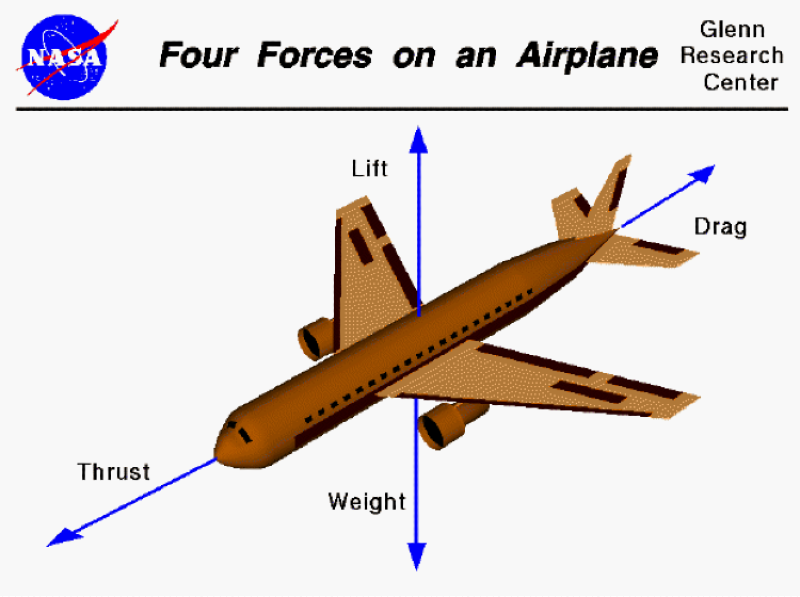
Four forces are constantly acting on an airplane. Engineers must carefully balance these forces to keep the plane flying safely.

Weight
The first force is weight. Weight is caused by gravity, the force that pulls everything toward Earth.
Gravity acts on everything around us. It keeps our feet on the ground, causes a dropped pencil to fall, and even pulls on giant airplanes. No matter how large or small an airplane is, gravity is always trying to pull it downward.
If weight were the only force acting on an airplane, flying would be impossible because it wouldn't even lift off the ground!
Lift
To overcome gravity, airplanes need lift.
Lift is the force that pushes an airplane upward into the sky. Most of this lift comes from the airplane's wings. Engineers carefully design wings with special shapes that help create lift as air moves around them.
When lift becomes stronger than weight, the airplane can rise off the ground and take flight.
Thrust
The next force is thrust.
Thrust is the force that pushes an airplane forward. It is created by the airplane's engines. Whether the plane uses jet engines or propellers, the goal is the same: move the airplane through the air.
Without thrust, the airplane would not move fast enough for its wings to create lift.
Drag
The final force is drag.
As an airplane moves through the air, the atmosphere pushes back against it. This force is called drag. You can think of drag as an invisible brake that tries to slow the airplane down.
Engineers work hard to design airplanes with smooth shapes so they can reduce drag and fly more efficiently.
Keeping Everything Balanced
For an airplane to fly smoothly, these four forces must work together.
- Weight pulls down.
- Lift pushes up.
- Thrust pushes forward.
- Drag pushes backward.
When engineers balance these forces correctly, an airplane can safely carry hundreds of passengers thousands of miles through the sky.
The next time you see a plane overhead, remember: you're looking at one of the greatest engineering inventions ever created. By balancing four powerful forces, airplanes can carry people thousands of miles through the sky and take you from Dallas to New York City (over 1,500 miles away!) in about the time it takes to watch a Harry Potter movie and eat a snack!