About

Tag: Technology

  • The Green Price of Intelligence

    The Green Price of Intelligence

    By Summer Chen

    ~ 6 minutes


    Over the past three years, a rush of excitement has emerged globally regarding artificial intelligence. In a student’s everyday life, discussions about artificial intelligence arise frequently- whether about the potential benefits of generative AI, using ChatGPT on homework assignments, or seeing AI’s growing presence on social media platforms like TikTok. 

    Claims that AI holds significant potential in the development of society and technology are impossible to ignore, with AI occupying numerous sectors seen throughout daily life. In fact, when I began writing this article, even clicking enter on a google search titled “Impact of AI on climate change” immediately caused an AI overview to pop up unprompted.  

    AI generated images / The Economic Times India

    While the environmental repercussions of AI usage cannot be ignored, to deny the multitude of potential benefits from artificial intelligence would be absurd. Instead, it makes more sense that the use of (mostly generative) AI for recreational purposes is the issue– hundreds of thousands of people contribute to this environmental impact, not realizing that even a short prompt into ChatGPT has been proven by the International Energy Agency to equate to 4-10x the amount of energy that just one Google search consumes.

    There are four key problems attributed to why AI can cause widespread harm to our environment. First, the mining required to extract critical minerals and rare earth elements for the microchips that power AI is incredibly destructive to the environments where these resources are found. Navigating New Horizons confirms this, stating,

    “[The minerals and elements] are often mined unsustainably”.

    The second is that AI servers are held in data centers which produce a shocking amount of electronic waste. They also contain hazardous substances such as mercury and lead, according to the United Nations Environment Program (UNEP). This is harmful because when they are (often) disposed of improperly, the wildlife, soil, air, and water around it are contaminated. 

    Thirdly, these AI data centers use preposterous amounts of electricity and energy, due to advanced technology seen in these models. Therefore, the energy used in most of these data centers comes from fossil fuels which produce greenhouse gases that further contribute to global warming. Research by the University of Nottingham shows that by 2026, AI data centers will likely account for nearly 35% of Ireland’s energy consumption. Added effects to climate change are something that we simply can’t afford currently, with the already increasing rate of rising global temperatures.  

    Pollution due to Elon Musk’s AI data center in Memphis / NAACP

    Finally, and most of all, data centers consume a colossal amount of water, not only to construct but also to cool electrical components of AI. Chilled water absorbs heat from computing equipment. This water does not return to the water cycle; most of it is gone forever when used to cool these heated data centers. The centers use mechanical chillers which carry heat away from the servers, releasing it through a condenser, and so the water becomes water vapor where it does not cycle back through treatment systems like in a typical household. Even though some of it returns as rainfall, a majority of vapor in the air cannot be recovered. Not only this, but data centres are often located near locations which are already prone to droughts, which gives the inhabitants of this area even less access to water. This is a huge problem when a quarter of humanity already lacks access to clean water and sanitation. MIT News tells us that for every single kilowatt hour of energy a data center consumes, it would need two entire liters of water for cooling. It is an atrocity to restrict so much life from access to clean water and instead use it on generating ‘a cartoon version of me’ or asking ChatGPT to write a quick email that could be written by the individual in just two minutes instead.  

    The impacts of these contributors on climate change are immense. It also doesn’t help that generative AI models have an extremely short shelf-life as AI companies such as ChatGPT and DeepSeek consistently deliver new models, provoked by rising demand for new AI applications. So, the energy used to train previous models goes to waste every few weeks, and new models use even more energy because they are more advanced than the previous ones. Sure, one person using Perplexity AI doesn’t do much to the environment, but if everyone follows this logic, the large scale of people using AI results in terrible repercussions.

    On the other hand, popular articles repeat that because “500ml of water are used for every 20-50 ChatGPT prompts, not every prompt”, the amount of energy that ChatGPT uses is not that significant. However, like govtech.com states, even if 500ml sounds small, combined with the 122 million people who use ChatGPT daily, this is a lot of water that is wasted for purposeless reasons. AI’s energy use has exploded only because AI has exploded. It is not that each prompt uses a significant amount of energy, but that AI has had an explosive growth being the quickest adopted technology ever, therefore the energy adds up to be significant through the sum of people using AI. 

    As a society, we have to acknowledge that even though AI provides us an abundance of opportunities and ideas for our modern world, we must not forget the consequences to the already declining environment that overuse brings. We should take into consideration that life would most likely not be worse without generative AI for the average person. We should take into consideration that the tradeoff of mindless entertainment and having ChatGPT search for basic facts is worth a better chance at restoring our Earth. And ultimately, we should simply refrain from using AI for recreational reasons unless the purpose is absolutely urgent and necessary.  


    References

    After Ghibli art trend, Barbie Box Challenge breaks the internet: How to create your ai doll avatar?. The Economic Times. (n.d.). https://economictimes.indiatimes.com/magazines/panache/after-ghibli-art-trend-barbie-box-challenge-breaks-the-internet-how-to-create-your-ai-doll-avatar/articleshow/120257077.cms?from=mdr
    Elon Musk’s Xai threatened with lawsuit over air pollution from Memphis Data Center, filed on behalf of NAACP. NAACP. (2025, June 17). https://naacp.org/articles/elon-musks-xai-threatened-lawsuit-over-air-pollution-memphis-data-center-filed-behalf
    GovTech. (n.d.). About Us. GovTech. https://www.govtech.com/about 

  • October Monthly STEM Recap: How’s It Falling?

    October Monthly STEM Recap: How’s It Falling?

    By Bela Koganti

    ~ 14 minutes


    This October, STEM has reached new heights in astronomy, medicine, and awards. So, here’s an outline of what you need to know to stay informed.

    October 1: Enceladus

    Enceladus / NASA Science ©

    Saturn already has the highest number of known moons in our solar system, with 250, but it could also become the only planet with a habitable moon. Greedy, right? The 2005-2017 Cassini-Huygens mission to Saturn revealed clefts in the surface of Enceladus (one of Saturn’s moons) that shoot out water vapor ‘plumes’ into space as a ring (dubbed the E-ring) that circles Saturn. These clefts are believed to receive their water from an ocean below Enceladus’ surface. When the Cassini spacecraft flew through the plumes as they sprayed, it collected ice grains. Since the mission, scientists have been researching these grains, and they’ve found that Enceladus’ plumes hold carbon-containing molecules like aliphatic, heterocyclic esters, alkalines, ethers, ethyl, possibly nitrogenic, and possibly oxygenic compounds. They published their most up-to-date findings this October 1. 

    To break all this down, these carbon-containing molecules basically mean that the moon Enceladus might have the potential to house life. But don’t get too excited— it’s also possible that these molecules only become organic due to radiation, where ions in Saturn’s magnetosphere chemically react with the E-ring particles. To find out the truth, the European Space Agency might send an orbiter to Enceladus to sample fresh ice. Their orbiter wouldn’t arrive till 2054, so I suppose we’ll just cross our fingers till then. 

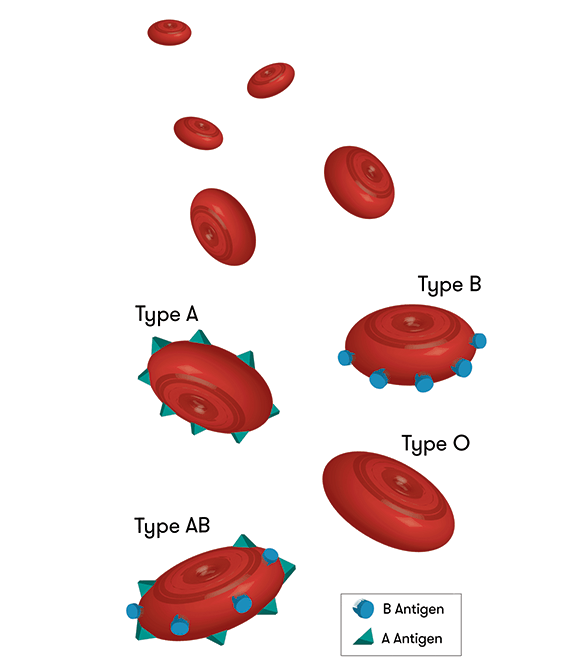
    October 3: From Type A to Type O

    We all know and love universal blood type O, but what about those who actually have it? For kidney transplants, type-A positive, -B positive, and -AB positive patients can receive their own respective type and type-O; however, type-O patients can only receive type-O kidneys. Thus, when these other patients receive type-O kidneys, people with type-O lack donors, end up waiting two to four years longer for their kidneys, and often die during the wait. Oh, and let’s not forget that type-O patients comprise over half of the kidney waiting lists!

    Scientists from the University of British Columbia have been tirelessly studying this catastrophe for over a decade, and they published their first successful transplant this October 3. They managed to place two reactive enzymes in a type-A kidney so that the kidney changed to universal type-O. Sugars that coat organs’ blood vessels determine blood type, so they created an enzyme reaction to strip away the defining sugars. While past conversions have needed live donors and changed antibodies within patients, compromising their immune systems, this new method changes the kidney itself and uses deceased donors.

    Blood Types / Australian Academy of Science ©

    So, here’s what happened in their transplant test:

    1. Scientists converted a type-A kidney using the enzymes
    2. Placed the kidney in a deceased recipient (with the family’s permission)
    3. Days 1-2: the body showed no signs of rejecting the kidney
    4. Day 3: a few of the type-A attributes reappeared, which is a slight reaction, but nothing as severe as in previous conversions
    5. The body showed signs of tolerating the kidney anyway
    6. Success!

    October 6: 2025 Nobel Prize in Physiology or Medicine

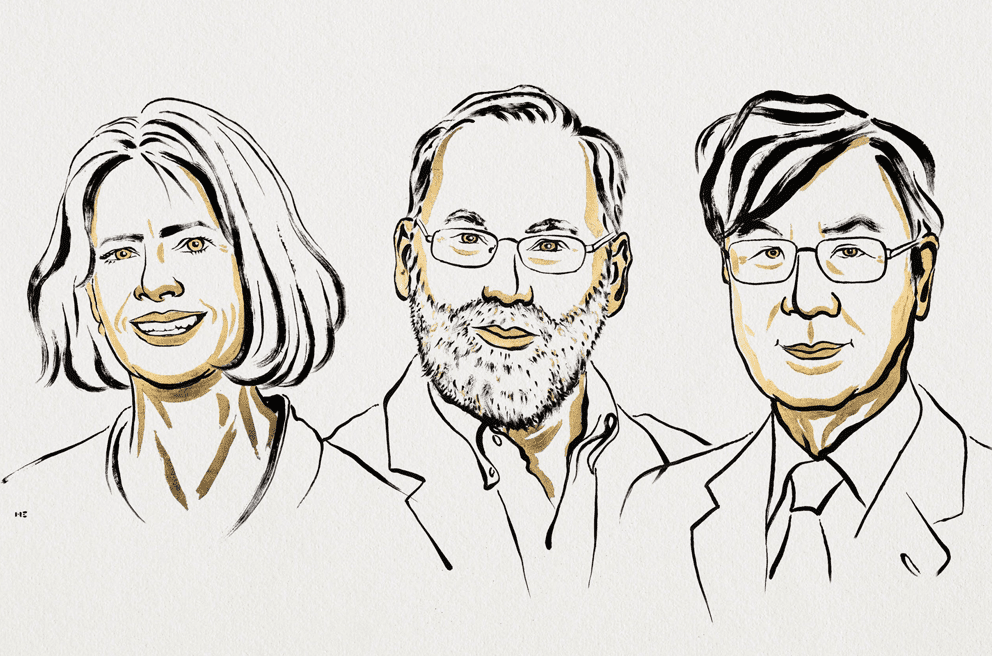
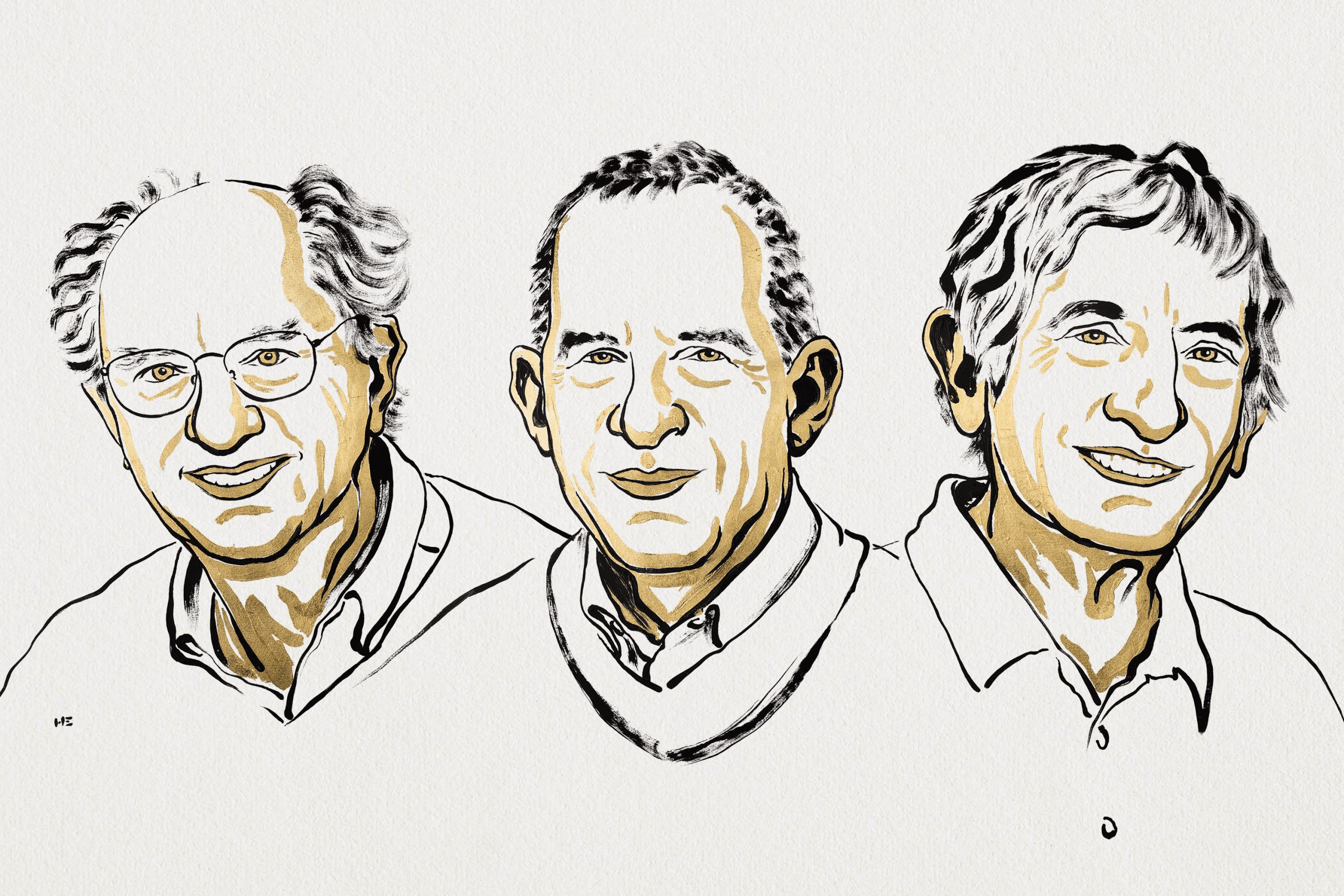
    This year, the 2025 Nobel Prize in Physiology or Medicine has been awarded to three people! Mary E. Brunkow, Fred Ramsdell, and Shimon Sakaguchi earned it for their advancements on ‘peripheral immune tolerance’, the mechanism that ensures the immune system doesn’t hurt the body. Essentially, peripheral immune tolerance prevents humans from having all kinds of autoimmune diseases. However, prior to these three, scientists had no real understanding of why or how this system worked. Brunkow, Ramsdell, and Sakaguchi built on each other’s findings to discover ‘regulatory T cells’, the agents behind peripheral immune tolerance.

    Nobel Prize in Medicine / Lindau Nobel Laureates ©

    Here’s how they did it:

    1. 1995: Sakaguchi debunked the popular theory of ‘central tolerance’ by discovering a new group of immune cells. 
    2. 2001: Brunkow and Ramsdell explained why a certain type of mice was particularly defenseless against autoimmune diseases. They found that strain to have a mutation in what they dubbed their ‘Foxp3’ gene, and they showed that humans have a similar gene, which also causes an autoimmune disease when mutated. 
    3. 2003: Sakaguchi showed that the Foxp3 gene dictates the growth of the cells he previously found. These cells became known as ‘regulatory T cells’, and they supervise cells in the immune system as well as the immune system’s tolerance of the human body.

    All this is awesome, but let’s see how their discovery actually impacted modern medicine. Scientists have found that regulatory T cells can actually protect tumours from the immune system, so, in this case, they are looking for a way to dismantle the cells. However, to combat autoimmune diseases, scientists can implant more regulatory T cells into the body to help prevent the immune system from attacking the body. So, just as Ann Fernholm proclaimed, “they have thus conferred the greatest benefit to humankind.”

    October 7: 2025 Nobel Prize in Physics

    Get this: another trio received the 2025 Nobel Prize in Physics! The Royal Swedish Academy of Sciences bestowed the honor onto John Clarke, Michel H. Devoret, and John M. Martinis for their experiments demonstrating quantum physics within a larger system. Quantum physics, or quantum mechanics, allows tunneling, which is when particles pass through barriers. Normally, the effects of quantum mechanics become negligible once they start working with large particles, but Clarke, Devoret, and Martinis showed that tunneling can still happen in a larger system.

    Nobel Prize in Physics / Lindau Nobel Laureates ©

    Just like with our last trio, here’s how they did it: 

    1. 1984-1985: They experimented with passing a current of charged particles through a controlled circuit containing superconductors. They found that the multiple particles acted like one large particle when going through the superconductor. The quantum part of this was that the system used tunneling to go from zero-voltage to a voltage. So, they concluded that quantum mechanics can still cause tunneling in a macroscopic system.

    And why do we care? Well, Olle Eriksson, the Chair of the Nobel Committee for Physics, said, “It is wonderful to be able to celebrate the way that century-old quantum mechanics continually offers new surprises. It is also enormously useful, as quantum mechanics is the foundation of all digital technology.” I don’t know about you, but I think I’ll take his word for it.

    October 8: 2025 Nobel Prize in Chemistry

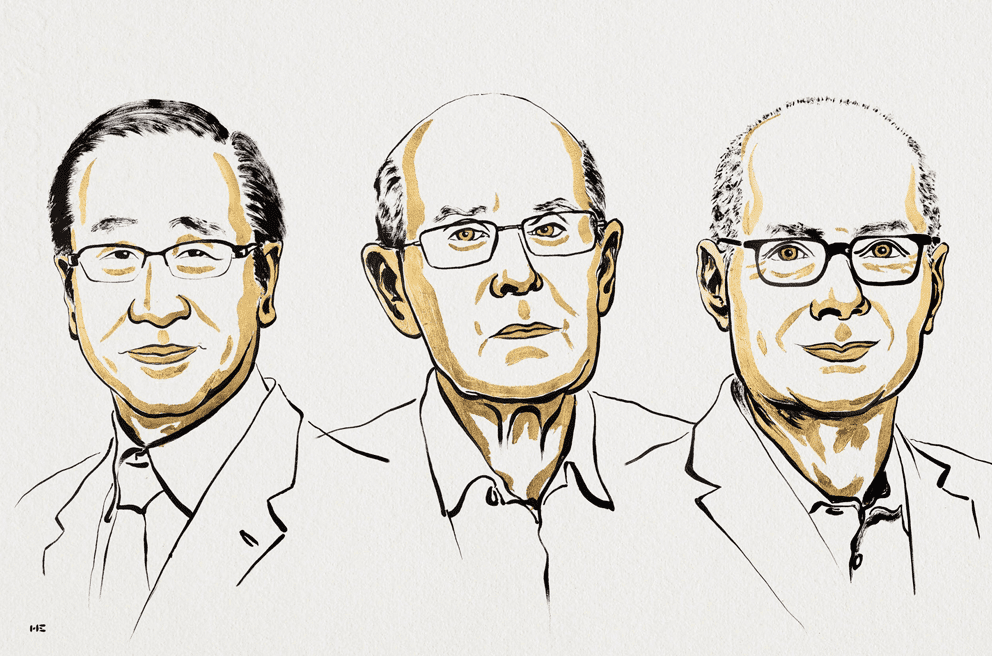
    Our LAST Nobel Prize trio of October comes in Chemistry! Susumu Kitagawa, Richard Robson, and Omar M. Yaghi received the 2025 Nobel Prize in Chemistry from the Royal Swedish Academy of Sciences for their ‘metal-organic frameworks (MOFs)’. These frameworks are from their new molecular construction, where carbon-based molecules link together metal ions so that the two form MOFs, which are essentially porous crystals. Scientists can then manipulate these MOFs to take in and guard particular substances. MOFs can also create chemical reactions and direct electricity. So, with these MOFs, scientists can design materials with particular functions of their choosing.

    Nobel Prize in Chemistry / Lindau Nobel Laureates ©

    You know the drill– here’s how they did it:

    1. 1989: Robson began testing the properties of atoms by combining copper molecules with four-pronged molecules, and this created porous crystals similar to MOFs. However, these MOF impersonators were unstable and needed someone to fix them.
    2. 1992-2003: Enter- Kitagawa and Yaghi. From his experiments, Kitagawa concluded that MOFs could be changed and modified as gases could run through them. Then, Yaghi made a stable MOF and showed that they could be manipulated to have new properties.

    Since their discoveries, scientists have made tons of their own unique MOFs, each equipped to solve a different problem. We can thank MOFs for giving us a safer Earth. I mean, any kind of chemical substance that can make clean water, grab carbon dioxide from the air, or produce water from desert air sounds like a good one to me. 

    October 11: The Surprising Link Between COVID-19 and Anxiety

    Covid. The word that teleports Gen-Z right back to online school in pajamas, Roblox, and Charli D’Amelio. We all know and hate it, but did we realize that it might be affecting future generations who weren’t even alive in 2020? 

    A study published on October 11 revealed that male mice who contracted COVID-19 birthed children with more anxiety-like behaviors than those of uninfected mice’s children. Basically, COVID-19 changes RNA molecules in the male’s sperm, which then dictates his children’s brain development. In female offspring specifically, their brain’s hippocampus region, which deals with behaviors including anxiety and depression, was altered. The authors of the study believe that these changes may cause increased anxiety levels.

    Okay, okay. Remember: this study was done on mice, not humans. More research is needed to see if humans will experience similar effects, but for now, we’re safe.

    October 12: Light Years Away

    “A long time ago in a galaxy far, far away…” Wait, what? A long time ago? Evidence suggesting that the closest alien civilization may be 33,000 light-years away did come out this October 12, but for the estimate to be feasible, the civilization would need to have already existed for at least 280,000 years. Yeah, that feels like a long time ago. And don’t worry about the far, far away part– I’d call 33,000 light-years pretty far. 

    At a recent meeting in Helsinki, research was shown indicating such a possibility. Here’s the criteria for a planet to have extraterrestrial life and actually sustain itself:

    1. Carbon dioxide in the atmosphere (so photosynthesis can work and support life)
    2. An atmosphere of at least 18% oxygen (complex animals need more oxygen, and there must be enough oxygen for fire because blacksmithing must happen to technologically advance)
    3. Average lifetime of about 10 million years (so they can exist at the same time as us)
    4. Already existed for at least 280,000 years (so civilization can develop and they can exist at the same time as us)

    Keeping these in mind, scientists have concluded that if there is an alien civilization existing at the same time as us in the same galaxy, it would have to be at least 33,000 light-years away. To put that into perspective, our Sun is about 27,000 light-years away from us. Yeah. Pretty far.

    October 20: Enteral Ventilation

    Sometimes, CPR isn’t enough to save respiratory failure. Then, patients turn to mechanical ventilation. But sometimes mechanical ventilation is too much, and the lungs end up even further damaged. Enteral ventilation, however, may just be the sweet spot. Enteral ventilation is a practice where perfluorodecalin, an exceptionally oxygen-soluble liquid, is administered through the intestine to deliver oxygen to the body while the lungs heal. Published on October 20, the first in-human study of enteral ventilation succeeded and was demonstrated to be safe. The only side effects were bloating and stomach pain, but those quickly resolved, and perfluorodecalin concentrations nearly disappeared from the bloodstream (a good thing!). 

    After this safe and tolerated success, more studies on enteral ventilation will soon develop, and lungs everywhere may be saved.

    October 20: CI Chondrite on the Moon

    Before we get into any of this moon stuff, you may be wondering what in the world (or should I say galaxy) CI Chondrite is. I’m here to help! CI Chondrite, a porous and the most water-dense meteorite, generally breaks before it can reach Earth because its properties make it so crumbly. CI Chondrite actually makes up less than one percent of all meteorites on Earth. That means it also barely ever reaches the moon. However, during their Chang’e-6 mission published on October 21, the China National Space Administration found traces of CI Chondrite dust on the moon.

    A Chondrite Meteorite

    Here’s how they did it:

    1. They looked at thousands of fragments from the Apollo Basin, a sub-basin in the South Pole-Aikten Basin that acts as a hotspot for debris since it covers one-fourth of the moon.
    2. They looked for pieces with olivine, a mineral normally in meteorites. 
    3. Then, they analyzed the olivine pieces and found seven with properties identical to CI Chondrite
    4. When analyzing, they found that the pieces did not have the chemical ratios expected for lunar debris.
    5. However, they realized that the seven fragments’ ratios did align with those of a CI Chondrite asteroid that crashed, melted, and solidified on the moon early in the solar system’s history.

    With these discoveries, the team found the first solid evidence that CI Chondrite once hit the moon and that CI Chondrite can be preserved after such a crash. Actually, they found that CI Chondrite could comprise up to 30 percent of the Moon’s meteorite debris. Additionally, their study provided evidence to help back up the theory that CI Chondrite once created water and volatiles on the Earth and Moon. More research is needed to see if it’s really true, but those missions will now be much easier with the China National Space Administration’s new process to find CI Chondrite.

    October 27: Back to the Basics

    Nope, not like the song. On October 27, in the Astrophysical Journal Letters, scientists described their findings of what they believed to be Population III stars, one of the first groups of stars in the galaxy. With the James Webb Space Telescope, they pinpointed them in LAP1-B, a cluster of stars 12 billion light-years away from Earth. Scientists believe Population III stars are some of the first stars made after the Big Bang, and they have a unique property of being a billion times brighter than and a million times the mass of our Sun. 

    Here’s why they believe their discovered stars to be Population III:

    1. Emission lines on the stars’ spectra indicated high-energy photons, which are consistent with Population III stars.
    2. Their spectra showed them to be extremely large.
    3. Their masses aligned with astronomers’ guesses for those of Population III stars.
    4. They were in LAP1-B, whose properties agree with the criteria for Population III.
      1. It’s a low hydrogen and helium environment.
      2. Its temperature can support star formation.
      3. It’s a low-mass cluster, and it had few large stars before those of Population III.
      4. It meets mathematical criteria for forming stars and keeping them alive.

    Seems pretty feasible, right? Anyways, these scientists were the first to find a group of stars that meets all criteria for being Population III, and these ancient stars can actually explain the galaxy’s construction and development. That’s all for STEM this October, but don’t worry, because this November’s looking like a great one.

    References

    Cooper, K. (2025, October 2). Saturn’s moon Enceladus is shooting out organic molecules that could help create life. Space.com. https://www.space.com/astronomy/saturn/saturns-moon-enceladus-is-shooting-out-organic-molecules-that-could-help-create-life 
    Europlanet. (2025, October 12). Closest alien civilization could be 33,000 light years away. Science Daily. https://www.sciencedaily.com/releases/2025/10/251011105533.htm 
    Fernholm, A. (2025, October 6). Popular science background: They understood how the immune system is kept in check. Nobel Prize. https://www.nobelprize.org/uploads/2025/10/popular-medicineprize2025-2.pdf 
    The Florey. (2025, October 11). COVID-19 causes changes in sperm that lead to increased anxiety in offspring. The Florey. https://florey.edu.au/news/2025/10/covid-19-causes-changes-in-sperm-that-lead-to-increased-anxiety-in-offspring/ 
    Howell, E. (2017, September 15). Cassini-Huygens: Exploring Saturn’s system. Space.com. https://www.space.com/17754-cassini-huygens.html 
    Howell, E. (2025, October 27). James Webb telescope may have found the first stars in the universe, new study claims. Live Science. https://www.livescience.com/space/cosmology/james-webb-telescope-may-have-found-the-universes-first-generation-of-stars 
    Kungl. Vetenskaps-Akademien. (2025, October 7). Press release (Nobel Prize in Physics 2025). Nobel Prize. https://www.nobelprize.org/prizes/physics/2025/press-release/ 
    Kungl. Vetenskaps-Akademien. (2025, October 8). Press release (Nobel Prize in Chemistry 2025). Nobel Prize. https://www.nobelprize.org/prizes/chemistry/2025/press-release/ 
    Med. (2025, October 20). Safety and tolerability of intrarectal perfluorodecalin for enteral ventilation in a first-in-human trial. Cell. https://www.cell.com/med/abstract/S2666-6340(25)00314-9 

    Nobelförsamlingen. (2025, October 6). Press release (Nobel Prize in Physiology or Medicine 2025). Nobel Prize. https://www.nobelprize.org/prizes/medicine/2025/press-release/ 
    Starr, M. (2025, October 21). China brought something unexpected back from the far side of the Moon. Science Alert. https://www.sciencealert.com/china-brought-something-unexpected-back-from-the-far-side-of-the-moon 
    University of British Columbia. (2025, October 3). UBC enzyme technology clears first human test toward universal donor organs for transplantation. Eurek Alert. https://www.eurekalert.org/news-releases/1100223 

  • The Fall of the Big, Bad Boiler: The Latest Climate Technology Infiltrating New York City

    The Fall of the Big, Bad Boiler: The Latest Climate Technology Infiltrating New York City

    By Montserrat Tang

    ~ 9 minutes


    The Hot Hell of Boilers

    As someone born and raised in New York City (NYC), I can attest to the urgent need to upgrade the city’s climate control infrastructure. Current systems are outdated and hinder the city’s ability to meet emissions goals and address global warming; the encapsulation of this problem is the boiler. A staggering 72.9% of heating in NYC comes from fossil-fuel-burning steam boilers, one of the most carbon-intensive options available. Tenants of apartments pay for the maintenance of centralized boilers without control over the temperature, leading many to open their windows in winter to release excessive warmth. This heat and the fossil fuels used to produce it are wasted, highlighting the inefficiency and impracticality of NYC’s existing infrastructure. 

    Industrial boiler room / Controlled Combustion ©

    Even when this heat remains indoors, steam boilers are only about 80-85% efficient at burning fossil fuels. Up to a fifth of a boiler’s fuel does not generate usable heat, but burning it still releases vast quantities of pollutants like CO2, exacerbating climate change. Furthermore, boilers continue to lose efficiency during their lifetimes and require frequent maintenance and replacement. While steam boiler systems were revolutionary in the 19th century, they may now become obsolete as NYC implements a technology that could change how the world thinks about climate control.

    The Cool(ing) Mechanics of Heat Pumps

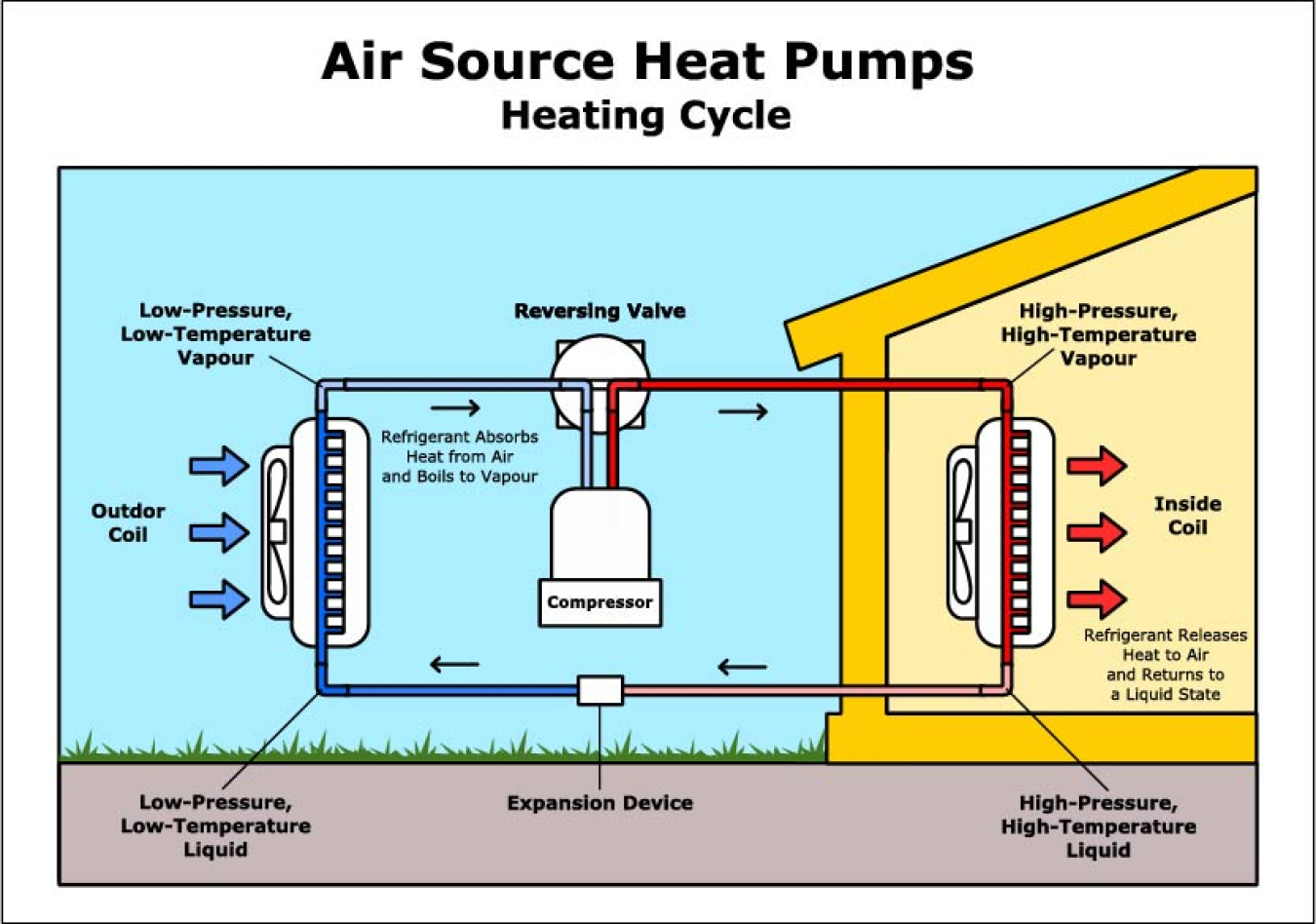
    Mechanics of an air source heat pump / U.S. Department of Energy ©

    The innovation behind heat pumps comes from the mantra of use what is given; instead of generating heat through combustion, they simply move existing warmth between two places. Most of these fully-electric pumps remain functional well below 0℃, even though it may seem like there is no warmth to be moved. This operative capacity allows them to have heating efficiencies of 300-500%! Because of this, International Energy Agency partner Yannick Monschauer estimates that “Heat pumps could bring down global CO2 emissions by half a gigaton by the end of this decade.”

    Heat pumps work by operating on the Second Law of Thermodynamics (SLOT), which states that heat will move from a hotter object to a colder one. In the wintertime, the pumps pull in outdoor air and blow it over fluids (called refrigerants) held in a closed-loop system. The air transfers warmth to the cold refrigerants through SLOT, and the heated fluids turn into gas. Heat pumps can work in freezing temperatures because these refrigerants have such unusually low boiling points, allowing them to vaporize easily; one of them, Refrigerant 12, has a boiling point of just -21.64°F!

    The hot, gaseous refrigerants move into a compressor that compacts their molecules, making them even warmer. They then flow through a coil that exposes them to indoor air, and the refrigerants release their warmth inside through SLOT. As the refrigerants cool, they condense back into liquid and pass through an expansion valve, decreasing their temperature further. They move to an outdoor coil and are ready to restart the process, continuing to warm cold homes during the winter.

    Even more significantly, heat pumps have reversing valves that switch the flow of their refrigerants. These valves allow the pumps to cool homes by pushing out warm, indoor air in the summertime. Thus, heat pumps make air conditioners, boilers, radiators, and related piping unnecessary, freeing space and alleviating material and labour costs that typically get passed on to homeowners. 

    Heat pumps in NYC

    In 2024, NYC pledged to have heat pumps provide 65% of residential heating, air conditioning, and water-heating needs by 2030. This shift would drastically reduce the city’s carbon emissions from the climate control sector, which contributed to 10% of global energy-related CO2 emissions in 2021.

    This pledge is logical both environmentally and practically: having one heat pump replace two systems saves valuable space, lowers costly installation and maintenance fees, and reduces energy demands. The NYC government realized this potential and signed a $70,000,000 contract to install 30,000 window heat pumps in NYCHA buildings, better known as public housing. Two heating companies, Midea and Gradient, will provide these units.

    In late 2023, Gradient installed 36 preliminary test units in NYCHA buildings. Most NYC steam boilers, including those in NYCHA’s current system, are powered by gas with oil reserves in case of an emergency. Gradient found that their pump can lower tenants’ heating bills by 29-62% on moderate winter days compared to gas-powered boilers. Savings are as high as 59-78% compared to oil-burning boilers. In testimonials that Gradient collected, NYCHA tenants noted the heat pumps’ impressive air filtration, heating, and operational capabilities. Midea conducted similar tests and soon plans to release its heat pump for public purchase.

    The Cold Drawbacks of Heat Pumps

    Although technological faults remain, NYC is continuing its plans to install and promote heat pumps to replace its intensive, outdated systems. For one, Midea’s upcoming pump will cost ~$3,000 per unit, greatly exceeding the combined price of ~$460 for their bestselling, single-room heating and cooling systems. This is a misleading comparison, however, because heat pumps also act as heating systems. The technology can lower electricity and fuel bills over an extended period, but the current price point makes heat pumps an unaffordable investment for many households – despite government subsidies and incentives. Even the NYC government’s bulk order of Midea and Gradient pumps averages over $2,300 per unit.

    Furthering the inaccessibility of these systems, the most advanced, aesthetically pleasing, and apartment-friendly heat pumps can only heat and cool individual rooms. This means that multiple units must be purchased, installed, and powered to service a home, and each must be replaced about every 20 years. Still, NYC’s firm stance on heat pumps indicates the climate control systems’ proven efficacy, practicality, and sustainability.

    Heat Pumps Globally, and Plans for the Future

    While technological challenges remain, NYC is continuing to deliver on its pledges. This decision on heat pumps is being made throughout the United States (US). In 2022, heat pump sales in the US significantly outpaced those of gas furnaces (a type of central heating system particularly popular in North America). This lead has continued into 2025 as more people realize that the pumps can lower fossil fuel emissions and energy bills.

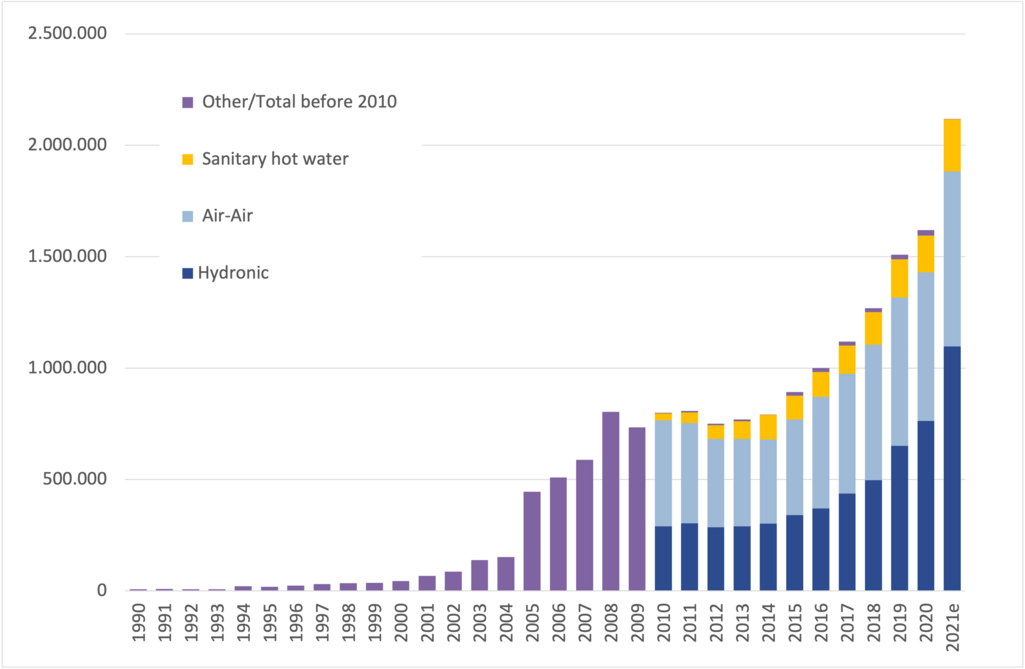
    This switch is not just happening in the US; countries worldwide are beginning – or continuing – to invest in these pumps. Sales in European countries have soared in the 21st-century, an accomplishment partly attributed to friendly government policy. The country with the most pumps relative to its population, Norway, has 632 heat pumps installed for every 1,000 households (the majority of these pumps service entire houses, unlike the Midea and Gradient systems discussed above). Despite this high ownership rate, 48 pumps were purchased in Norway for every 1,000 households in 2024.

    1990-2021 Heat pump sales in Europe, by technology / European Heat Pump Association ©

    In spite of these promising statistics, heat pump sales in most economies have either slowed or slumped in recent years – particularly in Europe. Analysts suspect this is due to high interest rates, rising electricity prices, low consumer confidence, and low gas prices. While this is discouraging, pump sales and ownership rates remain higher than they were several years ago.
    In 2023, New York Governor Kathy Hochul pledged to help the U.S. Climate Alliance (USCA) install 20,000,000 pumps across the U.S. The USCA is a coalition of 24 governors representing 54% of the United States population and 57% of its economy. The bipartisan group has successfully delivered on their promises of emissions reduction, climate resilience, economic growth, energy savings, and zero-carbon electricity standards that heat pumps are engineered to meet. 

    This coalition has proved that environmental action is popular, necessary, and possible. At a time when climate policy is under question, sustainable and feasible technologies – like heat pumps – need the investment of citizens, industries, and governments alike; no matter how small the scale.

    So, how can you help? Since 2022, the US government has given a federal tax credit to citizens who install efficient heat pumps. The Energy Efficient Home Improvement Credit provides eligible homeowners up to $2,000 annually. Combined with other energy-efficient credits, US citizens can regain up to $3,200 every year. These monetary incentives offer another reason to consider switching to heat pumps, and similar policies are being enacted worldwide.

    I am proud to live in a city that rewards and encourages the sustainability of citizens, corporations, and public works. As the severity and irreversibility of global warming loom, heat pumps offer us a breezy solution to polluting climate control systems. Eventually, NYC’s infamous boiler rooms and clanging pipes may become relics of the past.


    References

    About Us. (n.d.). United States Climate Alliance. https://usclimatealliance.org/
    Azau, S. (2025, July 3). Heat pump sales 14 times greater in lead countries. European Heat Pump Association. https://www.ehpa.org/news-and-resources/press-releases/heat-pump-sales-14-times-greater-in-lead-countries/
    Bray, T. (2021, October 7). How Do Heat Pumps Work? | Heat Pumps Explained. YouTube. https://www.youtube.com/watch?v=iQaycSD5GWE
    DeJong, K. (n.d.). The Difference Between Heat Pumps and Air Conditioners – Comparing Heat Pump Mini Splits with Cooling Only Systems. eComfort. Retrieved July 31, 2025, from https://www.ecomfort.com/stories/1310-Comparing-Heat-Pump-Mini-Splits-with-Cooling-Only-Systems.html
    Demir, H., Ulku, S., & Mobedi, M. (2013, August). A review on adsorption heat pump: Problems and solutions. ResearchGate. https://www.researchgate.net/publication/223303816_A_review_on_adsorption_heat_pump_Problems_and_solutions
    Ferrell, M. (2024, May 28). How does an air conditioner actually work? – Anna Rothschild. YouTube. https://www.youtube.com/watch?v=6sSDXurPX-s
    Ferrell, M., & Natividad, S. (2024, June 11). Why This Window Heat Pump Is Genius. Undecided. https://undecidedmf.com/why-this-window-heat-pump-is-genius/
    Gradient Transforms Public Housing HVAC at NYCHA. (2024, June 3). Gradient. https://www.gradientcomfort.com/blogs/news/how-gradient-is-transforming-public-housing-with-innovative-window-heat-pumps
    Heat pump. (2025, July 31). Wikipedia. https://en.wikipedia.org/wiki/Heat_pump
    Midea Packaged Window Heat Pump. (n.d.). Midea HVAC. Retrieved July 31, 2025, from https://www.mideacomfort.us/packaged.html
    New York City Climate Dashboard: Energy. (2024). NYC Comptroller. https://comptroller.nyc.gov/services/for-the-public/nyc-climate-dashboard/energy/
    New York State. (n.d.). Efficient and Emission-Free, Heat Pumps Are Gaining Popularity in New York and Beyond. New York State Energy Research and Development Authority. https://www.nyserda.ny.gov/Featured-Stories/US-Heat-Pump-Sales
    New York State. (2023). Recapping Climate Week 2023. New York State Energy Research and Development Authority. https://www.nyserda.ny.gov/Featured-Stories/Recapping-Climate-Week-2023
    New York State. (2023, September 20). Governor Hochul Announces Installation of Window Heat Pumps for New York City Public Housing Residents. Governor Kathy Hochul. https://www.governor.ny.gov/news/governor-hochul-announces-installation-window-heat-pumps-new-york-city-public-housing
    New York State & ENERGY STAR. (2024). 2024 ENERGY STAR Products Partner Meeting. New York State Energy Research and Development Authority. https://cdn.shopify.com/s/files/1/0558/4925/5070/files/NYSERDA_Room_Heat_Pump_Presentation_from_2024_ENERGY_STAR_Product_Partners_Meeting.pdf?v=1736361913United States Government. (2025, May 29). Energy Efficient Home Improvement Credit | Internal Revenue Service. IRS. https://www.irs.gov/credits-deductions/energy-efficient-home-improvement-credit

  • Cow Farts, Climate Change, and Coffee: The Unexpected Connection

    Cow Farts, Climate Change, and Coffee: The Unexpected Connection

    By Wanni Zhu

    ~10 minutes


    Though seemingly unrelated, cow farts, climate change, and coffee have unexpected connections. For starters, cow farts produce methane – and lots of it. In fact, a single cow can produce a massive amount of methane – usually 250-500 liters per day. Now, think of how many cows we have here on Earth (I’ll give you a hint: it’s 1.5 billion).  And while CO2 gets all the attention when it comes to climate change, methane has twice the effect on a per-unit basis.  But we can’t just blame climate change on the cows: other livestock also contribute to the greenhouse gases that warm our planet. Well, it’s a good thing that climate change is a widely known issue around the world, right? We know that these gases will cause the heating of the Earth, resulting in ice melting and oceans rising. However, while these problems may take years to manifest, other negative effects won’t be nearly as delayed. One impending problem is the devastation that this heat will bring to both weather patterns and crops. Warmer temperatures cause more evaporation, meaning more water in the atmosphere and more storms. Many plants, coffee included, can’t grow in these changing and unstable climates. And while scientists are doing all that they can to fix these problems, individual citizens are unlikely to act unless they understand the full extent of what is going on. 

    What Is Climate Change?

    Climate change is a universal issue backed by scientific evidence and recognized by most of the public. The Earth is warming, and rapidly at that. According to NASA, the average global temperature on Earth has increased by at least 1.1° Celsius (1.9° Fahrenheit) since 1880, and the majority of the warming has occurred since 1975, at a rate of roughly 0.15 to 0.20°C per decade. It may not seem like much, but the environment is not accustomed to adapting quickly, and if this goes on, the results could be devastating.

    Greenhouse Gases

    Greenhouse gases – let’s call them GHGs for short – are essential for our survival, but could very well be the key to our doom. The most common GHGs include water vapor, carbon dioxide, methane, and nitrous oxide. They absorb heat from the Sun and trap the warmth, preventing it from escaping into space. It’s the reason why life on Earth is possible: just like their name, these gases basically function as the glass in a greenhouse, raising the temperature so that we can thrive.

    But greenhouses can also get too hot. The more gases in the atmosphere, the more effective the heat-trapping process is. This excess heat-trapping is precisely what has been occurring over the past few decades, especially since the Industrial Revolution

    Left: Radiative forcing relative to 1750 due to the long-lived greenhouse gases CO2, methane, nitrous oxide and the synthetic greenhouse gases, expressed as watts per metre squared. Right: Global mean CO2 concentration and global mean greenhouse gas concentrations expressed as CO2-e (ppm). CO2-e is calculated from the atmospheric concentrations of CO2, methane, nitrous oxide and the suite of synthetic greenhouse gases. / Bureau of Meteorology ©

    So, what is causing the surplus of GHGs warming our Earth?

    One cause is transportation, which accounts for 14% of GHGs. Cars, buses, trains, airplanes – most of them use gasoline, diesel, or jet fuel to function. Burning these materials releases many harmful gases, the most relevant of them carbon dioxide, methane, or nitrous oxide. In some countries, like the US, transportation may be the leading cause of GHG emissions. However, there are many ways to combat these effects. You’ve most likely heard that walking and public transportation will reduce emissions, and they can! Even electric vehicles will help if you’re using clean electricity. Additionally, biofuels and hydrogen can replace fossil fuels in aviation and shipping.

    Another significant cause is electricity and heat production, which accounts for a fourth of total GHGs alone. These processes still rely heavily on burning fossil fuels, such as coal, oil, and natural gas. Now that more and more homes and buildings are being constructed, there is a higher electricity demand than before. As a result, more fuel is burned – unless we switch to cleaner sources such as wind, solar, or hydro power. Transmission losses (electricity lost as it travels over power lines) require extra generation, further increasing emissions. Therefore, improving efficiency in buildings and the power grid could reduce the demand and associated GHGs.

    Buildings can cause around 6-7% of GHG emissions. The production of materials like cement, steel, and aluminum all release gases such as carbon dioxide, and use the process of burning fossil fuels. According to the BBC, cement production contributes 8% of global GHGs. Not to mention, transporting those materials and the use of heavy machinery and equipment while building them also adds to emissions. 

    These are all large and well-known reasons that contribute to GHG emissions, so let’s take a look at something lesser known. Agriculture.

    What About Cows?

    Let’s be honest: your answer to the question about major sources of GHGs was probably not cows. But, in truth, these adorable creatures that we raise account for around 14.5 percent of greenhouse gases that warm our planet. Of course, it’s not cows alone: other livestock, including chickens, horses, pigs, and more, are all included in that percentage. We’re looking at cows specifically because a breakthrough with them could lead to resulting solutions with the other animals, and cows are large and easy to work with. 

    Cows make methane in two ways: through their digestive process and their waste.  They are part of a group of animals called ruminants, with four distinct stomach chambers. The first is called the rumen, a home for microorganisms that break down the starch and sugar from plants. The next chamber is called the reticulum, where hard-to-digest plant materials are stored. The next chamber is called the omasum, which mechanically breaks the food down further. Finally, the last chamber is called the abomasum, which absorbs the nutrients from the food. 

    In the rumen, a process called enteric fermentation takes place. This is where the previously stated microorganisms and bacteria break down complex carbohydrates and turn them into sugars. The resulting products include volatile fatty acids (used as a major energy source for the cows), as well as GHGs such as carbon dioxide and methane. The gases are released from the cows either as burps or farts.

    What Are We Doing About It?

    Trend Hunter / INTA ©

    Scientists are attempting to find the most effective solution to this large problem. There have been many different approaches to this issue, some of which are below.

    One method that has been used is seaweed in the cow feed. A 2018 study focused on mixing a seaweed species called Asparagopsis armata with hay and small amounts of molasses. Animal science professor Ermias Kebreab says they’re hoping that the seaweed can inhibit an enzyme that’s involved in producing methane in a cow’s gut, a chemical reaction discovered by researchers in Australia. After a day of eating this feed, the cow’s methane emission dropped by a drastic 50%. However, they also discovered a small dent in the amount of food consumed, as well as milk produced, due to the seaweed’s ocean smell. The next steps of this experiment are to find ways so the cows don’t notice the seaweed, and plan an experiment to use beef cattle instead of dairy cattle. Though there is still a long way before this can be implemented on a large scale, even the smallest start can lead to a bigger solution.

    Another study from 2019 discovered that selective breeding can lead to a “cleaner cow.”  Project’s leaders and co-author Professor John Williams says: “What we showed is that the level and type of methane-producing microbes in the cow is to a large extent controlled by the cow’s genetic makeup.” By selecting cattle that produce less methane than their counterparts, it may be possible to create a livestock industry that generates fewer GHGs. However, the breeding will also depend on other desired characteristics, such as meat quality, milk, and disease resistance.

    Finally, Argentina’s National Institute of Agricultural Technology (INTA) created the cow-fart-backpack (the picture shown above). This device captures the methane from these cows through a tube in their skin, which scientists claim is painless. The gas is then condensed and ready to provide power for the farm. By utilizing this gas for power, farms would consume less purchased gas and thereby reduce the total emissions.

    Where Does Coffee Come In?

    Even with all these solutions, climate change is still one of the biggest issues out there. One common outcome that you may have heard of is the rising ocean levels. Because of the rapid heating, the northern and southern reaches of the planet are warming faster than any area on Earth, with the temperatures there rising twice as much as elsewhere. This damages the fragile ecosystems there, leaving less space for animals such as polar bears, seals, and penguins to venture. Not only that, but the sheer amount of ice that is melting each year has increased ocean levels drastically. According to NASA, the ocean levels have risen 10.1 centimeters since 1992. 

    But there’s another effect that’s less heard of. Agriculture will also be greatly impacted by climate change, as some plants need very specific temperatures and weather conditions to grow. 

    Let’s take a closer look at coffee.

    Some plants need very specific temperatures and weather conditions to grow, and now that it’s all changing, the locations where the plants grow would need to change with it. For example, the coffee plant grows in temperatures of around 15-24 C, or 60-70 F. Areas such as Hawaii, Africa, and Brazil are all large coffee exporters, but if the temperatures keep rising, coffee would cease to grow in those places. Coffee plants are highly sensitive to temperature and moisture changes, and stress leads to lower yields and flavor quality. But, it’s okay, right? We can just plant coffee in different areas that are now suitable for coffee growth!

    Not quite. Coffee takes 3-4 years to grow, and needs to be processed after. Processing plants will take even longer to build, not to mention the cost and GHG emissions. So, in that time, global coffee supply shortages would lead to higher coffee prices, affecting consumers and businesses. Millions of jobs in farming, processing, transport, and retail depend on coffee, leading to unemployment in producing regions. Countries that rely on coffee exports would suffer major losses in GDP and stability.

    Now think of this on a large scale. Not just coffee, but other plants as well. The world would be in chaos: jobs lost, prices increased drastically, and businesses shut down. These are the results of climate change.

    Conclusion

    Ultimately, climate change is affecting our world fast. With the temperatures rising each year and GHG emissions growing, the world is in dire need of a solution. Though there isn’t a single “correct” fix to this problem, everything that we do to prevent it counts. The effects of climate change can be disastrous – environments are being destroyed, oceans are rising, and plants are dying. But…if everyone helps, if everyone contributes, and understands just how dangerous and volatile climate change can be…perhaps we can prevent the problem that we are causing in the first place.


    References

    Center for Climate and Energy Solutions. 2019. “Main Greenhouse Gases | Center for Climate and Energy
    Solutions.” Center for Climate and Energy Solutions. June 6, 2019.
    https://www.c2es.org/content/main-greenhouse-gases/.
    NASA. 2022. “World of Change: Global Temperatures.” Earth Observatory. NASA Earth Observatory. 2022. https://earthobservatory.nasa.gov/world-of-change/global-temperatures.
    Okshevsky, Mira. 2020. “Cows, Methane, and Climate Change.” Let’s Talk Science. March 15, 2020. https://letstalkscience.ca/educational-resources/stem-in-context/cows-methane-and-climate-change.
    “Potential for Reduced Methane from Cows.” 2019. ScienceDaily. 2019. https://www.sciencedaily.com/releases/2019/07/190708112514.htm.
    Rodgers, Lucy. 2018. “Climate Change: The Massive CO2 Emitter You May Not Know About.” BBC News, December 17, 2018. https://www.bbc.com/news/science-environment-46455844.
    “Surf and Turf: To Reduce Gas Emissions from Cows, Scientists Look to the Ocean.” n.d. NPR.org. https://www.npr.org/sections/thesalt/2018/07/03/623645396/surf-and-turf-to-reduce-gas-emissions-from-cows-scientists-look-to-the-ocean.
    “The Causes of Climate Change.” Edited by Kalina Velev. NASA. October 23, 2024. https://science.nasa.gov/climate-change/causes/.

  • Gene Editing in Focus

    Gene Editing in Focus

    By Maggie Wright

    ~6 minutes


    Advancements in genetic engineering have brought revolutionary tools to the forefront of biotechnology, with CRISPR leading as one of the most precise and cost-effective methods of gene editing. CRISPR, which stands for Clustered Regularly Interspaced Short Palindromic Repeats, allows scientists to alter DNA sequences by targeting specific sections of the genome. Originally discovered as part of a bacterial immune system, CRISPR systems have now been adapted to serve as programmable gene-editing platforms. This paper explores how CRISPR works, its current uses, its future potential, and the ethical considerations surrounding its application in both human and non-human systems.

    How CRISPR System Works

    The CRISPR-Cas system operates by combining a specially designed RNA molecule with a CRISPR-associated protein, such as Cas9 or Cas12a. The RNA guides the protein to a specific sequence in the genome, where the protein then cuts the DNA. Once the strand is cut, natural repair mechanisms within the cell are activated. Researchers can either allow the cell to disable the gene or insert a new gene into the gap. As described by researchers at Stanford University,

    “The system is remarkably versatile, allowing scientists to silence genes, replace defective segments, or even insert entirely new sequences.” (CRISPR Gene Editing and Beyond)

    This mechanism has been compared to a pair of molecular scissors that can cut with precision. For example, the Cas9 protein is programmed with a guide RNA to recognize a DNA sequence of about 20 nucleotides. Once it finds the target, it makes a double-stranded cut. The repair process that follows enables gene knockouts, insertions, or corrections. This technology has dramatically reduced the time and cost associated with gene editing, making previously complex tasks achievable in weeks rather than months. According to a 2020 review,

    “CRISPR/Cas9 offers researchers a user-friendly, relatively inexpensive, and highly efficient method for editing the genome.” (Computational Tools and Resources Supporting CRISPR-Cas Experiments)

    A simple guide to CRISPR / Javier Zarracina / Vox ©

    CRISPR’s Application in Medicine

    CRISPR’s influence extends across many fields, but its role in medicine has attracted the most attention. Scientists are using CRISPR to treat genetic diseases such as sickle cell anemia by editing patients’ own stem cells outside the body and then reinserting them. In 2023, researchers published results showing that a single treatment could permanently alleviate symptoms for some patients with these genetic diseases (Zhang 4.) Another area of exploration includes its potential for treating cancers by modifying immune cells to better recognize and destroy cancerous tissue. According to Molecular Cancer,

    “Gene editing technologies have successfully demonstrated the correction of mutations in hematopoietic stem cells, offering hope for long-term cures.” (Zhang 3)

    Current gene-editing uses / Royal Society ©

    CRISPR in Agriculture

    Beyond human health, CRISPR has transformed agricultural practices. Scientists are using it to develop crops that resist pests, drought, or disease without the need for traditional genetic modification methods that insert foreign DNA. One of the longer processes of traditional modifications in DNA could include conjugation. This is moving genetic material through bacterial cells in a direct contact. Conjugation is just one example of many of the traditional genetic modification methods.

    CRISPR has been used to produce tomatoes with longer shelf lives and rice varieties that can survive in low-water environments. According to the World Economic Forum,

    “CRISPR can help build food security by making crops more resilient and nutritious.” (CRISPR Gene Editing for a Better World)

    Such developments are increasingly critical in addressing global food demands and climate challenges.

    Research is also underway to apply CRISPR in animal breeding and disease control. In mosquitoes, scientists are testing ways to spread genes that reduce malaria transmission. In livestock, researchers are working to produce animals that are more resistant to disease. These experiments, while promising, require cautious monitoring to ensure ecosystem stability and safety.

    Future Potential

    Looking ahead, new techniques are refining CRISPR’s capabilities. Base editing allows researchers to change a single letter of DNA without cutting the strand entirely, reducing the off-targeting effect such as prime editing, a newer method that uses an engineered protein to insert new genetic material without causing double-stranded breaks. These tools provide even more control. According to the Stanford report,

    “Prime editing may become the preferred approach for correcting single-point mutations, which are responsible for many inherited diseases.” (CRISPR Gene Editing and Beyond)

    Possible Concerns

    Despite its potential, CRISPR also raises important ethical concerns. One of the most debated topics is germline editing, or the modification of genes in human embryos or reproductive cells. Changes made at this level can be passed down to future generations, leading to unknown consequences. In 2018, the birth of twin girls in China following germline editing sparked international outrage and led to widespread calls for stricter regulation. The scientific community responded swiftly, with many organizations calling for a global prohibition on clinical germline editing. As CRISPR & Ethics – Innovative Genomics Institute (IGI) states,

    “Without clear guidelines, genome editing can rapidly veer into ethically gray areas, particularly in germline applications.”

    Another concern is the potential for unintended consequences, known as off-target effects. These are accidental changes to parts of the genome that were not intended to be edited, which could lead to harmful mutations or unforeseen health problems. I will expand on this later in the article. Researchers are actively developing tools to better predict and detect such errors, but long-term safety remains a topic of study. The possibility of using CRISPR for non-therapeutic purposes, such as enhancing physical or cognitive traits.

    Cost and accessibility are also significant factors. Although the CRISPR tools themselves are affordable for research institutions, the cost of CRISPR-based therapies remains high. According to Integrated DNA Technologies,

    “Therapies based on CRISPR currently cost hundreds of thousands of dollars per patient, limiting their availability.” (CRISPR-Cas9: Pros and Cons)

    Bridging this gap requires investments in infrastructure, policy development, and global partnerships to ensure that developing countries are not left behind.

    In conclusion, CRISPR is reshaping the landscape of genetics and biotechnology. It has already brought major advances to medicine, agriculture, and environmental science. While the technology is still evolving, its precision offers a glimpse into the future of human health. CRISPR the potential to unlock solutions to some of humanity’s most pressing challenges.


    References

    “5 Novel Uses of CRISPR Gene Editing.” Genetic Engineering & Biotechnology News, http://www.genengnews.com/topics/genome-editing/5-novel-uses-of-crispr-gene-editing. Accessed 31 July 2025.
    “CRISPR Gene Editing and Beyond.” Stanford News, Stanford University, 2024, news.stanford.edu/stories/2024/06/stanford-explainer-crispr-gene-editing-and-beyond. Accessed 31 July 2025.
    “CRISPR-Cas9 Gene Editing.” Broad Institute of MIT and Harvard, http://www.broadinstitute.org/news/crispr-cas9-gene-editing-explained. Accessed 31 July 2025.
    “CRISPR Gene Editing for a Better World.” World Economic Forum, 2024, www.weforum.org/stories/2024/04/crispr-gene-editing-better-world. Accessed 31 July 2025.
    “CRISPR-Cas9: What Are the 10 Pros and 7 Cons?” IDT DNA, Integrated DNA Technologies, www.idtdna.com/pages/community/blog/post/crispr-cas9-what-are-the-10-pros-and-7-cons. Accessed 31 July 2025.
    “Current Gene Editing Uses.” National Human Genome Research Institute, http://www.genome.gov/about-genomics/fact-sheets/Genome-Editing. Accessed 31 July 2025.
    Lino, Cathryn A., et al. “Delivering CRISPR: A Review of Methods and Applications.” Drug Delivery and Translational Research, vol. 8, no. 1, 2020, pp. 1–14. PubMed Central, https://www.ncbi.nlm.nih.gov/pmc/articles/PMC7427626/. Accessed 31 July 2025.
    Zhang, Yujing, et al. “Gene Editing in Cancer: Opportunities and Challenges.” Molecular Cancer, vol. 22, no. 48, 2023, https://molecular-cancer.biomedcentral.com/articles/10.1186/s12943-023-01925-5. Accessed 31 July 2025.

  • Perovskite Based Photovoltaic Paint

    Perovskite Based Photovoltaic Paint

    By Katherine Mao

    ~ 9 minutes


    Imagine a world where every surface—the walls, the roof of your car—harnesses the sun to power your surroundings. Not with stiff, bulky solar panels, but with something as simple and inconspicuous as paint.

    Thanks to new and evolving technology, this vision inches closer and closer to reality. Perovskite-based photovoltaic paint is a developing technology with the potential to turn any paintable surface into a solar panel.

    What are Perovskites?

    Perovskites are a class of crystalline materials with the structural formula ABX₃. ABX₃ means that perovskites have a Large Cation(A), a Smaller Cation(B), and an Anion(X₃, often a halide). Their unique structure makes them incredibly efficient at converting sunlight into electricity, with recent developments reaching over 25% efficiency (25% of energy from the sun was converted into electricity), while traditional solar panels usually have 15-25% efficiency. 

    The Parts of Perovskite Solar Paint:

    Perovskite-based solar paint must be applied in multiple layers. The six main layers, in order, are: the transparent conductive layer (front/top electrode), electron transport layer, perovskite absorber layer, hole transport layer, back electrode, and substrate.

    The transparent conductive layer functions as the front electrode. It must be transparent, to allow sunlight to pass through, and conductive, to carry the extracted electrons.

    Next is the electron transport layer, which extracts and transports electrons from the perovskite layer to the electrode and prevents holes from moving in the wrong direction.

    The perovskite absorber layer is located at the center and is made of a perovskite compound that absorbs sunlight to create electron-hole pairs (excitons). It acts as the photoactive layer where sunlight is converted into electricity.

    The hole transport layer lies below, which extracts and transports holes (the positive charges) to the back electrode and blocks electrons from going backward, aiding in charge separation.

    The back electrode then collects the holes and completes the electrical circuit, allowing current to flow through an external device.

    Finally, the substrate is the surface being painted (can be glass, plastic, metal, etc.) and provides structural support.

    How Perovskite Solar Paint Works:

    Sunlight first hits a perovskite layer, and the perovskite material absorbs photons. This excites electrons from the valence band to the conduction band, creating electron-hole pairs (excitons). In perovskites, excitons require little energy to separate into electrons and holes, which improves efficiency. Electrons are pushed toward the electron transport layer and holes toward the hole transport layer. The front and back electrodes collect the charges, and because oppositely-charged electrons and holes are separated and collected on different sides, a voltage builds up between the two electrodes. When the painted solar surface is connected to a circuit, the voltage drives electrons through the wire, powering a device or charging a battery.

    A Game-Changer for Clean Energy

    Perovskite-based photovoltaic paint could radically transform the solar energy industry. Unlike traditional silicon, which requires high temperatures and vacuum conditions for production, perovskite materials are cheap and efficient. Perovskite paint can also be applied to a wide variety of surfaces, allowing homeowners to harness solar power in places where solar panels are impossible.

    The Challenges to Implementation

    As promising as perovskite solar paint is, several significant challenges stand in the way of widespread implementation. Current perovskite materials are highly sensitive to moisture, heat, and UV light, meaning they degrade quickly outdoors. While silicon panels can last 25 years or more, early perovskite prototypes can lose efficiency after months or just weeks. Researchers are working on protective coatings and new formulations to address this, but achieving long-term durability remains a hurdle. Most high-efficiency perovskite formulas also contain lead or other toxic heavy metals, raising concerns about environmental contamination and safe handling.

    Efforts to develop lead-free perovskites are ongoing (tin being a promising alternative), though they currently offer lower efficiency and a shorter lifespan. While perovskite solar paint and panels work well in laboratory settings, scaling up to commercial production is complex. A uniform coating that ensures proper perovskite crystallization must be applied over large areas, and surfaces must be treated to ensure adhesion and conductivity. In addition, regulatory bodies are still developing safety and performance standards for perovskite technologies. Gray areas remain about how these materials will be certified/recycled at the end of their lifespan.

    Global Progress and Investment

    In the U.S., the Department of Energy recently allocated over $40 million to perovskite R&D, focusing on improving durability and scaling up production methods. Startups like SolarPaint, Oxford PV, and Saule Technologies compete to bring the first market-ready products to consumers, while well-known companies like Mercedes-Benz seek to implement solar paint in their newest vehicles.

    Conclusion

    Perovskite-based photovoltaic paint is still in the early stages, but it represents one of the most exciting frontiers in renewable energy. If challenges like stability and toxicity can be solved, any painted surface could soon become a power source. Keep an eye on your walls—they might power the world someday.


    Glossary

    Valence Band:

    • The highest range of electron energies where electrons are normally present at low energy (ground state)
      • Valence electrons reside in the valence shell of atoms
      • In any given material, atoms are packed closely together so their valence shells overlap and form the valence band
    • Electrons here are bound to their atoms and don’t move freely.

    Band Gap:

    • The energy gap between the valence band and conduction band.
    • Electrons must absorb enough energy (like from sunlight) to jump across this gap.
    • The larger the gap, the more energy it takes to jump across, and the less conductive a material is
      • Semiconductors like perovskites have a small gap(1-2 electron volts) and can conduct electricity if energy is added(sunlight)

    Conduction Band:

    • The higher energy band where electrons are free to move through the material.
    • Electrons in this band can carry electricity.

    Electron-hole pairs:

    When a photon(light) hits the perovskite, it transfers energy to an electron, exciting it from the valence band to the conduction band.

    • The excited electron in the conduction band moves freely and can conduct electricity.
    • The “hole” is the spot the electron left behind—a positive charge in the valence band.
    • There is now an electron-hole pair

    Exciton:

    • An exciton is the state where an electron and a hole are bound together, still attracted to each other by opposing charges
    • Formed right after light absorption, before the electron fully separates from the hole/jumps to the conduction band.
    • Neutral overall, so they don’t conduct electricity until they break apart.
    • Common in some perovskites 

    Front and Back Electrode:

    • They collect and transport electrical charges (electrons and holes) generated by sunlight. 
    • They’re like the “wires” of the solar paint that let electricity flow out into a usable circuit.
    • Front electrode: Lets light in and collects electrons or holes(depends on design, usually electrons)
    • Back electrode: Collects the opposite of what the front electrode does(back electrode usually collects holes) and helps drive current through an external circuit

    Electron transport layer: 

    • Extracts and transports electrons to the correct electrode

    Hole transport layer:

    • Extracts and transports holes to the correct electrode
    • The transport layers guide the charges(electrons(-) and holes(+)) to the correct electrodes, helping to prevent recombination (when electrons and holes meet and cancel each other out).

     Voltage:

    • Voltage is defined as the electric potential difference between two points.
    • It tells you how much “push” electrons are getting.
    • Measured in volts (V)
    • Voltage is like water pressure in a pipe. The higher the pressure, the more push the water (electrons) is getting

    Current:

    • Definition: Current is the rate at which electric charge flows past a point.
    • Measured in amperes (A), or amps
    • More current = more electrons moving through the wire per second
    • Current is like the amount of water flowing through the pipe. The wider or faster the flow, the higher the current.

    Power:

    • Definition: Power is the rate at which electrical energy is used or produced
    • Measured in watts (W)
    • Formula: Power (P) = Voltage (V) × Current (I)
    • Power is like how much water pressure × amount of water is turning a waterwheel—how much work is being done.

    References

    A Khan, S., & Rahman, A. (2019). Efficiency of thin film photovoltaic paint: A brief review. International Journal of Recent Technology and Engineering (IJRTE), 7(6s), 1–7. ResearchGate. https://www.researchgate.net/profile/Md-Ataur-Rahman-14/publication/332762858_The_efficiency_of_thin_film_photovoltaic_paint_A_brief_review/links/5cc85708a6fdcc1d49bbb13d/The-efficiency-of-thin-film-photovoltaic-paint-A-brief-review.pdf
    Alanazi, T. I. (2023). Current spray-coating approaches to manufacture perovskite solar cells. Results in Physics, 44, 106144. https://doi.org/10.1016/j.rinp.2022.106144
    Bishop, J. E., Smith, J. A., & Lidzey, D. G. (2020). Development of Spray-Coated Perovskite Solar Cells. ACS Applied Materials & Interfaces, 12(43), 48237–48245. https://doi.org/10.1021/acsami.0c14540
    Chowdhury, T. A., Bin Zafar, Md. A., Sajjad-Ul Islam, Md., Shahinuzzaman, M., Islam, M. A., & Khandaker, M. U. (2023). Stability of perovskite solar cells: issues and prospects. RSC Advances, 13(3), 1787–1810. https://doi.org/10.1039/d2ra05903g
    Group, M.-B. (2025, January 15). Mercedes-Benz Group. Mercedes-Benz Group. https://group.mercedes-benz.com/innovations/product-innovation/technology/research-activities-2024.html
    https://www.facebook.com/8MSolar. (2025, April 2). Solar Paint – Turning Any Surface into a Solar Panel (2025) | 8MSolar. 8MSolar. https://8msolar.com/solar-paint-turning-any-surface-into-a-solar-panel/
    https://www.facebook.com/canadianassociationcor. (2023, September). How Does Solar Paint Work? – A Comprehensive Guide – Canadian Association for the Club of Rome. Canadian Association for the Club of Rome. https://canadiancor.com/breaking-news/how-does-solar-paint-work-a-comprehensive-guide/
    Khatoon, S., Kumar Yadav, S., Chakravorty, V., Singh, J., Bahadur Singh, R., Hasnain, M. S., & Hasnain, S. M. M. (2023). Perovskite solar cell’s efficiency, stability and scalability: A review. Materials Science for Energy Technologies, 6, 437–459. https://doi.org/10.1016/j.mset.2023.04.007
    News Release: Perovskite Technology is Scalable, But Questions Remain about the Best Methods | NREL. (2025). Nrel.gov. https://www.nrel.gov/news/detail/press/2018/perovskite-technology-is-scalable-but-questions-remain-about-the-best-methods
    NREL Inks a Future for Perovskites | NREL. (2025). Nrel.gov. https://www.nrel.gov/news/detail/features/2018/nrel-inks-a-future-for-perovskites
    Padgaonkar, A. (2023). The potential of solar paint to harvest solar energy. Journal of High School Science, 7(1). https://doi.org/10.64336/001c.73368
    Patel, P. (2022, December 21). Paper-Thin Solar Makes Any Surface Photovoltaic – IEEE Spectrum. Spectrum.ieee.org. https://spectrum.ieee.org/thin-film-solar-panels
    Sargent, E. H. (2010, January 29). Infrared Optoelectronics You Can Apply With a Brush. IEEE Spectrum. https://spectrum.ieee.org/infrared-optoelectronics-you-can-apply-with-a-brush
    Solar Energy Technologies Office. (2018). Perovskite Solar Cells. Energy.gov; US Department of Energy. https://www.energy.gov/eere/solar/perovskite-solar-cells
    SolarPaint – 972VC. (2024). 972VC. https://972vc.com/startups/solarpaint/
    Stability of Perovskite Solar Cells Tripled with Protective Coating. (2024, November 22). Northwestern Engineering. https://www.mccormick.northwestern.edu/news/articles/2024/11/stability-of-perovskite-solar-cells-doubled-with-protective-coating/

  • The Quantum Encryption Crisis

    The Quantum Encryption Crisis

    By Aashritha Shankar

    ~18 minutes


    “Some experts in the field predict that the first quantum computer capable of breaking current encryption methods could be developed within the next decade. Encryption is used to prevent unauthorized access to sensitive data, from government communications to online transactions, and if encryption can be defeated, the privacy and security of individuals, organizations, and entire nations would be under threat.” – The HIPAA Journal

    Introduction

    The cybersecurity landscape is facing a drastic shift as the increasing power of quantum computers threatens modern encryption. Experts predict a quantum D-day (Q-day) in the next 5-10 years, when quantum computers will be sufficiently powerful to break through even the strongest of cybersecurity mechanisms. Meanwhile, few companies have begun to prepare against the threat, developing quantum resistant cybersecurity methods. However, to fully combat the threat, we need to act now.

    Encryption Today

    Modern cryptography is dominated by two major algorithms that transform ordinary text into ciphertext:

    1. Rivest-Shamir-Adleman (RSA)

     Dating back to 1977, the RSA algorithm relies on the factoring of large numbers. RSA can be separated into two parts, a private and public key. The public key, used for encoding, is a pair of numbers (n, e)where n is the product of 2 large prime numbers (p•q=n). The value of e can be any number that is co-prime to (p-1)(q-1), meaning that the GCF of (p-1)(q-1) and e is 1. The private key (d), used for decoding, is the reciprocal of the least common multiple of (p-1)(q-1) and e and can also be found by solving the equation 1= d • e • (p-1)(q-1) for d. 

    For decades, RSA has provided security for digital data because large scale of (n, e) numbers in addition to the variability of e means that it is nearly impossible to decipher (p, q) from (n, e). However, quantum computing brings forth the ability to quickly factor large numbers, allowing (p, q) to be determined from just the public key. 

    2. Elliptic Curve Cryptography (ECC): 

    Since 1985, ECC algorithms have been favored over RSA’s due to their greater complexity and faster encryption, with ECC’s capabilities proving to be up to ten times faster.  ECC algorithms use an elliptical curve of the form y2=x3+ax+b over a finite field of not necessarily real numbers (Fp). A field Fp includes numbers from 0 to p-1,  where p is prime. 

    Figure 1: The elliptic curve 
    Figure 2: The elliptic curve over F11

    For the purpose of illustration, let us take the elliptical equation y2=x3+13 and a field F11. Figure 1 shows the elliptical curve while figure 2 shows the solutions to y2 =x3+13 (mod 11). The order of the curve is the number of points, including the arbitrary one at infinity, that satisfy the equation over a specific field (12 points in figure 2). The private key is some value k between 1 and the order of the curve. The public key can be calculated by taking one of the points, called the generator point (G), and multiplying it by k (kG). This system then encrypts the information using the public key (kG) and can only be decrypted by those who know k. 

    For example, let us take a value of k=5 and the point (9,4) as the generator point (G). When we multiply 5G, we are given the point (9,7), which would be the public key. However, just given the 2 points, it is extremely difficult to find the value of k

    ECC algorithms have long been considered nearly unbreakable due to the elliptic curve discrete logarithm problem , or the ‘ECDLP’. The ECDLP is a mathematical problem that asks: Given two points (P, Q) on an elliptic curve, what operation or algorithms could be used to find the specific constant k such that k multiplied by P equals Q?

    The key issue in solving this lies in point multiplication, where a tangent line is drawn to a point on the elliptical curve (P) as part of the operation. Wherever that line intersects the elliptical curve again is point Q’. When Q’ is reflected across the x-axis of the equation (not necessarily y=0),  the result is  Q which equates to 2P. This process is continued  until KP is reached.  While it is straightforward to find Q given P and K, it is nearly impossible to find K given P and Q because there is currently no known inverse operation to undo, or solve for the coefficient in point multiplication.

    Ultimately, RSA and ECC algorithms are what encrypt all of digital data and communication. They keep everything secure from classified government data to something as simple as a text message. Encryption allows private information to remain private and large national or international systems to continue functioning. It acts as a barrier against bad actors looking to hack or exploit this private data. Without encryption, there would be no safeguard for any data. Imagine if everything you ever put on  a device, whether private photos or bank information, suddenly became public. You would no longer be able to trust digital privacy and safety if these algorithms were to fail.

    A Brief History of Quantum

    Timeline of quantum / Quantum computing review / Fiveable ©

    To understand the momentous advancements in quantum computing, it is important to take a step back and examine the field’s origins as well as how quantum mechanics have evolved over time. Written in 1900 by Max Planck, the ‘Quantum Hypothesis’ explored the idea that rather than the conventionally accepted continuously flowing energy, energy was actually emitted in non-connected packets called quanta. His work laid the foundation for an exploration into what has become the field of quantum mechanics. Both Einstein’s 1905 work on the Photoelectric effect and Niels Bohr’s 1913 work on the atom further supported this claim by suggesting quantum leaps and the particle-like behaviors of a photon.

    In 1927, Heisenberg formulated his uncertainty principle, which stated that it is impossible to simultaneously know the position and the speed of a particle with perfect accuracy. Einstein, Podolsky, and Rosen each published various works in 1935, questioning quantum mechanics via entanglement, or the influence of the state of one particle on the state of another simultaneously over great distances. Recent works have shown that entanglement can connect particles even between a satellite and the Earth.  John Bell later proved entanglement by conducting experiments in search of violations of the Bell inequalities in 1964.

     In 1926 Schrodinger created a system of wave equations that accurately predicted the energy levels of electrons in atoms. Neumann built on this alongside Hilbert’s work to create the mathematical framework for quantum mechanics, formalizing quantum states and creating a method to understand the behavior of quantum systems. In the 1940s Feynman, Schwinger, and Tomonaga developed their theory of Quantum Electrodynamics (QED) which described the interactions of light and matter. 

    The 1980 conference of physicists, mathematicians, and computer scientists was the turning point from quantum theories into quantum applications, laying the foundation for all of quantum computing. While the first working laser was created in the 1950s, quantum mechanics was not explored much further untilPaul Benioff’s 1980 description of a quantum computer,the first step towards quantum computing.

    Quantum Computing: What is it and how does it work?

    Figure 3: Entanglement of 2 particles / Quantum explained / NIST ©
    Figure 4: Superposition with and without measurement / Quantum explained / NIST ©

    Quantum computing is based on two key principles:

    1. Superposition: The state of being in multiple states or places at once. Superposition is mostly commonly seen with overlaps of waves, but at a quantum level can be understood as a particle being in both state 1 and state 0 at the same time. However, when measured these particles must settle at either state 1 or state 0. The most commonly known analogy to explain this is the Schrodinger’s cat analogy: If you were to put a cat inside of a box with a substance that has an equal chance of killing or not killing the cat within an hour, then after one hour you could say that the cat is both dead and alive until you measure it, at which point it must be either dead or alive.
    2. Entanglement: A phenomenon by which two particles become connected such that the fate of one affects the other, irrespective of the distance between the two. Prior to any measurement, two particles will always be in a state of superposition, meaning that the particles can be in both state 0 and state 1 at the same time. However, when measured, the state of one particle will directly affect the state of the other. This principle was proven by John Bell via the Bell inequalities.

    Quantum computing allows storage of more information and more efficient processes, creating opportunities to infinitely increase the rate at which many modern machines work. While they face setbacks in these developing stages, they make it possible to perform multiple simultaneous operations rather than being limited by the tunnel effect that limits most modern machines to straightforward operations.

    Quantum systems use qubits as the fundamental unit of information transfer instead of the traditional bit. Qubits allow for the superposition of ones and zeros making it possible for quantum computers with very few qubits to perform billions of operations per second, over a million times faster than the best computers on the market today. In addition, the entanglement of multiple qubits means that information capacity grows exponentially rather than linearly.

    Compare and Contrast: Quantum Computers vs. Traditional Computers

    The Quantum Threat to Cryptography

    While current computers may not be strong enough to carry out an attack on cryptography, the emerging field of quantum computing poses a risk to all of modern encryption.

    Is the threat just theoretical?

    Even as an emerging technology, quantum computing poses a very real threat to cryptography. While many people would be more than willing to write it off as a threat of the future, that future may be closer than you believe. Quantum computing has shown its strength through many algorithms which could potentially result in the compromisation of sensitive data.

    The most prominent algorithm in regards to cryptography is Shor’s ‘Factoring Algorithm’ from 1994. Specifically, Shor’s Factoring Algorithm (SFA) is a major threat to RSA cryptography systems. As I mentioned earlier, RSA systems rely on the creation of large numbers as the product of two prime numbers, basing security over the inability to efficiently factor those numbers.

    According to Thorsten Kleinjung of the University of Bonn, it would take around two years to factor  N = 135066410865995223349603216278805969938881475605667027524485 14385152651060485953383394028715057190944179820728216447155137368041970396419174 304649658927425623934102086438320211037295872576235850964311056407350150818751067 6594629205563685529 475213500852879416377328533906109750544334999811150056977236 890927563  with under 2 GB of memory.

    Shor’s Algorithm could exponentially speed this up by working as follows:

    1. Start with the large number (N) and a guess (g). If g is a factor of N or shares a factor with N then we have already found the factors. 
    2. If g is foreign to N, then we use the property that for any 2 prime numbers (a,b) there exists one power (n) and one multiple (m) such that an= mb+1. Applying this here we get gn= mN + 1. We can further rewrite this as (gn/2-1)(gn/2+1)= mN. We can now change our objective from searching for values of g to searching for values of n. 
    3. This is where quantum computing makes a vital difference. By testing many possible values of n, the quantum system starts in a superposition of states. After attempting to solve for n using the above equation (mod N), we begin to take advantage of the fact that if gx mod(N) = r  then gx+pmod(N) =r if p is the period of the equation ( gp=1). When we utilize superposition, we test to see what values of x produce the same remainder, as the distance between those x values will be the period. 
    4. We can derive from this the frequency (f=1/p)
    5. Here we can apply a Quantum Fourier Transform (similar to a classical Fourier Transform): When we absorb all the constructive and destructive interference of the superposition, 1/p is the remaining frequency. 
    6. Now that we have a candidate for p, we calculate our best guess for gp and iterate as necessary to correct quantum error.

    Aside from algorithms, many corporations have made recent advancements towards building quantum computers as well. As recently as June 2025, Nord Quantique, a Canadian startup, announced their breakthrough ‘bosonic qubit’ which has built in error correction. This creates the potential to produce successful, encryption breaking 1000-qubit machines by 2031, far more efficient than the previously estimated 1 million-qubits.

    The ‘Harvest Now, Decrypt Later’ Tactic

    Another major reason why quantum mechanics is a threat to cryptography includes the ‘harvest now, decrypt later’ (HNDL) tactic.  As the predicted Q-day nears (2035), threatening actors have begun to collect and store encrypted data, with the goal of decrypting it in the future with sufficiently powerful quantum machines. The attackers may not be able to decrypt the data, but they can intercept communications to steal encrypted data.

    While it is easy to dismiss these attacks as something that could only be effective on nation-state levels, this assumption only feeds a false sense of security. For bad actors, corporate information could enable them to threaten economic chaos and large-scale disruptions. In fact, experts believe that these attacks have become increasingly focused on businesses as they hold the people’s data and the power to create mass economic instability.

    Matthew Scholl, Chief of the Computer Science at NIST described the threat by saying,

    “Imagine I send you a message that’s top secret, and I’ve encrypted it using this type of encryption, and that message is going to need to stay top secret for the next 20 years. We’re betting that an adversary a) hasn’t captured that message somehow as we sent it over the internet, b) hasn’t stored that message, and c) between today and 20 years from now will not have developed a quantum machine that could break it. This is what’s called the store-and-break threat.”

    The most concerning aspect of these HNDL attacks is that it is nearly impossible to know when your data has been stolen, until it comes into effect with the rise of quantum computing. By then, the damage will be irreversible. While not all data will be of high value over a decade from now, attackers are threatening specific data that they believe will hold long-term value. 

    Over the past 10 years, incidents have arisen that resemble HNDL attacks:

    • In 2016, Canadian internet traffic to South Korea, was being rerouted through China
    • In 2020, data from many large online platforms was rerouted through Russia
    • A study by HP’s Wolf Security discovered that one third of the cyber attacks conducted by nation-states between 2017 and 2020 were aimed at businesses 

    Post Quantum Cryptography ( PQC)

    However, companies and nations have already begun to look into ways to protect data from quantum attacks. Post-Quantum encryption algorithms focus on encrypting data in a way that will be equally difficult for quantum machines to break as it is for the classic computer.

    The Deputy Secretary of US Commerce, Don Graves said,

    “The advancement of quantum computing plays an essential role in reaffirming America’s status as a global technological powerhouse and driving the future of our economic security. Commerce bureaus are doing their part to ensure U.S. competitiveness in quantum, including the National Institute of Standards and Technology, which is at the forefront of this whole-of-government effort. NIST is providing invaluable expertise to develop innovative solutions to our quantum challenges, including security measures like post-quantum cryptography that organizations can start to implement to secure our post-quantum future. As this decade-long endeavor continues, we look forward to continuing Commerce’s legacy of leadership in this vital space.”

    One example of a potentially powerful PQC algorithm is CRYSTALS-Kyber, which the NIST declared the best for general encryption in 2022. They added HQC to their list of PQC algorithms in 2024, giving us a grand total of five algorithms that have met the standard.

    The NIST has named their standards for PQCs and urges people to work towards incorporating them now, because the full shift to PQCs may take as long as developing those quantum computers will take. Their key goals in this endeavor are to not only find algorithms that are resistant to quantum computing, but to diversify the types of mathematics involved to mitigate the risk of compromised data. They search for algorithms that are both able to be easily implemented and improved so that they maintain a ‘crypto-agility’.

    Many companies support PQCs and believe that they will safeguard the future of cryptography. Whitfield Diffie, cryptography expert, explains that

    “One of the main reasons for delayed implementation is uncertainty about what exactly needs to be implemented. Now that NIST has announced the exact standards, organizations are motivated to move forward with confidence.”

    Companies such as Google, Microsoft, IBM, and AWS are actively working to develop better resistance to quantum threats, helping to build some of the most powerful PQC algorithms. IBM is currently advocating for a Cryptography Bill of Materials (CBOM), a new standard to keep tabs on cryptographic assets and introduce more oversight into the system. Microsoft has become one of the founding members of the PQC Coalition, a group whose mission is to step forward and provide valuable outreach alongside education to support the shift towards PQC as the primary form of encryption.

    While PQCs could be a valuable resource against quantum threats, there are still setbacks that make people question the validity of the whole effort. The Supersingular Isogeny Key Exchange (SIKE) algorithm, one of the NIST finalists for the PQC standard, failed due to a successful attack by a classical computer, rendering many of the fundamental mathematical assumptions false. In addition, many of these algorithms suffer due to a lack of extensive testing and uncertainty regarding how much quantum machines will actually be able to accomplish.

    Conclusion

    While the timeline of PQC development might be uncertain, it is imperative that we work now. Quantum computing is no longer a threat looming in the future, but a present reality with significant impacts.It is imperative  that we begin shifting towards these safer systems as a community. We cannot wait until the threat has come, we need to prepare now.

    Rob Joyce, the Director of the National Security Administration’s Cybersecurity has stated that,

    “The transition to a secured quantum computing era is a long-term intensive community effort that will require extensive collaboration between government and industry. The key is to be on this journey today and not wait until the last minute.”

    Above all, it is crucial to recognize the threat and take action. Educating the people is the first step towards group action. Let awareness be our first line of defense.


    References

    Bakhtiari, M., & Mohd Aizaini Maarof. (2012). Serious Security Weakness in RSA Cryptosystem. International Journal of Computer Science Issues, 9(1). https://www.researchgate.net/publication/267941681_Serious_Security_Weakness_in_RSA_Cryptosystem
    Caltech. (2023a). What Is Entanglement and Why Is It Important? Caltech Science Exchange. https://scienceexchange.caltech.edu/topics/quantum-science-explained/entanglement
    Caltech. (2023b). What Is Superposition and Why Is It Important? Caltech Science Exchange. https://scienceexchange.caltech.edu/topics/quantum-science-explained/quantum-superposition
    Elliptic Curve Cryptography (ECC). (2020). Cryptobook.nakov.com. https://cryptobook.nakov.com/asymmetric-key-ciphers/elliptic-curve-cryptography-ecc
    Elliptic curve point multiplication algorithms | Elliptic Curves Class Notes | Fiveable. (2024). Fiveable. https://library.fiveable.me/elliptic-curves/unit-8/elliptic-curve-point-multiplication-algorithms/study-guide/LCuiAxqzJAcbiQYY
    Encyclopedia, Q.-T. Q. (2023, April 2). A Brief History of Quantum Computing. Medium. https://quantumpedia.uk/a-brief-history-of-quantum-computing-e0bbd05893d0
    Harvest. (2024). Harvest Now, Decrypt Later: A New Form of Attack. Keyfactor. https://www.keyfactor.com/blog/harvest-now-decrypt-later-a-new-form-of-attack/
    Historical context and motivation for quantum computing | Quantum Computing Class Notes | Fiveable. (2016). Fiveable. https://library.fiveable.me/quantum-computing/unit-1/historical-context-motivation-quantum-computing/study-guide/YmiqGYK4ig1skLMI
    Hughes, O. (2025, June 25). “A first in applied physics”: Breakthrough quantum computer could consume 2,000 times less power than a supercomputer and solve problems 200 times faster. Live Science. https://www.livescience.com/technology/computing/a-first-in-applied-physics-breakthrough-quantum-computer-could-consume-2-000-times-less-power-than-a-supercomputer-and-solve-problems-200-times-faster
    Iberdrola. (2021, April 22). ALL ABOUT QUANTUM COMPUTING. Iberdrola. http://iberdrola.com/innovation/what-is-quantum-computing
    Nation States, Cyberconflict and the Web of Profit. (2021, April 8). HP Threat Research. https://threatresearch.ext.hp.com/web-of-profit-nation-state-report/
    NIST. (2022). NIST Announces First Four Quantum-Resistant Cryptographic Algorithms. NIST, 1(1). https://www.nist.gov/news-events/news/2022/07/nist-announces-first-four-quantum-resistant-cryptographic-algorithms
    NIST. (2024, August 13). What Is Post-Quantum Cryptography?  | NIST. NIST. https://www.nist.gov/cybersecurity/what-post-quantum-cryptography
    NIST. (2025, March 18). Quantum Computing Explained | NIST. NIST. https://www.nist.gov/quantum-information-science/quantum-computing-explained
    Osborne, M., Moskvitch, K., & Janechek, J. (2024, August 13). NIST’s post-quantum cryptography standards are here. IBM Research; IBM. https://research.ibm.com/blog/nist-pqc-standards
    Patil, K. (2024, October 29). What You Need to Know About “Harvest-Now, Decrypt-Later” Attacks. AppViewX. https://www.appviewx.com/blogs/what-you-need-to-know-about-harvest-now-decrypt-later-attacks/
    Post-Quantum Cryptography Coalition |. (2025). Pqcc.org. https://pqcc.org/
    Quantum Algorithms: Shor’s Algorithm. (n.d.). http://Www.classiq.io. https://www.classiq.io/insights/quantum-algorithms-shors-algorithm
    Quantum Computing vs Classical Computing: Key Differences | SpinQ. (2025). Spinquanta.com. https://www.spinquanta.com/news-detail/quantum-computing-vs-classical-computing-full-breakdown
    Quantum Insider. (2020, May 26). The History of Quantum Computing You Need to Know [2022]. The Quantum Insider. https://thequantuminsider.com/2020/05/26/history-of-quantum-computing/
    SIKE – Supersingular Isogeny Key Encapsulation. (n.d.). SIKE – Supersingular Isogeny Key Encapsulation. https://sike.org/
    Tanguyvans. (2024, December 22). RSA and ECC encryption – Tanguyvans – Medium. Medium. https://medium.com/@tanguyvans/rsa-and-ecc-encryption-b182e67a872f
    The Nobel Prize. (2019). The Nobel Prize in Physics 1933. NobelPrize.org; The Nobel Prize. https://www.nobelprize.org/prizes/physics/1933/schrodinger/facts/