About

Tag: Space

  • November Monthly Recap: Thankful for STEM

    November Monthly Recap: Thankful for STEM

    By Bela Koganti

    ~10 minutes


    November is about the three S’s: scarfing down Thanksgiving dinner, seeing family, and splurging on Black Friday. But we’d like to add a fourth: STEM! This November, we’ve advanced in everything from the environment to Jeff Bezos’ Blue Origin, so here’s what you need to know.

    November 3: Gone Glacier

    Antarctica’s Hektoria glacier recently became the quickest-retreating glacier in modern history, and a CU Boulder study published November 3 revealed how and why. From late 2022 to early 2023, over half of Hektoria disintegrated– that’s eight kilometers of ice, gone in just two months.

    Essentially, the flat bedrock (or ice-plain) under Hektoria set it afloat as it thinned, causing the glacier to shed parts into the sea. Such a shedding process is generally called “calving”, and it’s pretty rare. Here’s why it happened in Hektoria’s case:

    1. In the past, glaciers resting on ice-plains dissolved hundreds of meters each day, so Hektoria probably experienced the same process. 
    2. The ice-plain forced Hektoria to begin calving, and that exposure to the ocean created further cracks in the glacier. As the cracks met, they eventually calved the entire glacier.
    3. To confirm the process, scientists found a set of glacier-earthquakes that occurred in unison with the retreat.
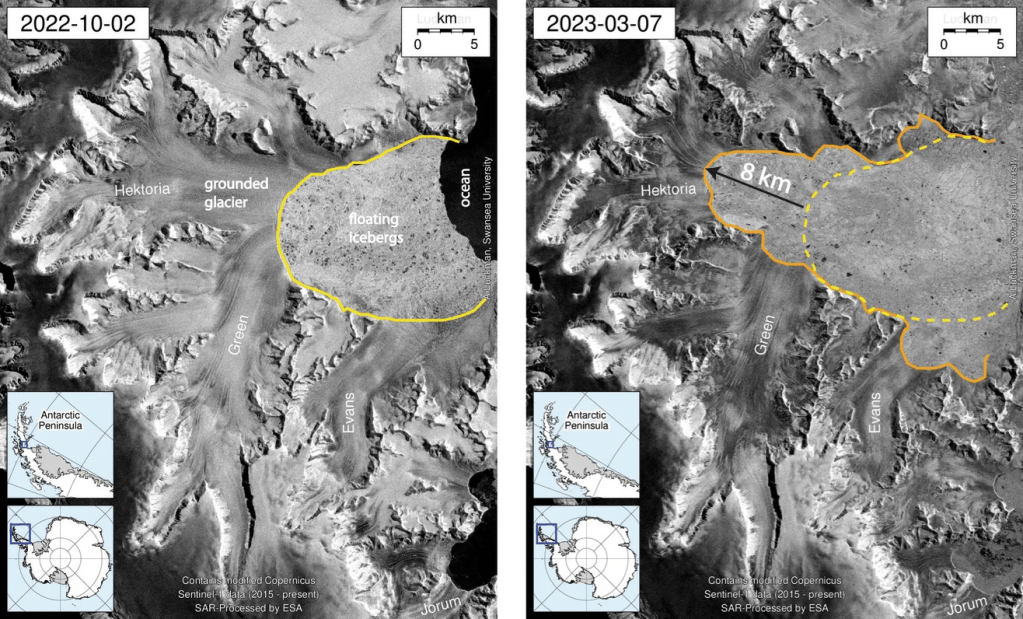
    Between 2022 and 2023, broken fast ice allowed ocean water to reach the Hektoria glacier, shrinking it by half / Adrian Luckman / CNN Climate ©

    With this new discovery of how and why Hektoria retreated, scientists can now predict and expect other glacier retreats. However, prediction does not equal prevention. These models show that continued warming, driven largely by human greenhouse gas emissions, will only accelerate this process. In order to help out, let’s follow this guide from the University Corporation for Atmospheric Research (UCAR) to minimize our CO2 emissions; I mean, we might just save a glacier.

    November 8: Crispr for Cholesterol

    Cholesterol. We know it and sometimes fear it, but what is it? Cholesterol levels are determined by LDL cholesterol, a waxy compound that can clog arteries, and triglycerides, the most prominent type of fat in the body. Triglycerides can also harden arteries and artery walls. So, when we have high cholesterol, our arteries might be blocked and we have increased risk of heart attacks, heart diseases, and strokes.

    Around 25% of adults in the United States have increased levels of LDL and triglycerides. Ouch. But never fear, Crispr is here! Crispr, a Swiss biotechnology company that deals with gene-editing, recently tested a new infusion and presented its results on November 8. 

    Their one-time infusion of CTX310, a therapy delivered by liquid nanoparticles, attempted to turn off ANGPTL3, a gene in the liver. Because some people are born with a mutated ANGPTL3 gene that safely protects them from heart disease, the Crispr scientists tried to replicate that. The highest dose given reduced triglyceride and harmful LDL by about 50% in two weeks, and the results lasted through the end of the trial.

    With this initial success, Crispr plans to begin Phase II studies in 2026, and they hope to achieve an infusion that lasts a lifetime. Once safety of treatments is further explored and confirmed, CTX310 may even become a preventative measure. As senior author and chief academic officer of the Heart, Vascular, and Thoracic Institute at Cleveland Clinic Steven Nissen said,

    “This is a revolution in progress.” -Steven Nissen

    November 10: One of a Kind

    The universe cannot be replicated. We follow no simulation, no set mathematics, and no algorithm. Who knew? Well, physicists, apparently. At the University of British Columbia in Okanagan, physicists proved that the universe cannot be simulated.

    There’s a mathematical layer of quantum gravity dubbed the “Platonic realm” that creates even the concepts of space and time. However, these physicists proved that it cannot recreate reality purely with computation. Known as “Gödelian truths,” some things just cannot be understood with logic as they contradict themselves. Think about this for a minute: how would you prove the idea that “this true statement is not provable”? You can’t, and neither can a computer. Statements like this one exist all throughout our universe; when faced with them, computers’ logical algorithms fail.

    Thus, computers cannot know and compute everything about our universe, so they cannot replicate it. We are one of a kind.

    November 13: Bezos in Space

    On November 13, Jeff Bezos launched Blue Origin’s New Glenn rocket out of Florida. New Glenn deployed two of NASA’s Escapade Satellites to measure Mars’ atmosphere and magnetic field, and, for the first time, its reusable booster successfully made it onto a landing pad in the Atlantic Ocean. Blue Origin is now the second company in the world to do so, with Elon Musk in first. Watch the landing here. Okay, check back in 22 months—hm, that’s September of 2027—when the satellites arrive at Mars! 
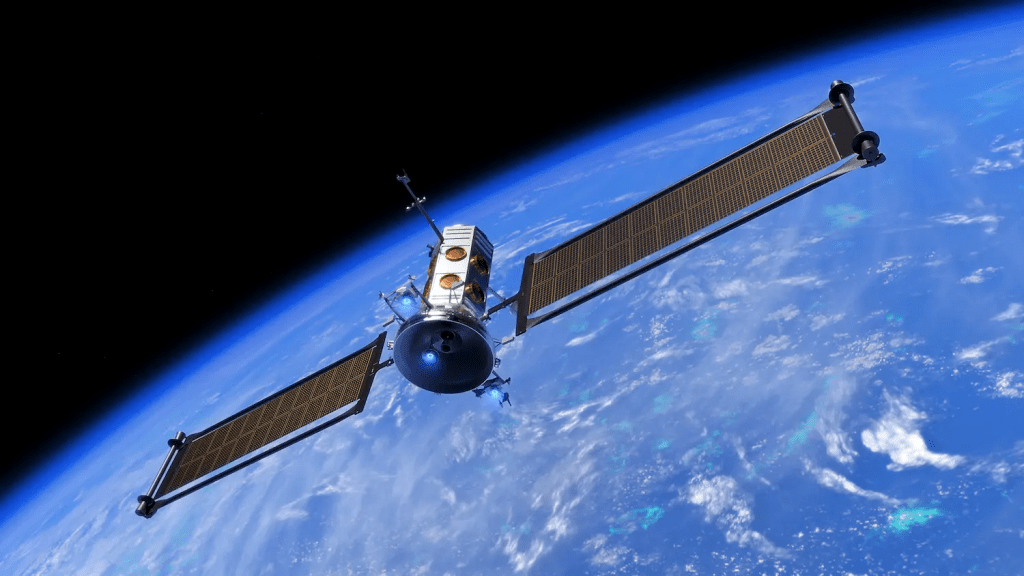
    New Glenn Launches NASA’s ESCAPADE, Lands Fully Reusable Booster / Blue Origin ©

    November 14: Crispr for Cancer

    And for the second time in one article, Crispr’s here! This time, however, it tackles chemotherapy resistance in lung cancer. A gene called NRF2 can cause resistance to chemotherapy in some cases of cancer, so Crispr scientists looked at disabling it in lung squamous cell carcinoma, an aggressive type of lung cancer that makes up around a quarter of all lung cancer cases.

    They infused R34G, a mutation in NRF2 that can regulate cellular stress reactions; when NRF2’s is overactive, it causes cancer cells to resist chemotherapy, so they used R34G to subdue NRF2’s behavior. Even when they only calmed NRF2 in less than half of tumor cells, it still reduced tumors and improved chemotherapy response.

    “The power of this CRISPR therapy lies in its precision. It’s like an arrow that hits only the bullseye,” Kelly Banas, lead author of the study, said. As Crispr will continue to perform and study trials, R34G might just be the future of cancer treatment.

    November 18: Gemini 3’s Release

    We’ve all seen the AI overviews embedded into Google’s search results. You’re just wondering how long to bake your snickerdoodles for, but the AI’s answer ranges from 8 minutes to 25. What? Then, you look and see twelve recipes referenced. Huh? There’s no way it’s that difficult, you wonder. Yeah, we’ve all been there. 

    However, Google just launched Gemini 3, and they proclaim it their “most intelligent model” yet. Maybe we’ll get a more precise answer on those snickerdoodles now! More confident than ever in Gemini 3, Google embedded it into its search engine on the first day of its release, which they had never done before. Normally, they gradually implant new versions over weeks, or even months. 

    Gemini 3 also brings new features to the table. Or, well, to the phone. “Gemini Agent” can book travel plans, organize your overwhelmed email, and do other multi-step jobs. Additionally, they updated the Gemini app to respond to prompts with answers so thorough they look like websites.

    Well, if you’re looking for a new AI model, Gemini 3 may very well be what you need. And if you’re looking for ridiculously incorrect and vague answers to make fun of, the jury’s still out on whether Gemini 3 is the platform for you or not.

    November 18: A Milky Way Model

    We already discussed computers’ inability to model our universe, but I never said anything about the Milky Way! Researchers from the RIKEN Center for Interdisciplinary Theoretical and Mathematical Sciences (iTHEMS) in Japan, The University of Tokyo, and the Universitat de Barcelona in Spain managed to accurately simulate 100 billion stars over the course of 10 thousand years. 
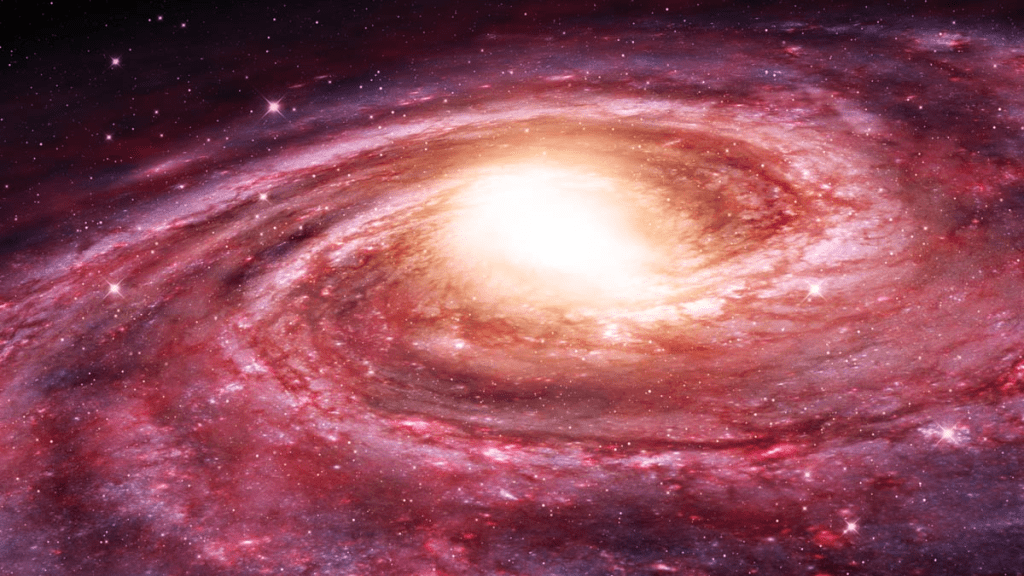
    Researchers Create First 100-billion-star Milky Way Simulation Using AI / NRAO / Orbital Today ©

    These researchers trained an AI model using high-resolution simulations, and it eventually managed to predict resulting gas expansions. Thus, it created a simulation of the galaxy’s overall dynamics as well as its smaller phenomena. Previous models of the universe would struggle to predict on a small-scale, but this new one can do exactly that. Also, it did so quickly! In just under 3 hours, it created a simulation of the galaxy over 1 million years.

    This new model could become popular for making other simulations that need small- and large-scale accuracy. Like lead researcher Keiya Hirashima said,

    “This achievement also shows that AI-accelerated simulations can move beyond pattern recognition to become a genuine tool for scientific discovery—helping us trace how the elements that formed life itself emerged within our galaxy.” -Keiya Hirashima

    November 18: Antimatter Aplenty

    Have you noticed that this is the third event from November 18? Sounds like a hat trick to me! Anyways, CERN’s Antimatter factory recently undertook a new project called the ALPHA experiment, and they published their findings on November 18. Essentially, they managed to create over 15,000 antihydrogen atoms in under 7 hours.

    Antihydrogen is the most basic form of atomic antimatter, and antimatter is a substance with the same mass and particles as another substance but opposite charges. For example, antihydrogen has the same mass and particles as hydrogen, but hydrogen’s protons have positive charges and its electrons have negative charges while antihydrogen’s protons have negative charges and its electrons have positive charges. When antimatter and matter meet, they destroy each other, creating an immense amount of energy. Antimatter is normally found in particle accelerators, cosmic rays, and medical imaging, but it’s fairly rare as creating it is a lengthy process.

    However, with the ALPHA team’s new method, they’ve managed to make antimatter 8 times faster than normal. Normally, the process involves creating and trapping antiprotons and positrons separately before cooling and merging them together to form antihydrogen, but ALPHA’s unique success came from the way they create their positrons. The general problem with creating antimatter is that trapped positrons refuse to stay still once trapped, and they don’t cool down enough. So, the ALPHA team approached the antihydrogen by adding laser-cooled beryllium ions to the positron trap. The beryllium makes the positrons lose energy through sympathetic cooling, which cools the positrons to around -266 °C and makes them more likely to merge with the antiprotons and form antihydrogen, creating more antimatter.

    Scientists thoroughly study any antimatter they can get, so, with this new abundance, they plan to study gravity’s effect on antimatter in the ALPHA-g experiment. Stay tuned because they may discover new properties and behavior of antimatter, which wouldn’t be possible without ALPHA’s new process.

    Okay, that’s all I have for November. Consider this my holiday gift to you. Enjoy December, and come back for Stemline’s next recap!

    References

    Cai, K. (2025, November 18). Google launches Gemini 3, embeds AI model into search immediately. Reuters. https://www.reuters.com/business/media-telecom/google-launches-gemini-3-embeds-ai-model-into-search-immediately-2025-11-18/
    ChristianaCare Gene Editing Institute. (2025, November 17). CRISPR breakthrough reverses chemotherapy resistance in lung cancer. Eurek Alert! https://www.eurekalert.org/news-releases/1106182
    CRISPR Therapeutics AG. (2025, November 8). CRISPR Therapeutics announces positive phase 1 clinical data for CTX310® demonstrating deep and durable ANGPTL3 editing, triglyceride and lipid lowering. CRISPR Therapeutics. https://crisprtx.com/about-us/press-releases-and-presentations/crispr-therapeutics-announces-positive-phase-1-clinical-data-for-ctx310-demonstrating-deep-and-durable-angptl3-editing-triglyceride-and-lipid-lowering 
    Harris, R. (2025, November 18). Breakthrough in antimatter production. CERN. https://home.cern/news/news/experiments/breakthrough-antimatter-production
    Lohnes, K. (2025, June 13). What is antimatter?. Encyclopedia Britannica. https://www.britannica.com/story/what-is-antimatter 
    Mullin, E. (2025, November 8). A gene-editing therapy cut cholesterol levels by half. Wired. https://www.wired.com/story/a-gene-editing-therapy-cut-cholesterol-levels-by-half/ 
    Riken. (2025, November 18). The simulated Milky Way: 100 billion stars using 7 million CPU cores. Riken. https://www.riken.jp/en/news_pubs/research_news/pr/2025/20251117_2/index.html 
    UCAR. (2020). How do we reduce greenhouse gases? UCAR: Center for Science Education. https://scied.ucar.edu/learning-zone/climate-solutions/reduce-greenhouse-gases 
    University of British Columbia Okanagan campus. (2025, November 10). Physicists prove the Universe isn’t a simulation after all. ScienceDaily. Retrieved December 13, 2025 from http://www.sciencedaily.com/releases/2025/11/251110021052.htm 
    University of Colorado at Boulder. (2025, November 3). Antarctic glacier retreated faster than any other in modern history. Eurek Alert. https://www.eurekalert.org/news-releases/1104274 
    Watch: Blue Origin rocket successfully lands booster for first time [Video]. (2025, November 13). BBC. https://www.bbc.com/news/videos/c5yd0zd6eddo 

  • the entire history of spacetime, i guess (part 3)

    the entire history of spacetime, i guess (part 3)

    By Aashritha Shankar

    ~ 11 minutes


    While the concepts of space and time were fundamental to the Newtonian world, centuries of digging deeper into the mechanics of our universe have uncovered that it isn’t all as simple as it seems. From Einstein’s Special Relativity to theories of multi-dimensional time, the science behind space and time has evolved into a complex field.

    Why Extra Temporal Dimensions?

    The search for extra spatial dimensions raises questions of the potential for extra temporal dimensions. If space can have more dimensions, why can’t time? The motivations to explore the potential for extra temporal dimensions arise from a desire to better understand the nature of time and the symmetries between them.

    Another reason to study these extra-temporal dimensions is the desire to unify seemingly disconnected parts of time. Many frameworks for extra temporal dimensions have revealed previously unnoticed symmetries and relationships between different temporal systems that would not be discovered while only working in one dimension.

    The concept of “complex time” is used to fix some of the problems of quantum mechanics. This idea suggests that time should be represented as a complex value rather than a real number. It would allow more ways to represent wave-particle duality, entanglement, and other fundamental concepts of quantum physics.

    2T-Physics

    Proposed by physicist Itzhak Bars, 2T-Physics suggests that the one dimension of time we experience is really just a “shadow” of the real two dimensions of time. The core motivation of 2T-Physics is to reveal the deeper temporal connections that we don’t see in our one-dimensional perspective. In 2T-Physics, two seemingly disconnected temporal systems are actually connected and represent different views or ‘shadows’ of the same two-dimensional time. 

    2T-Physics unifies a wide range of physical systems using “gauge symmetry,” which is the property of a system where a set of transformations, called gauge transformations, can be used on a system without changing any of the physical properties of that system. Bars also illustrated that the Standard Model could be explained by 2T-Physics with four spatial dimensions. Not only can this model predict most of the Standard Model, but it also provides a solution to some quantum issues.

    An interesting difference between the Standard Model and the predictions of 2T-Physics is the gravitational constant. While it is currently established that the coefficient in gravitational equations is a constant 6.67⋅10-11, the mathematics of 2T-Physics means that the gravitational constant has different values for different periods of our universe (inflation, grand unification, etc). This allows new possibilities for early expansion of our universe that General Relativity and the Standard Model do not. Through its new perspectives, 2T-Physics allows a more complete framework of gravity, especially at higher dimensions.

    While 2T-Physics is well-established, it remains highly theoretical and has little to no practical impact. While there is no evidence directly supporting the theory, 2T-Physics predicts certain connections between different physical systems that could potentially be verified through complex experiments, though none have been conducted so far. Above all, 2T-Physics provides a new perspective on time and the nature of the laws of physics that has opened the eyes of many scientists and will likely inspire future discoveries.

    3D Time

    One of the most recent papers in the field, Kletetschka, proposes a mathematical framework of spacetime that includes temporal dimensions. Kletetschka provides a new perspective on combining gravity and quantum mechanics. Instead of having two hidden dimensions of time, Kletetschka theorizes that each of these dimensions is used to represent time at different scales: the quantum scale, the interaction scale, and the cosmological scale. He explains that the other two dimensions are not visible in our daily life because they occur at very small (quantum) levels or very large (cosmological) levels.

    Figure 3, Three-Dimensional Time: A Mathematical Framework for Fundamental Physics, World Scientific Connect ©

    A massive difference between this theory and conventional physics is that while conventional physics considers space to be something vastly different from time, Kletetschka proposes that space is a byproduct of time in each of these dimensions, rather than an entirely separate entity. What we experience as mass or energy actually arises from the curvature of time in these three dimensions. As Kletetschka explored more into this, he discovered surprising consistency in the mathematics, leading to a deeper exploration into the concept.

    The key to not creating causality issues and instability in the theory was the usage of regular geometry and spatial dimensions instead of exotic situations that are hard to prove or test. This theory aimed to address many of the long-standing issues in quantum mechanics, and its success thus far makes it a prominent theory in the field.

    The theory is able to add extra temporal dimensions without causing causality issues, something very few theories of its type have been able to grapple with. This is due to its structure. The theory is designed so that the three axes share an ordered flow, preventing an event from happening before its cause. Furthermore, these three axes operate at very different scales, leaving very little overlap between them. The mathematics of the framework does not allow for the alteration of events in the past, something that many other theories allow.

    The theory is able to offer physical significance and a connection to our world alongside mathematical consistency. Things such as finite quantum corrections, which other theories were not able to predict, were mechanized by this model without creating extra complexity.

    This mathematical framework is able to predict several properties and new phenomena that can be experimentally tested, allowing pathways to prove or disprove it soon. Meanwhile, many scientists have spoken in support of the theory, considering it a promising candidate for a near “Theory of Everything” just a few months after its publication.

    Conclusion

    While the theoretical motivation for extra dimensions is compelling, the reality of their existence remains unconfirmed. Meanwhile, the scientific community works to experimentally prove or disprove their existence through observational evidence.

    The Large Hadron Collider (LHC) at CERN is one of the major players on the experimental side. They engage in many experiments, a few of which I have highlighted below.

    1. Tests for Microscopic Black Holes: Many of the theories that propose extra dimensions lead to increased gravitational power within short distances. This manifests physically as microscopic black holes that would dissipate near instantaneously due to Hawking Radiation. However, the byproduct of this dissipation would be particles detected through the LHC.
    2. The Graviton Disappearance: Another common feature of extra-dimensional theories is the manifestation of gravity as a particle called a graviton. That particle would disappear into these extra dimensions, taking energy with it. This would result in an imbalance in the total energy of the system.

    While experiments have managed to provide more limitations for potential values that would work in certain theories, they have yet to prove or disprove them.

    Meanwhile, it is important to consider what extra dimensions would mean for us and the way we live. The concept of extra dimensions provides multiple philosophical considerations for us as humans. This concept completely changes our worldview and affects our perception of the universe. Dr. Michio Kaku explains this through the analogy of a fish in a pond, unaware of the world outside its simple reality. Our perception of reality is limited, not only by our understanding of physics, but also by the biology of our brains.

    The work towards a “Theory of Everything” is not only a physical goal but a philosophical one as well. We strive to understand our universe and everything within it in the simplest way possible. It embodies human desire for ultimate knowledge and drives centuries of physical progress.

    Overall, the concept of extra dimensions represents one of the most arduous and ambitious goals in human history. While they lack proof, these theories motivate people to search more into the nature of our universe and question the very fabric of our reality. The exploration into further discoveries about our universe truly shows who we are as humans and will continue to motivate centuries of physicists to question the very nature of everything.


    References

    6.2: Relation Between Events- Timelike, Spacelike, or Lightlike. (2022, January 20). Physics LibreTexts. https://phys.libretexts.org/Bookshelves/Relativity/Spacetime_Physics_(Taylor_and_Wheeler)/06%3A_Regions_of_Spacetime/6.02%3A_Relation_Between_Events-Timelike_Spacelike_or_Lightlike
    A quote from Physics of the Impossible. (2025). Goodreads.com. https://www.goodreads.com/quotes/8392801-but-historically-the-fourth-dimension-has-been-considered-a-mere
    Albert Einstein Quote: “When forced to summarize the general theory of relativity in one sentence: Time and space and gravitation have no separa…” (n.d.). Quotefancy.com. https://quotefancy.com/quote/763238/Albert-Einstein-When-forced-to-summarize-the-general-theory-of-relativity-in-one-sentence
    Bars, I. (2006). The Standard Model as a 2T-physics Theory. 903(1). https://doi.org/10.1063/1.2735245
    Bars, I., & Costas Kounnas. (1997). Theories with two times. Physics Letters B, 402(1-2), 25–32. https://doi.org/10.1016/s0370-2693(97)00452-8
    Bars, I., & Kuo, Y.-C. (2007). Field Theory in Two-Time Physics withN=1Supersymmetry. Physical Review Letters, 99(4). https://doi.org/10.1103/physrevlett.99.041801
    Bars, I., & Terning, J. (2010). Extra Dimensions in Space and Time (F. Nekoogar, Ed.). Springer New York. https://doi.org/10.1007/978-0-387-77638-5
    Bell, J. (n.d.). Time and Causation in Gödel’s Universe. https://publish.uwo.ca/~jbell/Time.pdf
    Beuke, F. (2025). beuke.org. Beuke.org. https://beuke.org/calabi-yau-manifold/
    Centre for Theoretical Cosmology: The Origins of the Universe: M-theory. (n.d.). http://Www.ctc.cam.ac.uk. https://www.ctc.cam.ac.uk/outreach/origins/quantum_cosmology_four.phpcern. (2000, March 7). Discovering new dimensions at LHC – CERN Courier. CERN Courier.
    Church, B. (2022). Kaluza-Klein Theory. https://web.stanford.edu/~bvchurch/assets/files/talks/Kaluza-Klein.pdf
    Continuing the search for extra dimensions. (2025, July 8). ATLAS. https://atlas-public.web.cern.ch/updates/briefing/continuing-search-extra-dimensions
    DUFF, M. J. (1996). M THEORY (THE THEORY FORMERLY KNOWN AS STRINGS). International Journal of Modern Physics A, 11(32), 5623–5641. https://doi.org/10.1142/s0217751x96002583
    Dunn, T. (2017, January 10). Classic Time Travel Paradoxes (And How To Avoid Them). Quirk Books. https://www.quirkbooks.com/classic-time-travel-paradoxes-and-how-to-avoid-them/
    Extra Dimensions. (n.d.). Retrieved August 10, 2025, from https://pdg.lbl.gov/2025/listings/rpp2025-list-extra-dimensions.pdf
    Extra dimensions – (Principles of Physics III) – Vocab, Definition, Explanations | Fiveable. (2025). Fiveable.me. http://library.fiveable.me/key-terms/principles-physics-iii-thermal-physics-waves/extra-dimensions
    Extra dimensions – and how to hide them «Einstein-Online. (2025). Einstein-Online.info. https://www.einstein-online.info/en/spotlight/hiding_extra_dimensions/
    Fazekas, L. (2025, July 13). How Einstein’s Special Relativity Theory Redefined Space and Time. Medium. https://thebojda.medium.com/how-einsteins-special-relativity-theory-redefined-space-and-time-45b79573443d
    Filimowicz, M. (2025, April). Hidden Geometries: The Search for Extra Dimensions and Their Technological Implications. Medium: Quantum Psychology, Biology, and Engineering. https://medium.com/quantum-psychology-and-engineering/hidden-geometries-the-search-for-extra-dimensions-and-their-technological-implications-b999133086c9
    Foster, J. G., & Müller, B. (2025). Physics With Two Time Dimensions. ArXiv.org. https://arxiv.org/abs/1001.2485
    Gunther Kletetschka. (2025). Three-Dimensional Time: A Mathematical Framework for Fundamental Physics. Reports in Advances of Physical Sciences, 09. https://doi.org/10.1142/s2424942425500045
    Hawking, S. W. (1992). Chronology protection conjecture. Physical Review D, 46(2), 603–611. https://doi.org/10.1103/physrevd.46.603
    Hoang, L. N. (2013, June 2). Spacetime of General Relativity. Science4All. http://www.science4all.org/article/spacetime-of-general-relativity/
    Horoto, L., & G, S. F. (2024). A New Perspective on Kaluza-Klein Theories. ArXiv.org. https://arxiv.org/abs/2404.05302https://www.facebook.com/thoughtcodotcom. (2009). The Physics of Moving Backward in Time. ThoughtCo. https://www.thoughtco.com/closed-timelike-curve-2699127
    Hyperspace – A Scientific Odyssey: Official Website of Dr. Michio Kaku. (n.d.). https://mkaku.org/home/articles/hyperspace-a-scientific-odyssey/
    Kalligas, D., S, W. P., & Everitt,. (1995). The classical tests in Kaluza-Klein gravity. The Astrophysical Journal, Part 1, 439(2). https://ntrs.nasa.gov/citations/19950044695
    Kaluza, Klein and their story of a fifth dimension. (2012, October 10). Plus.maths.org. https://plus.maths.org/content/kaluza-klein-and-their-story-fifth-dimension
    Kaluza-Klein theories. (n.d.). Retrieved August 10, 2025, from https://indico.cern.ch/event/575526/contributions/2368967/attachments/1430033/2196226/Mondragon_BeyondSM_L3.pdf
    Lee, S. (2025a). Calabi-Yau Manifolds: A Deep Dive. Numberanalytics.com. https://www.numberanalytics.com/blog/calabi-yau-manifolds-deep-dive-differential-topology#google_vignette
    Lee, S. (2025b). The M-Theory Revolution. Numberanalytics.com. https://www.numberanalytics.com/blog/m-theory-revolution
    Lloyd, S., Maccone, L., Garcia-Patron, R., Giovannetti, V., Shikano, Y., Pirandola, S., Rozema, L. A., Darabi, A., Soudagar, Y., Shalm, L. K., & Steinberg, A. M. (2011). Closed Timelike Curves via Postselection: Theory and Experimental Test of Consistency. Physical Review Letters, 106(4). https://doi.org/10.1103/physrevlett.106.040403
    M. S., M. E., & B. A., P. (n.d.). M-Theory: Maybe Even More Dimensions Can Fix String Theory. ThoughtCo. https://www.thoughtco.com/m-theory-2699256
    Mei, Z.-H. (2024). Time Has Two Dimensions-Exploring Coordinate Connotation of Five-Dimensional Space. 24(7), 21–25. https://www.researchgate.net/publication/381282542_Time_Has_Two_Dimensions-Exploring_Coordinate_Connotation_of_Five-Dimensional_Space
    Michael B. Schulz: Research Interests – String Theory Compactifications. (2024). Bryn Mawr College. https://www.brynmawr.edu/inside/academic-information/departments-programs/physics/faculty-staff/michael-b-schulz/michael-b-schulz-research-interests-string-theory-compactifications
    Muntean, I. L. (2017). Unification and explanation in early Kaluza-Klein theories. Escholarship.org. https://escholarship.org/uc/item/5ws3s18g
    Research Interests – Itzhak Bars. (2024, July 15). Itzhak Bars. https://dornsife.usc.edu/bars/research/
    Richmond, A. (2018). Time Travelers. Inference, 3(4). https://inference-review.com/article/time-travelers
    Rynasiewicz, R. (2011). Newton’s Views on Space, Time, and Motion (Stanford Encyclopedia of Philosophy). Stanford.edu. https://plato.stanford.edu/entries/newton-stm/
    Stein, V., & Dobrijevic, D. (2025, May 12). Einstein’s Theory of Special Relativity. Space.com. https://www.space.com/36273-theory-special-relativity.html
    String Theory. (2025, May 8). Institute for Advanced Study. https://www.ias.edu/default/tags/string-theory
    Tegmark, M. (1997). On the dimensionality of spacetime. Classical and Quantum Gravity, 14(4), L69–L75. https://doi.org/10.1088/0264-9381/14/4/002
    The Many Dimensions of Oskar Klein. (2021, February 11). Galileo Unbound; Galileo Unbound. https://galileo-unbound.blog/2021/02/10/the-many-dimensions-of-oskar-klein/
    There are 2 dimensions of time, theoretical physicist states. (2017, May 9). Big Think. https://bigthink.com/surprising-science/there-are-in-fact-2-dimensions-of-time-one-theoretical-physicist-states/
    Tillman, N. T., Bartels, M., & Dutfield, S. (2024, October 29). Einstein’s Theory of General Relativity. Space.com. https://www.space.com/17661-theory-general-relativity.html
    Visser, M. (2025). The quantum physics of chronology protection. ArXiv.org. https://arxiv.org/abs/gr-qc/0204022
    Weinstein, S. (2025). Multiple Time Dimensions. ArXiv.org. https://arxiv.org/abs/0812.3869
    Wolchover, N. (2017). Why Is M-Theory the Leading Candidate for Theory of Everything? | Quanta Magazine. Quanta Magazine. https://www.quantamagazine.org/why-is-m-theory-the-leading-candidate-for-theory-of-everything-20171218/

  • the entire history of spacetime, i guess (part 1)

    the entire history of spacetime, i guess (part 1)

    By: Aashritha Shankar

    ~ 8 minutes


    While the concepts of space and time were fundamental to the Newtonian world, centuries of digging deeper into the mechanics of our universe have uncovered that it isn’t all as simple as it seems. From Einstein’s Special Relativity to theories of multi-dimensional time, the science behind space and time has evolved into a complex field.

    Newtonian Absolutism

    At the dawn of classical mechanics, Newton created the foundation upon which all of modern spacetime theory is built. Space and time were considered to be entirely unrelated and absolute concepts. There was no question in his mind that time moves forward and space exists around us. Space was considered a static body within which we exist, while time was described as flowing in only one direction at a steady rate. Imagine space as a box, where events are contained within, and time as a river whose current pulls us along.

    Newton coined the terms ‘absolute space’ and ‘absolute time’ to describe the absolutes from the relativity we measure. For centuries, this theory remained unquestioned, so physicists didn’t consider time and space to be real entities, but rather our human way of interpreting the world around us.

    Einstein’s Revolution:

    Special Relativity

    The first true challenge to the Newtonian perspective of space and time came in the form of Einstein’s Special Relativity. He introduced one key revolutionary concept: everything, including space and time, is relative, depending only upon the observer’s frame of reference.

    The motivations for Einstein’s work arose from the desire to eliminate the contradiction between Maxwell’s equations and Newtonian Mechanics. A simple way to visualize this contradiction is by imagining the following scenario:

    Two rockets in space are flying towards each other at a speed of 500 miles per hour. This would result in a relative speed of 1000 miles per hour. Now, if you were to throw a rock from one ship to another at a speed of 10 miles per hour, it would reach the other ship with a relative speed of 510 miles per hour. However, the substitution of light into this situation instead of a rock changes this because the speed of light is constant. No matter how fast you travel towards light, it will always come towards you at the same constant speed: 3·108m/s, or the speed of light.

    Many tests were done to prove that the wave-particle duality of light was the reason for this phenomenon. Rather than trying to disprove or explain away the theory, Einstein decided to take the constant speed of light as a fundamental property. He didn’t explain the speed of light, but used it to explain other things. Einstein was willing to give up the time-honored fundamentals of Newton’s laws in favor of the constant speed of light. 

    He began with the basic definition of speed as the distance divided by the time. If the speed of light remains constant as this rocket reduces the distance to be travelled, then the time must also decrease to preserve this equality. When mathematically calculating this, Einstein discovered the concept of time dilation, where objects in motion experience time more slowly than objects at rest. Continuing with similar methods for other properties, such as conservation, he discovered that mass would increase with speed and length would decrease. The true genius in Einstein was his willingness to question his own assumptions and give up some of the most basic qualities of the universe, in favor of the speed of light.

    General Relativity

    Special Relativity, however, did not incorporate gravity. Before Einstein, physicists believed that gravity was an invisible force that dragged objects towards one another. However, Einstein’s general relativity suggested that the ‘dragging’ was not gravity, but rather an effect of gravity. He theorized that objects in space bent the space around them, inadvertently bringing objects closer to one another.

    General Relativity defines spacetime as a 4D entity that has to obey a series of equations known as Einstein’s equations. He used these equations to suggest that gravity isn’t a force but instead a name we use to describe the effects of curved spacetime on the distance between objects. Einstein proved a correlation between the mass and energy of an object and the curvature of the spacetime around it.

    His work allowed him to prove that:

    “When forced to summarize the general theory of relativity in one sentence: Time and space and gravitation have no separate existence from matter.” -Einstein.

    Einstein’s General Relativity predicted many things that were only observationally noticed years later. A famous example of this is gravitational lensing, which is when the path of light curves as it passes a massive object. This effect was noticed by Sir Arthur Eddington in 1919 during a solar eclipse, yet Einstein managed to predict it with no physical proof in 1912.

    Closed-Timelike-Curves (CTCs)

    Another major prediction made by Einstein’s General Relativity is Closed-Timelike-Curves (CTCs), which arise from mathematical solutions to Einstein’s equations. Some specific solutions to these equations, such as massive, spinning objects, create situations in which time could loop.

    In physics, objects are considered to have a specific trajectory through spacetime that will indicate the object’s position in space and time at all times. When these positions in spacetime are connected, they form a story of an object’s past, present, and future. An object that is sitting still will have a worldline that goes straight in the time direction. Meanwhile, an object in motion will also have an element of spatial position. Diagrams of a worldline are drawn as two light cones, one into the future and one into the past, with a spatial dimension on the other axis, as seen in figure 1.

    Figure 1 / Takeshimg ©

    CTCs are created when the worldline of an object is a loop, meaning that the object will go backwards in time at some point to reconnect to its starting point. Closed-Timelike-Curves are, in essence, exactly what they sound like: closed curving loops that travel in a timelike way. Traveling in a timelike way, meaning that their change in time is greater than their change in space, suggests that these objects would have to be static or nearly static. As seen in Figure 2, the worldline of a CTC would be a loop, as there is some point in space and time that connects the end and the beginning.

    Figure 2 / Classical and Quantum Gravity / ResearchGate ©

    Two major examples of famous CTC solutions are the Gödel Universe and the Tipler Cylinder:

    • Gödel Universe: Suggested by mathematician Kurt Gödel in 1949, the Gödel Universe is a rotating universe filled with swirling dust. The rotation must be powerful enough that it can pull the spacetime around it as it spins. The curvature would become the CTC. This was the first solution found that suggested the potential for time-travel to be a legitimate possibility, not just a hypothetical scenario. 
    • Tipler Cylinder: In the 1970s, physicist Frank Tipler suggested an infinitely long, massive cylinder spinning along the vertical axis at an extremely high speed. This spinning would twist the fabric of spacetime around the cylinder, creating a CTC.

    Closed timelike curves bring many paradoxes with them, the most famous of which is the grandfather paradox. It states that if a man has a granddaughter who goes back in time to kill her grandfather before her parents are born, then she wouldn’t exist. However, if she doesn’t exist, then there is no one to kill her grandfather, thus meaning that she must exist. Yet if she exists, then her grandfather doesn’t.

    Most importantly, CTCs drove further exploration and directed significant attention to the spacetime field for decades. Scientists who didn’t fully believe Einstein’s General Relativity pointed to CTCs as proof of why it couldn’t be true, leaving those who supported Einstein to search extensively for a way to explain them. This further exploration into the field has laid the foundation for many theories throughout the years.

    The belief amongst scientists is that CTCs simply don’t exist because, while they are hypothetically possible, the energy requirements to create them are not yet feasible. Many of these setups require objects with negative energy density and other types of  ‘exotic matter’ that have not been proven to even exist yet. Furthermore, even if CTCs were to be formed, the specific region of spacetime where they form would be highly unstable, meaning that these CTCs would not sustain themselves. The situations in which CTCs would be feasible require types of fields of energy that would approach infinity and the Cauchy Horizon (the limit at which causality no longer exists, therefore making these situations physically unviable).


    All references listed on Part 3.