About

Tag: quantum-mechanics

  • the entire history of spacetime, i guess (part 3)

    the entire history of spacetime, i guess (part 3)

    By Aashritha Shankar

    ~ 11 minutes


    While the concepts of space and time were fundamental to the Newtonian world, centuries of digging deeper into the mechanics of our universe have uncovered that it isn’t all as simple as it seems. From Einstein’s Special Relativity to theories of multi-dimensional time, the science behind space and time has evolved into a complex field.

    Why Extra Temporal Dimensions?

    The search for extra spatial dimensions raises questions of the potential for extra temporal dimensions. If space can have more dimensions, why can’t time? The motivations to explore the potential for extra temporal dimensions arise from a desire to better understand the nature of time and the symmetries between them.

    Another reason to study these extra-temporal dimensions is the desire to unify seemingly disconnected parts of time. Many frameworks for extra temporal dimensions have revealed previously unnoticed symmetries and relationships between different temporal systems that would not be discovered while only working in one dimension.

    The concept of “complex time” is used to fix some of the problems of quantum mechanics. This idea suggests that time should be represented as a complex value rather than a real number. It would allow more ways to represent wave-particle duality, entanglement, and other fundamental concepts of quantum physics.

    2T-Physics

    Proposed by physicist Itzhak Bars, 2T-Physics suggests that the one dimension of time we experience is really just a “shadow” of the real two dimensions of time. The core motivation of 2T-Physics is to reveal the deeper temporal connections that we don’t see in our one-dimensional perspective. In 2T-Physics, two seemingly disconnected temporal systems are actually connected and represent different views or ‘shadows’ of the same two-dimensional time. 

    2T-Physics unifies a wide range of physical systems using “gauge symmetry,” which is the property of a system where a set of transformations, called gauge transformations, can be used on a system without changing any of the physical properties of that system. Bars also illustrated that the Standard Model could be explained by 2T-Physics with four spatial dimensions. Not only can this model predict most of the Standard Model, but it also provides a solution to some quantum issues.

    An interesting difference between the Standard Model and the predictions of 2T-Physics is the gravitational constant. While it is currently established that the coefficient in gravitational equations is a constant 6.67⋅10-11, the mathematics of 2T-Physics means that the gravitational constant has different values for different periods of our universe (inflation, grand unification, etc). This allows new possibilities for early expansion of our universe that General Relativity and the Standard Model do not. Through its new perspectives, 2T-Physics allows a more complete framework of gravity, especially at higher dimensions.

    While 2T-Physics is well-established, it remains highly theoretical and has little to no practical impact. While there is no evidence directly supporting the theory, 2T-Physics predicts certain connections between different physical systems that could potentially be verified through complex experiments, though none have been conducted so far. Above all, 2T-Physics provides a new perspective on time and the nature of the laws of physics that has opened the eyes of many scientists and will likely inspire future discoveries.

    3D Time

    One of the most recent papers in the field, Kletetschka, proposes a mathematical framework of spacetime that includes temporal dimensions. Kletetschka provides a new perspective on combining gravity and quantum mechanics. Instead of having two hidden dimensions of time, Kletetschka theorizes that each of these dimensions is used to represent time at different scales: the quantum scale, the interaction scale, and the cosmological scale. He explains that the other two dimensions are not visible in our daily life because they occur at very small (quantum) levels or very large (cosmological) levels.

    Figure 3, Three-Dimensional Time: A Mathematical Framework for Fundamental Physics, World Scientific Connect ©

    A massive difference between this theory and conventional physics is that while conventional physics considers space to be something vastly different from time, Kletetschka proposes that space is a byproduct of time in each of these dimensions, rather than an entirely separate entity. What we experience as mass or energy actually arises from the curvature of time in these three dimensions. As Kletetschka explored more into this, he discovered surprising consistency in the mathematics, leading to a deeper exploration into the concept.

    The key to not creating causality issues and instability in the theory was the usage of regular geometry and spatial dimensions instead of exotic situations that are hard to prove or test. This theory aimed to address many of the long-standing issues in quantum mechanics, and its success thus far makes it a prominent theory in the field.

    The theory is able to add extra temporal dimensions without causing causality issues, something very few theories of its type have been able to grapple with. This is due to its structure. The theory is designed so that the three axes share an ordered flow, preventing an event from happening before its cause. Furthermore, these three axes operate at very different scales, leaving very little overlap between them. The mathematics of the framework does not allow for the alteration of events in the past, something that many other theories allow.

    The theory is able to offer physical significance and a connection to our world alongside mathematical consistency. Things such as finite quantum corrections, which other theories were not able to predict, were mechanized by this model without creating extra complexity.

    This mathematical framework is able to predict several properties and new phenomena that can be experimentally tested, allowing pathways to prove or disprove it soon. Meanwhile, many scientists have spoken in support of the theory, considering it a promising candidate for a near “Theory of Everything” just a few months after its publication.

    Conclusion

    While the theoretical motivation for extra dimensions is compelling, the reality of their existence remains unconfirmed. Meanwhile, the scientific community works to experimentally prove or disprove their existence through observational evidence.

    The Large Hadron Collider (LHC) at CERN is one of the major players on the experimental side. They engage in many experiments, a few of which I have highlighted below.

    1. Tests for Microscopic Black Holes: Many of the theories that propose extra dimensions lead to increased gravitational power within short distances. This manifests physically as microscopic black holes that would dissipate near instantaneously due to Hawking Radiation. However, the byproduct of this dissipation would be particles detected through the LHC.
    2. The Graviton Disappearance: Another common feature of extra-dimensional theories is the manifestation of gravity as a particle called a graviton. That particle would disappear into these extra dimensions, taking energy with it. This would result in an imbalance in the total energy of the system.

    While experiments have managed to provide more limitations for potential values that would work in certain theories, they have yet to prove or disprove them.

    Meanwhile, it is important to consider what extra dimensions would mean for us and the way we live. The concept of extra dimensions provides multiple philosophical considerations for us as humans. This concept completely changes our worldview and affects our perception of the universe. Dr. Michio Kaku explains this through the analogy of a fish in a pond, unaware of the world outside its simple reality. Our perception of reality is limited, not only by our understanding of physics, but also by the biology of our brains.

    The work towards a “Theory of Everything” is not only a physical goal but a philosophical one as well. We strive to understand our universe and everything within it in the simplest way possible. It embodies human desire for ultimate knowledge and drives centuries of physical progress.

    Overall, the concept of extra dimensions represents one of the most arduous and ambitious goals in human history. While they lack proof, these theories motivate people to search more into the nature of our universe and question the very fabric of our reality. The exploration into further discoveries about our universe truly shows who we are as humans and will continue to motivate centuries of physicists to question the very nature of everything.

    References

    6.2: Relation Between Events- Timelike, Spacelike, or Lightlike. (2022, January 20). Physics LibreTexts. https://phys.libretexts.org/Bookshelves/Relativity/Spacetime_Physics_(Taylor_and_Wheeler)/06%3A_Regions_of_Spacetime/6.02%3A_Relation_Between_Events-Timelike_Spacelike_or_Lightlike
    A quote from Physics of the Impossible. (2025). Goodreads.com. https://www.goodreads.com/quotes/8392801-but-historically-the-fourth-dimension-has-been-considered-a-mere
    Albert Einstein Quote: “When forced to summarize the general theory of relativity in one sentence: Time and space and gravitation have no separa…” (n.d.). Quotefancy.com. https://quotefancy.com/quote/763238/Albert-Einstein-When-forced-to-summarize-the-general-theory-of-relativity-in-one-sentence
    Bars, I. (2006). The Standard Model as a 2T-physics Theory. 903(1). https://doi.org/10.1063/1.2735245
    Bars, I., & Costas Kounnas. (1997). Theories with two times. Physics Letters B, 402(1-2), 25–32. https://doi.org/10.1016/s0370-2693(97)00452-8
    Bars, I., & Kuo, Y.-C. (2007). Field Theory in Two-Time Physics withN=1Supersymmetry. Physical Review Letters, 99(4). https://doi.org/10.1103/physrevlett.99.041801
    Bars, I., & Terning, J. (2010). Extra Dimensions in Space and Time (F. Nekoogar, Ed.). Springer New York. https://doi.org/10.1007/978-0-387-77638-5
    Bell, J. (n.d.). Time and Causation in Gödel’s Universe. https://publish.uwo.ca/~jbell/Time.pdf
    Beuke, F. (2025). beuke.org. Beuke.org. https://beuke.org/calabi-yau-manifold/
    Centre for Theoretical Cosmology: The Origins of the Universe: M-theory. (n.d.). http://Www.ctc.cam.ac.uk. https://www.ctc.cam.ac.uk/outreach/origins/quantum_cosmology_four.phpcern. (2000, March 7). Discovering new dimensions at LHC – CERN Courier. CERN Courier.
    Church, B. (2022). Kaluza-Klein Theory. https://web.stanford.edu/~bvchurch/assets/files/talks/Kaluza-Klein.pdf
    Continuing the search for extra dimensions. (2025, July 8). ATLAS. https://atlas-public.web.cern.ch/updates/briefing/continuing-search-extra-dimensions
    DUFF, M. J. (1996). M THEORY (THE THEORY FORMERLY KNOWN AS STRINGS). International Journal of Modern Physics A, 11(32), 5623–5641. https://doi.org/10.1142/s0217751x96002583
    Dunn, T. (2017, January 10). Classic Time Travel Paradoxes (And How To Avoid Them). Quirk Books. https://www.quirkbooks.com/classic-time-travel-paradoxes-and-how-to-avoid-them/
    Extra Dimensions. (n.d.). Retrieved August 10, 2025, from https://pdg.lbl.gov/2025/listings/rpp2025-list-extra-dimensions.pdf
    Extra dimensions – (Principles of Physics III) – Vocab, Definition, Explanations | Fiveable. (2025). Fiveable.me. http://library.fiveable.me/key-terms/principles-physics-iii-thermal-physics-waves/extra-dimensions
    Extra dimensions – and how to hide them «Einstein-Online. (2025). Einstein-Online.info. https://www.einstein-online.info/en/spotlight/hiding_extra_dimensions/
    Fazekas, L. (2025, July 13). How Einstein’s Special Relativity Theory Redefined Space and Time. Medium. https://thebojda.medium.com/how-einsteins-special-relativity-theory-redefined-space-and-time-45b79573443d
    Filimowicz, M. (2025, April). Hidden Geometries: The Search for Extra Dimensions and Their Technological Implications. Medium: Quantum Psychology, Biology, and Engineering. https://medium.com/quantum-psychology-and-engineering/hidden-geometries-the-search-for-extra-dimensions-and-their-technological-implications-b999133086c9
    Foster, J. G., & Müller, B. (2025). Physics With Two Time Dimensions. ArXiv.org. https://arxiv.org/abs/1001.2485
    Gunther Kletetschka. (2025). Three-Dimensional Time: A Mathematical Framework for Fundamental Physics. Reports in Advances of Physical Sciences, 09. https://doi.org/10.1142/s2424942425500045
    Hawking, S. W. (1992). Chronology protection conjecture. Physical Review D, 46(2), 603–611. https://doi.org/10.1103/physrevd.46.603
    Hoang, L. N. (2013, June 2). Spacetime of General Relativity. Science4All. http://www.science4all.org/article/spacetime-of-general-relativity/
    Horoto, L., & G, S. F. (2024). A New Perspective on Kaluza-Klein Theories. ArXiv.org. https://arxiv.org/abs/2404.05302https://www.facebook.com/thoughtcodotcom. (2009). The Physics of Moving Backward in Time. ThoughtCo. https://www.thoughtco.com/closed-timelike-curve-2699127
    Hyperspace – A Scientific Odyssey: Official Website of Dr. Michio Kaku. (n.d.). https://mkaku.org/home/articles/hyperspace-a-scientific-odyssey/
    Kalligas, D., S, W. P., & Everitt,. (1995). The classical tests in Kaluza-Klein gravity. The Astrophysical Journal, Part 1, 439(2). https://ntrs.nasa.gov/citations/19950044695
    Kaluza, Klein and their story of a fifth dimension. (2012, October 10). Plus.maths.org. https://plus.maths.org/content/kaluza-klein-and-their-story-fifth-dimension
    Kaluza-Klein theories. (n.d.). Retrieved August 10, 2025, from https://indico.cern.ch/event/575526/contributions/2368967/attachments/1430033/2196226/Mondragon_BeyondSM_L3.pdf
    Lee, S. (2025a). Calabi-Yau Manifolds: A Deep Dive. Numberanalytics.com. https://www.numberanalytics.com/blog/calabi-yau-manifolds-deep-dive-differential-topology#google_vignette
    Lee, S. (2025b). The M-Theory Revolution. Numberanalytics.com. https://www.numberanalytics.com/blog/m-theory-revolution
    Lloyd, S., Maccone, L., Garcia-Patron, R., Giovannetti, V., Shikano, Y., Pirandola, S., Rozema, L. A., Darabi, A., Soudagar, Y., Shalm, L. K., & Steinberg, A. M. (2011). Closed Timelike Curves via Postselection: Theory and Experimental Test of Consistency. Physical Review Letters, 106(4). https://doi.org/10.1103/physrevlett.106.040403
    M. S., M. E., & B. A., P. (n.d.). M-Theory: Maybe Even More Dimensions Can Fix String Theory. ThoughtCo. https://www.thoughtco.com/m-theory-2699256
    Mei, Z.-H. (2024). Time Has Two Dimensions-Exploring Coordinate Connotation of Five-Dimensional Space. 24(7), 21–25. https://www.researchgate.net/publication/381282542_Time_Has_Two_Dimensions-Exploring_Coordinate_Connotation_of_Five-Dimensional_Space
    Michael B. Schulz: Research Interests – String Theory Compactifications. (2024). Bryn Mawr College. https://www.brynmawr.edu/inside/academic-information/departments-programs/physics/faculty-staff/michael-b-schulz/michael-b-schulz-research-interests-string-theory-compactifications
    Muntean, I. L. (2017). Unification and explanation in early Kaluza-Klein theories. Escholarship.org. https://escholarship.org/uc/item/5ws3s18g
    Research Interests – Itzhak Bars. (2024, July 15). Itzhak Bars. https://dornsife.usc.edu/bars/research/
    Richmond, A. (2018). Time Travelers. Inference, 3(4). https://inference-review.com/article/time-travelers
    Rynasiewicz, R. (2011). Newton’s Views on Space, Time, and Motion (Stanford Encyclopedia of Philosophy). Stanford.edu. https://plato.stanford.edu/entries/newton-stm/
    Stein, V., & Dobrijevic, D. (2025, May 12). Einstein’s Theory of Special Relativity. Space.com. https://www.space.com/36273-theory-special-relativity.html
    String Theory. (2025, May 8). Institute for Advanced Study. https://www.ias.edu/default/tags/string-theory
    Tegmark, M. (1997). On the dimensionality of spacetime. Classical and Quantum Gravity, 14(4), L69–L75. https://doi.org/10.1088/0264-9381/14/4/002
    The Many Dimensions of Oskar Klein. (2021, February 11). Galileo Unbound; Galileo Unbound. https://galileo-unbound.blog/2021/02/10/the-many-dimensions-of-oskar-klein/
    There are 2 dimensions of time, theoretical physicist states. (2017, May 9). Big Think. https://bigthink.com/surprising-science/there-are-in-fact-2-dimensions-of-time-one-theoretical-physicist-states/
    Tillman, N. T., Bartels, M., & Dutfield, S. (2024, October 29). Einstein’s Theory of General Relativity. Space.com. https://www.space.com/17661-theory-general-relativity.html
    Visser, M. (2025). The quantum physics of chronology protection. ArXiv.org. https://arxiv.org/abs/gr-qc/0204022
    Weinstein, S. (2025). Multiple Time Dimensions. ArXiv.org. https://arxiv.org/abs/0812.3869
    Wolchover, N. (2017). Why Is M-Theory the Leading Candidate for Theory of Everything? | Quanta Magazine. Quanta Magazine. https://www.quantamagazine.org/why-is-m-theory-the-leading-candidate-for-theory-of-everything-20171218/

  • the entire history of spacetime, i guess (part 2)

    the entire history of spacetime, i guess (part 2)

    By Aashritha Shankar

    ~ 8 minutes


    While the concepts of space and time were fundamental to the Newtonian world, centuries of digging deeper into the mechanics of our universe have uncovered that it isn’t all as simple as it seems. From Einstein’s Special Relativity to theories of multi-dimensional time, the science behind space and time has evolved into a complex field.

    What are Extra Spatial Dimensions?

    As scientists explored further into spacetime, theories of more dimensions of space, beyond the three we know, were suggested as a way to explain many of the phenomena that we cannot explain with only three dimensions. These ideas gained most of their traction from the pursuit to combine quantum mechanics with General Relativity, especially issues such as quantum gravity. These theories also attempt to address the rapid growth of the universe after the Big Bang.

    What were the motivations to search for Extra Dimensions?

    The idea of more dimensions began as a way to unify the fundamental forces of our universe. Modern theories regarding these ideas come from a drive to resolve some of the unaddressed issues of the Standard Model of physics. While the Standard Model is able to describe fundamental particles and the strong, weak, and electromagnetic forces, it is unable to describe gravity. In addition, the Standard Model cannot address dark matter and dark energy, which make up the majority of our universe.

    One of the most significant problems in physics is the Hierarchy problem. It refers to the massive gap in strength between gravity and the other three fundamental forces. This extreme difference comes from the small scale of the strength of gravity in comparison to the other forces. Extra-Dimensions have attempted to resolve this by suggesting that while gravity may be just as strong as the other forces, its strength is leaked into the other dimensions, thus weakening it.

    This search to discover extra dimensions is not only about solving these specific technical issues; it’s about the centuries-long quest to find a Theory of Everything. Physicists constantly strive to find simpler solutions to describe our universe rather than leaning on hyperspecific coefficients/constants.

    While there are many theories involving extra-spatial dimensions, part 2 will focus on a few of the biggest and most influential theories so far.

    Kaluza-Klein Theory

    In 1919, Theodor Kaluza proposed his theory of four-dimensional space as an attempt to combine gravity and electromagnetism. This theory was later built upon by Oscar Klein in 1926.

    In Kaluza’s attempt to combine these fundamental forces, he suggested a fourth, unseen spatial dimension. To create this system, he used Einstein’s equations and extended them into a fifth dimension. He found that the five-dimensional version of Einstein’s equations naturally created the four-dimensional version in one part. The equation had fifteen components, ten of which described our four-dimensional General Relativity. Four of the remaining five described the electromagnetic force through Maxwell’s equations, while the last dimension was the scalar field, which had no known use. 

    A key concept of Kaluza-Klein theory is that, rather than seeing electric charge as simply an event or calculation, it is represented as the motion of the fifth dimension. The attempt to create the simplest mathematical structure that could represent the five dimensions led to the assumption that no part of the five-dimensional Einstein equations relied explicitly on this fifth dimension. Instead, its presence was there to alleviate other issues in the Standard Model without disrupting the basic functions of Einstein’s equations. In order to do this, Kaluza created the cylinder condition, where he described all coordinate values in the fifth dimension to be zero, effectively hiding it at a macroscopic level, preserving the four dimensions that we experience.

    Oscar Klein produced a physical explanation for the cylinder condition in 1926. He suggested that the fifth dimension was compactified and curled up into an unobservable circle with an incredibly small radius, explaining that this is why we are unable to witness the fifth dimension.

    An interesting way to understand this is to think of a hose. From a distance, the hose looks like a single-dimensional line. However, the hose actually has two dimensions, both a dimension of length as well as a circular dimension.

    This theory revolutionized how physicists thought about spacetime. In a letter to Kaluza that same year, Einstein wrote,

    “The idea of achieving unification by means of a five-dimensional cylinder world never dawned on me […]. At first glance, I like your idea enormously. The formal unity of your theory is startling.” (Einstein, 1919)

    Over time, Kaluza-Klein theory has been disproven due to its several fundamental flaws. Scientists have tested for Kaluza-Klein resonances, particles that would have to exist if the theory were to be true, and have found none. In addition, Kaluza-Klein theory only addresses gravity and electromagnetism but excludes the strong and weak forces. When incorporated with quantum mechanics, Kaluza-Klein theory predicts many incorrect values for otherwise known constants, showing massive discrepancies. Despite these issues, Kaluza-Klein theory has long been considered the first step into the exploration of extra-dimensions, becoming the precursor to many theories in the decades after. Its core idea- that hidden dimensions cause forces in our four dimensions-has been crucial to further exploration into the concept of spacetime.

    String Theory and M-Theory

    String Theory / Kids Press Magazine ©

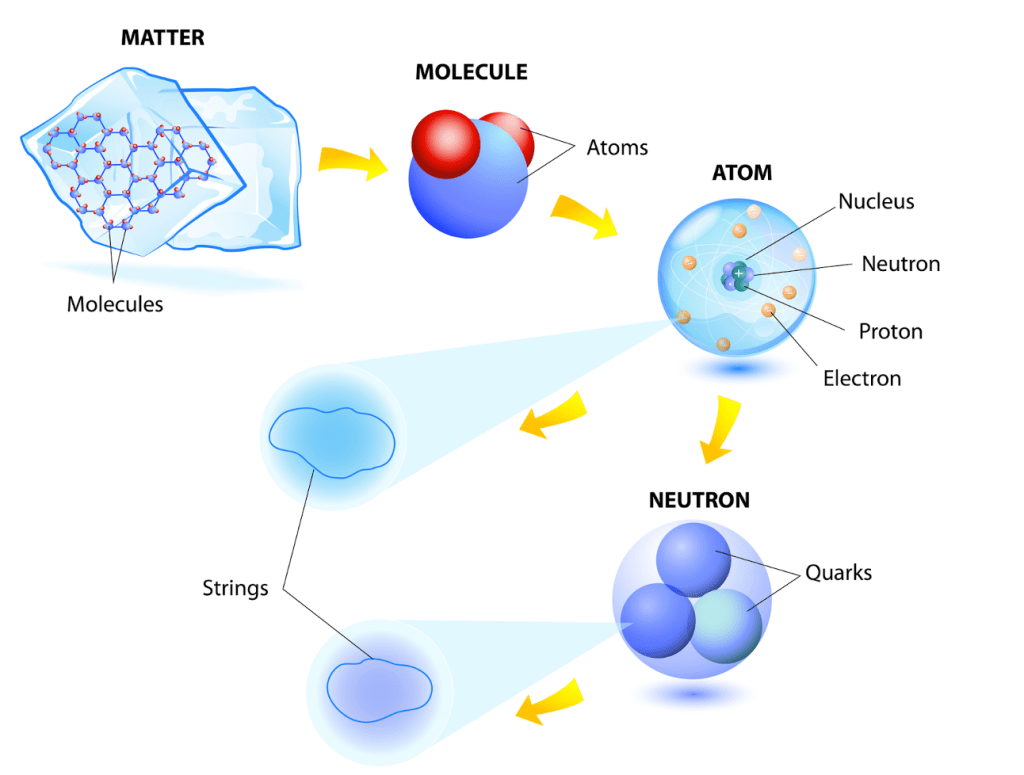
    String Theory is a very common term, but few people actually know what it means. String theory proposed that instead of the universe being made up of zero-dimensional points, it is made up of strings that vibrate. The specific vibration of these strings would determine what they would be (photon, quark, etc.). The theory aimed to unify all of these different particles and properties into one thing: the string.

    When physicists first began to work on String Theory, they found many mathematical issues, such as negative probabilities. In four dimensions, these strings don’t have enough space to produce the wide range of vibrations needed to create all the particles in the standard model.  Thus, Superstring Theory suggests that these strings are ten-dimensional objects (nine dimensions of space and one of time). A major reason why physicists were happy with string theory at the time was that it naturally predicted a particle called a ‘graviton’. This particle would have the same effect as the force of gravity. Theoretical physicist Edward Witten has commented on this by saying,

    “Not only does [string theory] make it possible for gravity and quantum mechanics to work together, but it […] forces them upon you.” (Edward Witten, NOVA, PBS)

    M-Theory is an extension of String Theory that adds one more spatial dimension. Prior to its creation, different groups of physicists had created five versions of String Theory.

    However, a true “Theory of Everything” should be one theory, not five possibilities.

    M-Theory was created as an attempt to unify these five types of string theory. The key to the development of M-Theory was the discovery of mathematical transformations that took you from one version of String Theory to another, showing that these were not truly separate theories. M-theory theorized that these different versions were just different approximations of the same theory that could be unified by adding another dimension. M-Theory’s eleven-dimensional framework allowed for the unification of these five theories alongside the theory of supergravity.

    M-Theory, similarly to Kaluza-Klein Theory, also proposes that the extra dimensions are curled up and compacted. M-Theory uses a specific geometric shape, known as a Calabi-Yau manifold, to create the physical effects we observe in our four dimensions from the other hidden seven. Calabi-Yau manifolds are a highly compact and complex type of manifold that are the foundation of M-Theory because they allow complex folding without affecting the overall curvature of our universe through a property called “Ricci-flatness”.  The Calabi-Yau manifolds also have “holes” within their shapes that are thought to connect to the number of families of particles we experience in the Standard Model. This introduces the key concept that, instead of the fundamental laws of physics just being rules, they are actually geometric properties of our universe.

    The biggest challenge that M-Theory is facing is its lack of experimental evidence. Predictions made by this model are not testable by currently available or foreseeable technology due to the high-dimensional microscopic levels required. Without making testable predictions, the theory remains just a theory for the time being.

    Despite this lack of proof, many physicists still see M-Theory as a prominent candidate in our search for a “Theory of Everything”. Its mathematical consistency and its ability to unify both gravitational and quantum effects lead to it being considered highly promising.

    However, while the math behind M-Theory is highly developed, it is not yet complete. The theory is still a work in progress as research is being conducted to better understand its structure and significance.

    Meanwhile, critics believe that M-Theory is fundamentally flawed. Many of them believe that the “Landscape” problem is a significant reason that M-Theory is untrue. The “Landscape” problem is described as the fact that the theory predicts many different universes, each with its own set of physical laws. Critics believe that this prediction proves the unreliability of M-Theory and that a true “Theory of Everything” would be applicable only to our universe.

    Overall, M-Theory has neither been proven nor disproven and remains a crucial area for future exploration.


    All references listed on Part 3.