

By Aravli Paliwal
~8 minutes
Growing up with thick, unruly curls, I rarely felt comfortable wearing my hair down at events without straightening it completely. The frizz felt impossible to tame, the ends felt rough and bushy, and even up in a ponytail, my hair still looked like it had survived a whirlwind.
Now, I’m writing this all in the past-tense, because just this week I decided to undergo a permanent Japanese hair straightening treatment. Usually, when I mention this, people fixate on the word “permanent,” followed by “but your natural hair was so pretty” or “why would you do that?” These comments don’t bother me too much because my hair looks and feels 100x better than it did previously. But what really gets under my skin is just how much time and research it took to find the right treatment option, thanks to the internet’s endless muddle of conflicting information about hair straightening.
There are a bajillion different options- Which one is right for me?
As soon as I clicked “enter” after searching “permanent hair straightening,” I was introduced to 3 different treatments that all sounded, well, exactly the same. To the untrained reader, a Japanese hair straightening treatment, Brazilian blowout, and Korean Keratin treatment sound like different countries each decided to stick their name in front of the exact same thing, but after doing a couple hours of research, it wasn’t the pros that stuck out to me- it was the cons.
Brazilian Blowout
Uterine cancer. Ovarian cancer. Leukemia. Well, it sounds like I should be showing up to the hair salon in a hazmat suit if these are the side effects- so is this actually true? Short answer- yes.
Everyone’s hair is composed primarily of Keratin, a protein structure held together by disulfide bonds (S-S) → (this determines if your hair is curly or straight to begin with) and weaker hydrogen bonds (easily broken down by water).

Unlike Japanese hair straightening treatments, Brazilian blowouts do NOT permanently break down and restructure these S-S bonds, so the straightening effect is more temporary. The straightened results typically last around 3-4 months; though, the thicker and healthier your hair is, the longer the treatment lasts. However, after treatment at the salon, the hair is never pin-straight, and throughout this 3-4 month period, your hair gradually gains its natural curl pattern back.
After thoroughly washing the hair and exposing its cuticle, Brazilian blowout stylists begin to apply a solution that includes aldehydes like methylene glycol. This is where the cancer sirens go off. When brands claim that their treatment is formaldehyde-free, what they don’t understand is that this methylene glycol releases formaldehyde when heated, and formaldehyde exposure is known to increase the risk of all the nasty cancers that Google warns you about from the beginning. The following chemical equation explains exactly how formaldehyde gas fumes are produced during Brazilian blowouts.
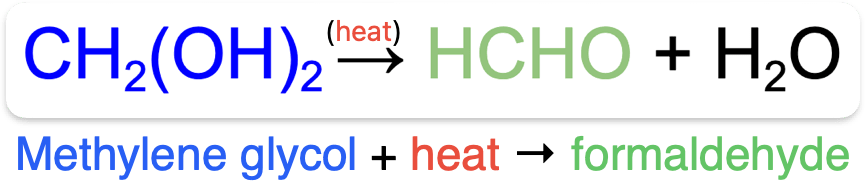
This heat is introduced when the stylist flat-irons hair at ~450°F. Instead of breaking the preexisting disulfide bonds and reforming them, the treatment adds new chemical S-S bridges that hold the hair in a straighter shape temporarily, with a carcinogenic formaldehyde byproduct.
Keratin Treatment
When researching different straightening treatments, Keratin treatments are often the most difficult to understand because there are two different techniques. In both treatments, a Keratin-based solution (primarily peptides and protein because “keratin” is literally just the protein that makes up your hair) is applied to the hair. Now after this, the stylist has two options:
- They can continue by essentially replicating the Brazilian blowout and reintroducing the carcinogenic formaldehyde after flat-ironing the hair (same 3-4 month results, never achieve pin-straight hair).
- They can go the formaldehyde-free route and only coat the hair’s cuticle in the Keratin-solution without taking further steps. This results in smoother, shinier hair with less frizz; however, this process does not chemically alter any disulfide bonds, and has practically no permanent straightening effect.
Japanese Hair Straightening
Websites like to scare people by framing Japanese straightening treatments as the “nuclear option,” with “straight hair for life” and “no room for regrets.” While it is more of a commitment than the other straightening treatments because it actually lasts no matter what hair texture you have, it is by no means “lifelong.” Furthermore, Japanese straightening is the only treatment that doesn’t produce carcinogenic formaldehyde as a byproduct, and instead uses a safer ammonium thioglycolate.
The strongly alkaline ammonium thioglycolate directly attacks disulfide bonds and completely restructures them:

This “weaker” hair is easily manipulated into the straightened shape you want, and after the solution has set, the hair is rinsed with a 0.5% hydrogen peroxide neutralizer (drugstore hydrogen peroxide used to treat cuts and wounds is around 3%). The hydrogen peroxide forms new disulfide bonds that naturally fall straight.
From this point on, many stylists begin to take “creative liberties” and begin to dump all sorts of expensive shampoos and conditioners on your hair while also warning you that the next 48 hours you cannot wash, put it in clips or ponytail holders, eat, sleep, or breathe around your hair- basically saying “if anything goes wrong in the next 48 hours, the blame is 100% on YOU.” This is why it is extremely important to have a professional stylist who is familiar with their product and takes accountability when necessary. It’s also why I am so grateful for Bijin Salon’s Michelle, who has 22 years of experience under her belt.
“With the amount of information that stylists now have readily available online, there should be no excuses for professionals not to know their products.” -Michelle
She told me straight-up that this 48-hour policy is completely made up to strip stylists of accountability: Scientifically, after the neutralizer has been introduced, there is no reason why you cannot go home and wash/put up your hair immediately. Bijin Japanese Permanent Hair Straightening is located in Farmers Branch, Texas, and you can find their website here.
While Japanese straightening sounds great, there are still a couple of things to keep in mind. As I mentioned earlier, this is definitely a commitment. Not lifelong, but if you want your natural hair back, you’re going to have to grow it out- completely. This includes the awkward stage where your roots are curly while the ends are pin straight.

Additionally, Japanese straightening requires regular maintenance. Depending on how fast your hair grows and what your curl pattern is, root touch-ups are typically needed at least once a year.
Quick Recap:
→ If you are committed to getting a hair straightening treatment, the safest and longest-lasting option is by far the Japanese treatment.
→ If you are not interested in changing your curl pattern but want softer, less frizzy hair, the formaldehyde-free keratin treatment is for you.
General Things to Check for:
- Watch out for sodium hydroxide (the main chemical in drain cleaner) → it’s a strong base commonly used to raise pH levels in popular haircare. When overused, it can force the hair’s cuticle open and permanently damage keratin structure. Brands rely on it because if a product’s pH drops too low, preservatives fail, and the product’s shelf life is severely compromised. So while sodium hydroxide is often necessary, because concentrations are not disclosed, it’s important to pay attention to how your hair feels after using products that contain it.
- The word “straightener” is often used too loosely when describing a wide array of retexturing treatments, leading many people to conflate straighteners with smoothers and relaxers. In reality, the difference is quite simple. Straighteners use a thioglycolate solution, while smoothers either coat the hair with chemical (like a Brazilian Blowout), or use glyoxylic acid after a sodium hydroxide shampoo. Relaxers, on the other hand, and purely sodium hydroxide.
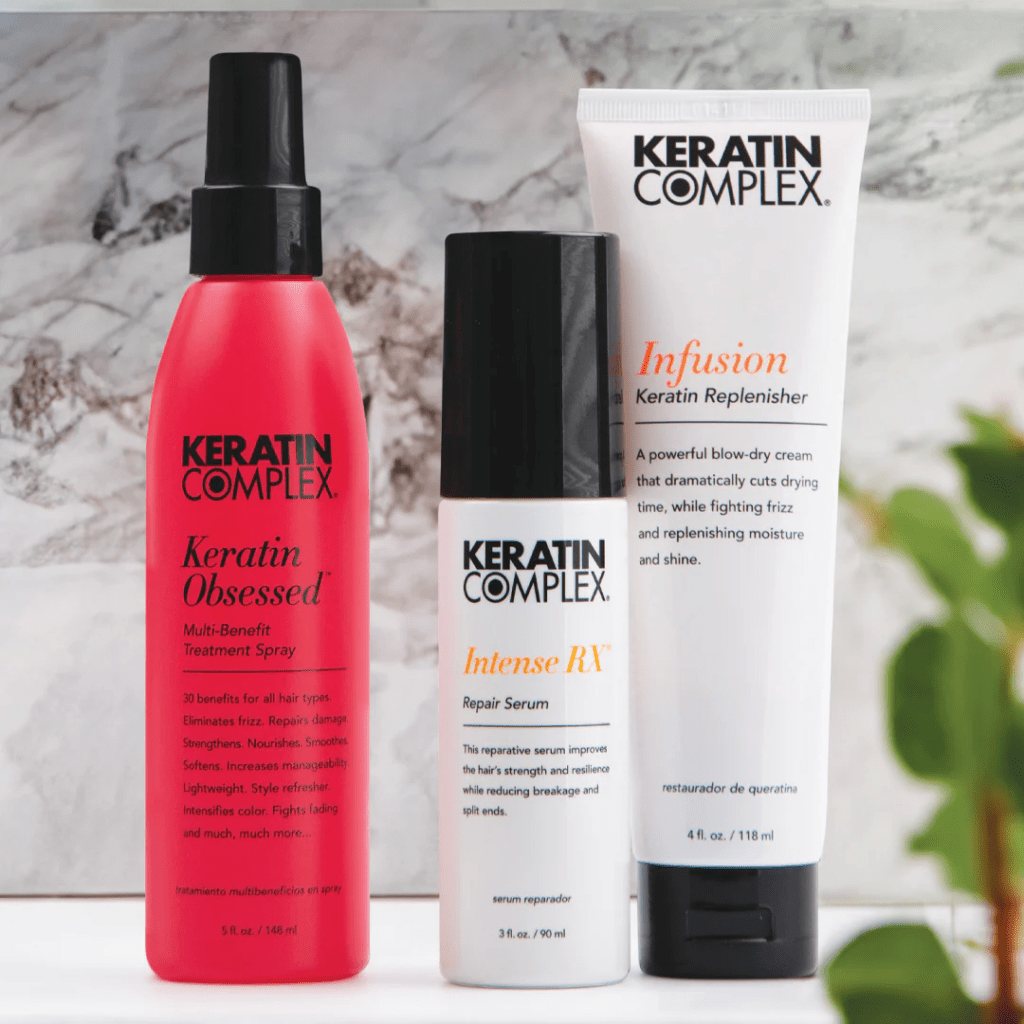
- “Keratin” products are largely a scam → theoretically, any hair product could be labeled “keratin” because keratin is simply what hair is made of; adding trace amounts of keratin to a product does not rebuild or restructure hair, it just temporarily coats it and doesn’t really do anything at all. Claims that keratin products are “so good for your hair’s health” are usually marketing schemes.
References
American Council on Science and Health. (2018, April 21). What do perm chemicals and cystic fibrosis drugs have in common? Retrieved from https://www.acsh.org/news/2018/04/21/what-do-perm-chemicals-and-cystic-fibrosis-drugs-have-common-12844
Color Wow. (n.d.). What is a hair cuticle? Retrieved from https://colorwowhair.com/blogs/all/what-is-a-hair-cuticle?srsltid=AfmBOopre5yB2FbyrucIX1A8_PbEIOOv2a6kudPZy7hQXLzsh-_6QXL9
Gavazzoni Dias, M. F., de Almeida, A. M., Cecato, P. M., Adriano, A. R., & Pichler, J. (2014). The Shampoo pH can Affect the Hair: Myth or Reality?. International journal of trichology, 6(3), 95–99. https://doi.org/10.4103/0974-7753.139078
Keratin Complex. (n.d.). 3 must-have hair products for the new year. Retrieved from https://keratincomplex.com/blogs/post/3-must-have-hair-products-for-the-new-year?srsltid=AfmBOoqDHCEha9yxfLvtUsxkvIr6Ys7J_-UcCwugTrzZRUZ6qnSPLDJu
National Center for Biotechnology Information. (2021). Straight to the point: What do we know so far on hair straightening? International Journal of Cosmetic Science. Retrieved from https://pmc.ncbi.nlm.nih.gov/articles/PMC8280444/
Occupational Safety and Health Administration. (n.d.). Hair salons and stylists: background on hair smoothing products that could release formaldehyde. Retrieved from https://www.osha.gov/hair-salons/background
The Times of Israel. (n.d.). 17-year-old girl hospitalized for kidney failure after hair-straightening treatment. Retrieved from https://www.timesofisrael.com/liveblog_entry/17-year-old-girl-hospitalized-for-kidney-failure-after-hair-straightening-treatment/
Also, a special thank you to Michelle Moore at Bijin Salon, whose expertise offered valuable insight into the realities behind modern haircare!


 Youth Stemline