About

Tag: energy

  • The Pinnacle of Motorsport: F1’s Sustainable Future

    The Pinnacle of Motorsport: F1’s Sustainable Future

    By Aniela Coughlin

    ~ 7 minutes


    Formula 1 has been given many names. From the “Pinnacle of Motorsport” to the “Motorsport soap opera,” its high stakes and thrilling speeds have earned it many nicknames. Most recently, Formula 1 has also been dubbed a “tech lab on wheels”.1 This nickname is well-deserved, as the innovations brought to F1 in order to make the cars quicker or more efficient often carry over into every-day road vehicles. One example of this is the carbon-fibre monocoque chassis introduced by McLaren in 1981. This light but durable material is now ubiquitous; it is the basis of almost every supercar and is used in everything from spacecraft to golf clubs. This leads us to reflect on just how much Formula 1 has influenced our daily lives, and how different our world would be today without it. For decades, Formula 1 has served as a model for elite performance in road vehicles and has sparked a passion for engineering in many people.

    Ferrari drivers Sainz and Leclerc shake down new F1-75 car at Fiorano / F1

    But with this attention comes a great responsibility for Formula 1. It must set the standard toward which the rest of the automobile industry strives. With global warming becoming an increasingly pressing issue in the global community, Formula 1 must find ways to keep racing at high speeds that are also sustainable for our environment. In 2026, Formula 1 seeks to radically change its regulations in order to reach its goal of going 100% carbon neutral by 2030.2 What do these new regulations mean for the sport, and, most importantly, what do they mean for us? 

    The new 2026 regulations encompass a wide variety of details, from aerodynamics to tyre size, and everything in between. Most of these will not have a tremendous impact on everyday road cars, as these regulations are focused more on getting these supercars to be even more “super”. One major change that does impact standard vehicles, though, is the new fuel regulations. Formula 1 cars use a hybrid of electric and hydrocarbon-fueled energy. Each of the (soon to be) eleven Formula 1 teams outsources their fuel to a third party. Ferrari famously partners with Shell, for instance, and Aston Martin works with Aramco. Throughout 2025, the petrol used in Formula 1 cars had to be ten percent bioethanol, a green alcohol fuel derived from biomass. But this requirement goes away in 2026, when the teams will have to supply their cars with 100% sustainable fuels.3 This means that no fossil carbons may be used, and the teams must produce net-zero carbon cars: they will have to extract carbon from pre-existing sources, instead of adding more into the atmosphere.

    What does this look like? Well, air-capture technologies for carbon already exist, but these are inefficient since only 0.04% of the air is carbon dioxide. Teams are instead looking toward non-food bio sources of carbon, such as excess from the wood or paper industries, or municipal waste. A caveat to this, however, is that they cannot compete with existing food sources. In an interview about Formula 1’s sustainable fuel plans, F1’s chief technology officer Pat Symonds explains,

    “You can make this fuel out of potato peelings, but not out of potatoes.

    Sustainable fuels are, ironically, still not financially sustainable options for “layman” car manufacturers. 100% sustainable fuel is much more expensive to produce than standard fossil fuels, which cost about $63 per barrel compared with the $300 for the sustainable fuel. Add that to the cost of experimenting with and researching new technologies, and you are looking at a budget that far exceeds what the average car manufacturer can afford. This is why Formula 1 is the optimal test hamster for sustainable technologies: its teams deal with huge budgets, which are designed to be spent on innovative technologies. Plus, in Formula 1, the goal is to produce the most efficient and high-performing car possible, not the cheapest. With some luck, these innovations in the way carbon fuels are sourced in Formula 1 will trickle down into the “real world.” 

    Another major change to occur in 2026 is the removal of the MGU-H unit. This component is part of the Energy Recovery System on an F1 car, along with the MGU-K and the energy store. The energy store is essentially a large lithium-ion battery that stores energy recovered from breaking or excess exhaust. The MGUs (Motor Generator Units) act as both motors and generators, depending on what the car necessitates. This works because providing energy to the motors causes them to spin, and spinning the motors causes them to generate energy. The MGU-K (Motor Generator Unit Kinetic) works alongside the car’s engine to provide extra power to the car. It harvests excess energy from braking, when the MGU-K is spinning solely due to the rotational energy of the wheels, and the still-rotating magnets inside the motor provide energy to the battery for later use. The MGU-H (Motor Generator Unit Heat), to be removed in 2026, supplies the same energy storage system. It works alongside the turbocharger so that when exhaust gas passes through the generator turbine of the MGU-H, the turbine spins, transforming kinetic energy into electric energy. The MGU-H can also supply electric energy to the turbocharger, and thus eliminate turbo lag in the engine.5
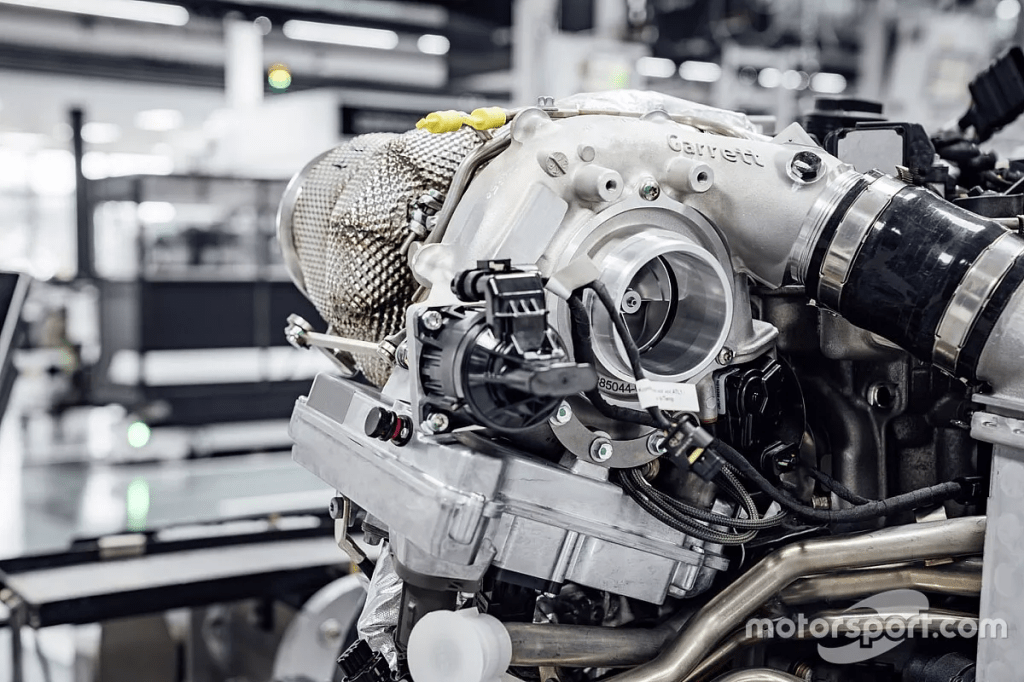
    Mercedes reveals first use of F1’s MGU-H in road cars / motorsport

    The MGU-H does serve a purpose, but only in the context of Formula 1. Everyday road cars do not travel at fast enough speeds to require a component to diminish turbolag; in fact, most hybrid cars do not have a turbocharger at all. This, coupled with the fact that the MGU-H is incredibly expensive to produce, is why the MGU-H will be removed from F1 cars in 2026. 

    But with the switch to a 50/50 ICE-electric engine in 2026, F1 cars still need an energy recovery system to boost performance and efficiency. The MGU-K is much more affordable to produce than the MGU-H because it is mechanically simpler. To compensate for the loss of the MGU-H, the MGU-K output nearly triples in 2026, with a jump from 120 kWh to 350 kWh. The impacts of this on the “real” world are that now everyday road cars have a realistic exemplar of what an efficient hybrid car looks like, and can look to F1 cars to minimize their carbon footprint. 

    Formula 1 is more than just a sport. At the pinnacle of speed, its cars are the role models for the maximized efficiency and performance to which most cars aspire. F1 cars have the responsibility to set the example for others by reducing their carbon footprint, and this is just what the 2026 regulations aim to do. With the implementation of 100% sustainable fuel and increased reliance on electrical power, Formula 1 is pioneering technologies that have the potential to lead the world to a more sustainable future. 


    Bibliography

    Explained: The chemistry behind F1’s sustainable fuel future.” Race Fans, 25 March 2023, Explained: The chemistry behind F1’s sustainable fuel future · RaceFans. Accessed 15 November 2025. 
    “FIA unveils Formula 1 regulations for 2026 and beyond featuring more agile cars and active aerodynamics.” FIA, 06 June 2024, FIA unveils Formula 1 regulations for 2026 and beyond featuring more agile cars and active aerodynamics | Formula 1®. Accessed 15 November 2025. 
    “Formula One Isn’t Just Racing – It’s A Tech Lab On Wheels.” DCB Editorial, 26 August 2025, Formula One Isn’t Just Racing-It’s A Tech Lab On Wheels. Accessed 09 November 2025. 
    “The game-changer in F1’s 2026 fuel evolution.” The Race, 17 September 2025, The game-changer in F1’s 2026 fuel revolution – The Race. Accessed 23 November 2025.
    “What Is ERS In F1? (How The MGU-H And MGU-K Work).” Flow Racers. Accessed 23 November 2025.

  • The Green Price of Intelligence

    The Green Price of Intelligence

    By Summer Chen

    ~ 6 minutes


    Over the past three years, a rush of excitement has emerged globally regarding artificial intelligence. In a student’s everyday life, discussions about artificial intelligence arise frequently- whether about the potential benefits of generative AI, using ChatGPT on homework assignments, or seeing AI’s growing presence on social media platforms like TikTok. 

    Claims that AI holds significant potential in the development of society and technology are impossible to ignore, with AI occupying numerous sectors seen throughout daily life. In fact, when I began writing this article, even clicking enter on a google search titled “Impact of AI on climate change” immediately caused an AI overview to pop up unprompted.  

    AI generated images / The Economic Times India ©

    While the environmental repercussions of AI usage cannot be ignored, to deny the multitude of potential benefits from artificial intelligence would be absurd. Instead, it makes more sense that the use of (mostly generative) AI for recreational purposes is the issue– hundreds of thousands of people contribute to this environmental impact, not realizing that even a short prompt into ChatGPT has been proven by the International Energy Agency to equate to 4-10x the amount of energy that just one Google search consumes.

    There are four key problems attributed to why AI can cause widespread harm to our environment. First, the mining required to extract critical minerals and rare earth elements for the microchips that power AI is incredibly destructive to the environments where these resources are found. Navigating New Horizons confirms this, stating,

    “[The minerals and elements] are often mined unsustainably”.

    The second is that AI servers are held in data centers which produce a shocking amount of electronic waste. They also contain hazardous substances such as mercury and lead, according to the United Nations Environment Program (UNEP). This is harmful because when they are (often) disposed of improperly, the wildlife, soil, air, and water around it are contaminated. 

    Thirdly, these AI data centers use preposterous amounts of electricity and energy, due to advanced technology seen in these models. Therefore, the energy used in most of these data centers comes from fossil fuels which produce greenhouse gases that further contribute to global warming. Research by the University of Nottingham shows that by 2026, AI data centers will likely account for nearly 35% of Ireland’s energy consumption. Added effects to climate change are something that we simply can’t afford currently, with the already increasing rate of rising global temperatures.  

    Pollution due to Elon Musk’s AI data center in Memphis / NAACP ©

    Finally, and most of all, data centers consume a colossal amount of water, not only to construct but also to cool electrical components of AI. Chilled water absorbs heat from computing equipment. This water does not return to the water cycle; most of it is gone forever when used to cool these heated data centers. The centers use mechanical chillers which carry heat away from the servers, releasing it through a condenser, and so the water becomes water vapor where it does not cycle back through treatment systems like in a typical household. Even though some of it returns as rainfall, a majority of vapor in the air cannot be recovered. Not only this, but data centres are often located near locations which are already prone to droughts, which gives the inhabitants of this area even less access to water. This is a huge problem when a quarter of humanity already lacks access to clean water and sanitation. MIT News tells us that for every single kilowatt hour of energy a data center consumes, it would need two entire liters of water for cooling. It is an atrocity to restrict so much life from access to clean water and instead use it on generating ‘a cartoon version of me’ or asking ChatGPT to write a quick email that could be written by the individual in just two minutes instead.  

    The impacts of these contributors on climate change are immense. It also doesn’t help that generative AI models have an extremely short shelf-life as AI companies such as ChatGPT and DeepSeek consistently deliver new models, provoked by rising demand for new AI applications. So, the energy used to train previous models goes to waste every few weeks, and new models use even more energy because they are more advanced than the previous ones. Sure, one person using Perplexity AI doesn’t do much to the environment, but if everyone follows this logic, the large scale of people using AI results in terrible repercussions.

    On the other hand, popular articles repeat that because “500ml of water are used for every 20-50 ChatGPT prompts, not every prompt”, the amount of energy that ChatGPT uses is not that significant. However, like govtech.com states, even if 500ml sounds small, combined with the 122 million people who use ChatGPT daily, this is a lot of water that is wasted for purposeless reasons. AI’s energy use has exploded only because AI has exploded. It is not that each prompt uses a significant amount of energy, but that AI has had an explosive growth being the quickest adopted technology ever, therefore the energy adds up to be significant through the sum of people using AI. 

    As a society, we have to acknowledge that even though AI provides us an abundance of opportunities and ideas for our modern world, we must not forget the consequences to the already declining environment that overuse brings. We should take into consideration that life would most likely not be worse without generative AI for the average person. We should take into consideration that the tradeoff of mindless entertainment and having ChatGPT search for basic facts is worth a better chance at restoring our Earth. And ultimately, we should simply refrain from using AI for recreational reasons unless the purpose is absolutely urgent and necessary.  


    References

    After Ghibli art trend, Barbie Box Challenge breaks the internet: How to create your ai doll avatar?. The Economic Times. (n.d.). https://economictimes.indiatimes.com/magazines/panache/after-ghibli-art-trend-barbie-box-challenge-breaks-the-internet-how-to-create-your-ai-doll-avatar/articleshow/120257077.cms?from=mdr
    Elon Musk’s Xai threatened with lawsuit over air pollution from Memphis Data Center, filed on behalf of NAACP. NAACP. (2025, June 17). https://naacp.org/articles/elon-musks-xai-threatened-lawsuit-over-air-pollution-memphis-data-center-filed-behalf
    GovTech. (n.d.). About Us. GovTech. https://www.govtech.com/about 

  • The Fall of the Big, Bad Boiler: The Latest Climate Technology Infiltrating New York City

    The Fall of the Big, Bad Boiler: The Latest Climate Technology Infiltrating New York City

    By Montserrat Tang

    ~ 9 minutes


    The Hot Hell of Boilers

    As someone born and raised in New York City (NYC), I can attest to the urgent need to upgrade the city’s climate control infrastructure. Current systems are outdated and hinder the city’s ability to meet emissions goals and address global warming; the encapsulation of this problem is the boiler. A staggering 72.9% of heating in NYC comes from fossil-fuel-burning steam boilers, one of the most carbon-intensive options available. Tenants of apartments pay for the maintenance of centralized boilers without control over the temperature, leading many to open their windows in winter to release excessive warmth. This heat and the fossil fuels used to produce it are wasted, highlighting the inefficiency and impracticality of NYC’s existing infrastructure. 

    Industrial boiler room / Controlled Combustion ©

    Even when this heat remains indoors, steam boilers are only about 80-85% efficient at burning fossil fuels. Up to a fifth of a boiler’s fuel does not generate usable heat, but burning it still releases vast quantities of pollutants like CO2, exacerbating climate change. Furthermore, boilers continue to lose efficiency during their lifetimes and require frequent maintenance and replacement. While steam boiler systems were revolutionary in the 19th century, they may now become obsolete as NYC implements a technology that could change how the world thinks about climate control.

    The Cool(ing) Mechanics of Heat Pumps

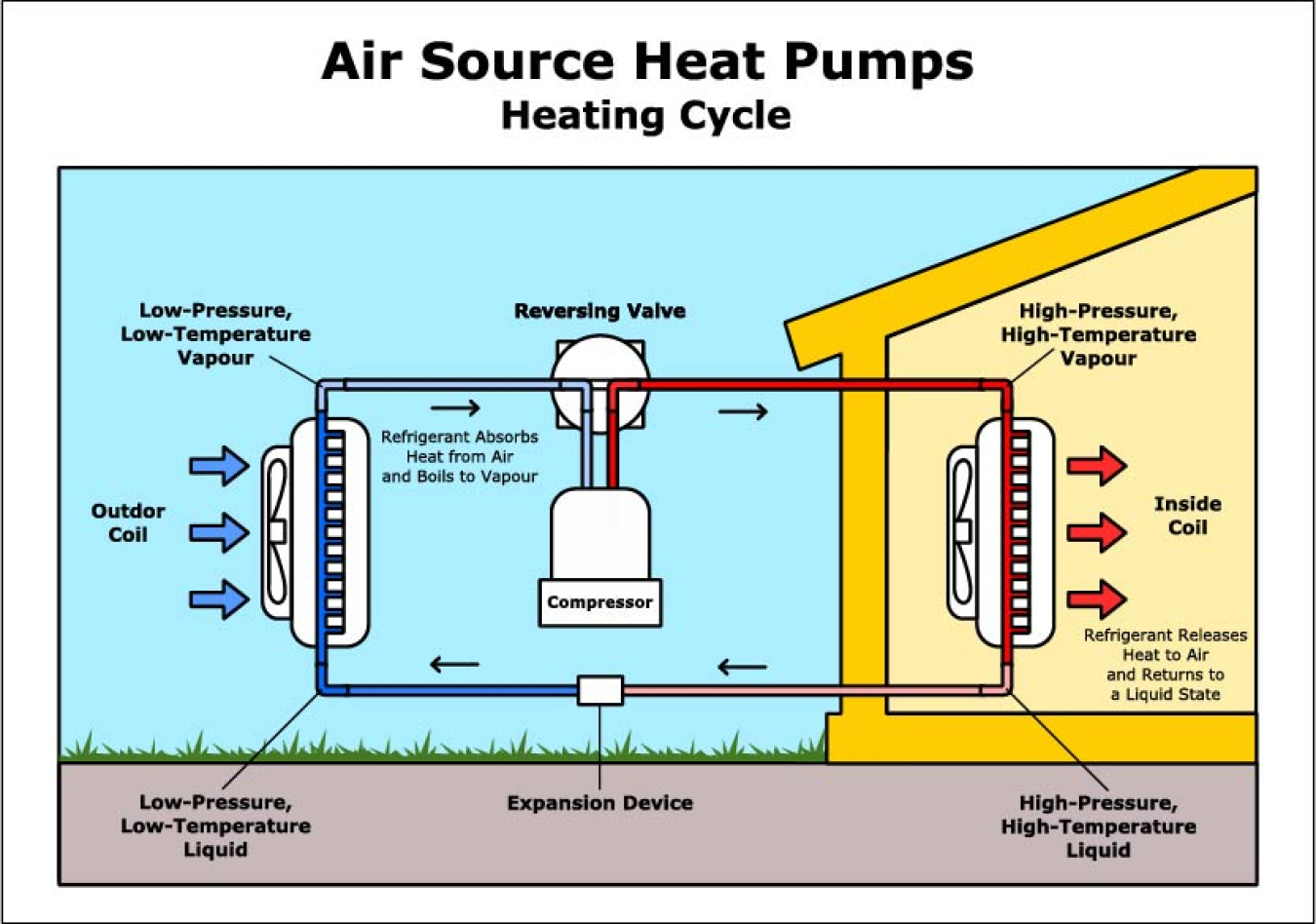
    Mechanics of an air source heat pump / U.S. Department of Energy ©

    The innovation behind heat pumps comes from the mantra of use what is given; instead of generating heat through combustion, they simply move existing warmth between two places. Most of these fully-electric pumps remain functional well below 0℃, even though it may seem like there is no warmth to be moved. This operative capacity allows them to have heating efficiencies of 300-500%! Because of this, International Energy Agency partner Yannick Monschauer estimates that “Heat pumps could bring down global CO2 emissions by half a gigaton by the end of this decade.”

    Heat pumps work by operating on the Second Law of Thermodynamics (SLOT), which states that heat will move from a hotter object to a colder one. In the wintertime, the pumps pull in outdoor air and blow it over fluids (called refrigerants) held in a closed-loop system. The air transfers warmth to the cold refrigerants through SLOT, and the heated fluids turn into gas. Heat pumps can work in freezing temperatures because these refrigerants have such unusually low boiling points, allowing them to vaporize easily; one of them, Refrigerant 12, has a boiling point of just -21.64°F!

    The hot, gaseous refrigerants move into a compressor that compacts their molecules, making them even warmer. They then flow through a coil that exposes them to indoor air, and the refrigerants release their warmth inside through SLOT. As the refrigerants cool, they condense back into liquid and pass through an expansion valve, decreasing their temperature further. They move to an outdoor coil and are ready to restart the process, continuing to warm cold homes during the winter.

    Even more significantly, heat pumps have reversing valves that switch the flow of their refrigerants. These valves allow the pumps to cool homes by pushing out warm, indoor air in the summertime. Thus, heat pumps make air conditioners, boilers, radiators, and related piping unnecessary, freeing space and alleviating material and labour costs that typically get passed on to homeowners. 

    Heat pumps in NYC

    In 2024, NYC pledged to have heat pumps provide 65% of residential heating, air conditioning, and water-heating needs by 2030. This shift would drastically reduce the city’s carbon emissions from the climate control sector, which contributed to 10% of global energy-related CO2 emissions in 2021.

    This pledge is logical both environmentally and practically: having one heat pump replace two systems saves valuable space, lowers costly installation and maintenance fees, and reduces energy demands. The NYC government realized this potential and signed a $70,000,000 contract to install 30,000 window heat pumps in NYCHA buildings, better known as public housing. Two heating companies, Midea and Gradient, will provide these units.

    In late 2023, Gradient installed 36 preliminary test units in NYCHA buildings. Most NYC steam boilers, including those in NYCHA’s current system, are powered by gas with oil reserves in case of an emergency. Gradient found that their pump can lower tenants’ heating bills by 29-62% on moderate winter days compared to gas-powered boilers. Savings are as high as 59-78% compared to oil-burning boilers. In testimonials that Gradient collected, NYCHA tenants noted the heat pumps’ impressive air filtration, heating, and operational capabilities. Midea conducted similar tests and soon plans to release its heat pump for public purchase.

    The Cold Drawbacks of Heat Pumps

    Although technological faults remain, NYC is continuing its plans to install and promote heat pumps to replace its intensive, outdated systems. For one, Midea’s upcoming pump will cost ~$3,000 per unit, greatly exceeding the combined price of ~$460 for their bestselling, single-room heating and cooling systems. This is a misleading comparison, however, because heat pumps also act as heating systems. The technology can lower electricity and fuel bills over an extended period, but the current price point makes heat pumps an unaffordable investment for many households – despite government subsidies and incentives. Even the NYC government’s bulk order of Midea and Gradient pumps averages over $2,300 per unit.

    Furthering the inaccessibility of these systems, the most advanced, aesthetically pleasing, and apartment-friendly heat pumps can only heat and cool individual rooms. This means that multiple units must be purchased, installed, and powered to service a home, and each must be replaced about every 20 years. Still, NYC’s firm stance on heat pumps indicates the climate control systems’ proven efficacy, practicality, and sustainability.

    Heat Pumps Globally, and Plans for the Future

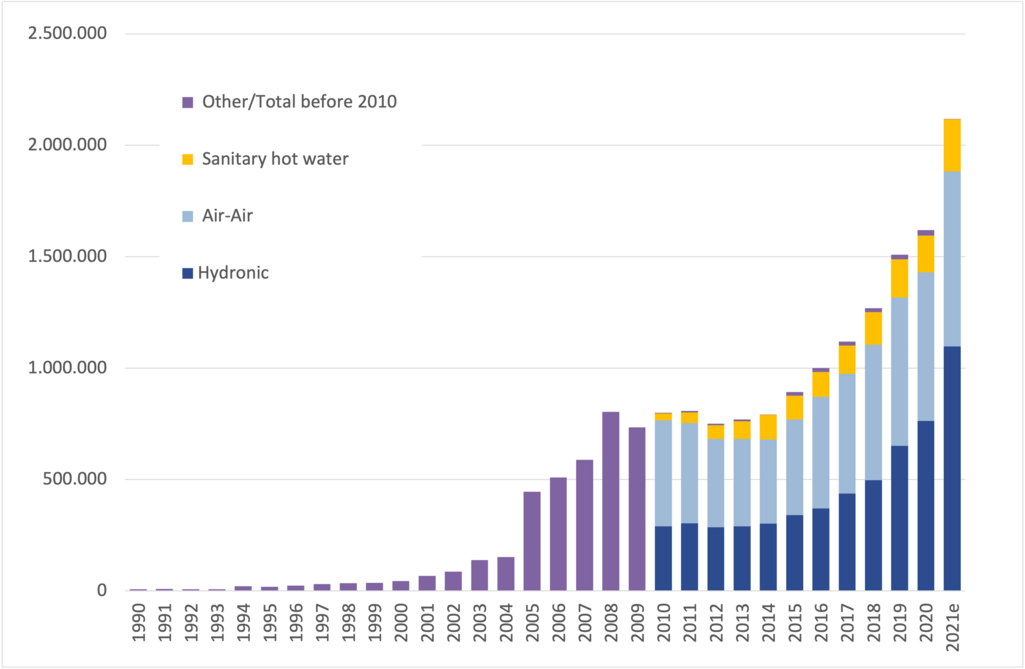
    While technological challenges remain, NYC is continuing to deliver on its pledges. This decision on heat pumps is being made throughout the United States (US). In 2022, heat pump sales in the US significantly outpaced those of gas furnaces (a type of central heating system particularly popular in North America). This lead has continued into 2025 as more people realize that the pumps can lower fossil fuel emissions and energy bills.

    This switch is not just happening in the US; countries worldwide are beginning – or continuing – to invest in these pumps. Sales in European countries have soared in the 21st-century, an accomplishment partly attributed to friendly government policy. The country with the most pumps relative to its population, Norway, has 632 heat pumps installed for every 1,000 households (the majority of these pumps service entire houses, unlike the Midea and Gradient systems discussed above). Despite this high ownership rate, 48 pumps were purchased in Norway for every 1,000 households in 2024.

    1990-2021 Heat pump sales in Europe, by technology / European Heat Pump Association ©

    In spite of these promising statistics, heat pump sales in most economies have either slowed or slumped in recent years – particularly in Europe. Analysts suspect this is due to high interest rates, rising electricity prices, low consumer confidence, and low gas prices. While this is discouraging, pump sales and ownership rates remain higher than they were several years ago.
    In 2023, New York Governor Kathy Hochul pledged to help the U.S. Climate Alliance (USCA) install 20,000,000 pumps across the U.S. The USCA is a coalition of 24 governors representing 54% of the United States population and 57% of its economy. The bipartisan group has successfully delivered on their promises of emissions reduction, climate resilience, economic growth, energy savings, and zero-carbon electricity standards that heat pumps are engineered to meet. 

    This coalition has proved that environmental action is popular, necessary, and possible. At a time when climate policy is under question, sustainable and feasible technologies – like heat pumps – need the investment of citizens, industries, and governments alike; no matter how small the scale.

    So, how can you help? Since 2022, the US government has given a federal tax credit to citizens who install efficient heat pumps. The Energy Efficient Home Improvement Credit provides eligible homeowners up to $2,000 annually. Combined with other energy-efficient credits, US citizens can regain up to $3,200 every year. These monetary incentives offer another reason to consider switching to heat pumps, and similar policies are being enacted worldwide.

    I am proud to live in a city that rewards and encourages the sustainability of citizens, corporations, and public works. As the severity and irreversibility of global warming loom, heat pumps offer us a breezy solution to polluting climate control systems. Eventually, NYC’s infamous boiler rooms and clanging pipes may become relics of the past.


    References

    About Us. (n.d.). United States Climate Alliance. https://usclimatealliance.org/
    Azau, S. (2025, July 3). Heat pump sales 14 times greater in lead countries. European Heat Pump Association. https://www.ehpa.org/news-and-resources/press-releases/heat-pump-sales-14-times-greater-in-lead-countries/
    Bray, T. (2021, October 7). How Do Heat Pumps Work? | Heat Pumps Explained. YouTube. https://www.youtube.com/watch?v=iQaycSD5GWE
    DeJong, K. (n.d.). The Difference Between Heat Pumps and Air Conditioners – Comparing Heat Pump Mini Splits with Cooling Only Systems. eComfort. Retrieved July 31, 2025, from https://www.ecomfort.com/stories/1310-Comparing-Heat-Pump-Mini-Splits-with-Cooling-Only-Systems.html
    Demir, H., Ulku, S., & Mobedi, M. (2013, August). A review on adsorption heat pump: Problems and solutions. ResearchGate. https://www.researchgate.net/publication/223303816_A_review_on_adsorption_heat_pump_Problems_and_solutions
    Ferrell, M. (2024, May 28). How does an air conditioner actually work? – Anna Rothschild. YouTube. https://www.youtube.com/watch?v=6sSDXurPX-s
    Ferrell, M., & Natividad, S. (2024, June 11). Why This Window Heat Pump Is Genius. Undecided. https://undecidedmf.com/why-this-window-heat-pump-is-genius/
    Gradient Transforms Public Housing HVAC at NYCHA. (2024, June 3). Gradient. https://www.gradientcomfort.com/blogs/news/how-gradient-is-transforming-public-housing-with-innovative-window-heat-pumps
    Heat pump. (2025, July 31). Wikipedia. https://en.wikipedia.org/wiki/Heat_pump
    Midea Packaged Window Heat Pump. (n.d.). Midea HVAC. Retrieved July 31, 2025, from https://www.mideacomfort.us/packaged.html
    New York City Climate Dashboard: Energy. (2024). NYC Comptroller. https://comptroller.nyc.gov/services/for-the-public/nyc-climate-dashboard/energy/
    New York State. (n.d.). Efficient and Emission-Free, Heat Pumps Are Gaining Popularity in New York and Beyond. New York State Energy Research and Development Authority. https://www.nyserda.ny.gov/Featured-Stories/US-Heat-Pump-Sales
    New York State. (2023). Recapping Climate Week 2023. New York State Energy Research and Development Authority. https://www.nyserda.ny.gov/Featured-Stories/Recapping-Climate-Week-2023
    New York State. (2023, September 20). Governor Hochul Announces Installation of Window Heat Pumps for New York City Public Housing Residents. Governor Kathy Hochul. https://www.governor.ny.gov/news/governor-hochul-announces-installation-window-heat-pumps-new-york-city-public-housing
    New York State & ENERGY STAR. (2024). 2024 ENERGY STAR Products Partner Meeting. New York State Energy Research and Development Authority. https://cdn.shopify.com/s/files/1/0558/4925/5070/files/NYSERDA_Room_Heat_Pump_Presentation_from_2024_ENERGY_STAR_Product_Partners_Meeting.pdf?v=1736361913United States Government. (2025, May 29). Energy Efficient Home Improvement Credit | Internal Revenue Service. IRS. https://www.irs.gov/credits-deductions/energy-efficient-home-improvement-credit

  • Perovskite Based Photovoltaic Paint

    Perovskite Based Photovoltaic Paint

    By Katherine Mao

    ~ 9 minutes


    Imagine a world where every surface—the walls, the roof of your car—harnesses the sun to power your surroundings. Not with stiff, bulky solar panels, but with something as simple and inconspicuous as paint.

    Thanks to new and evolving technology, this vision inches closer and closer to reality. Perovskite-based photovoltaic paint is a developing technology with the potential to turn any paintable surface into a solar panel.

    What are Perovskites?

    Perovskites are a class of crystalline materials with the structural formula ABX₃. ABX₃ means that perovskites have a Large Cation(A), a Smaller Cation(B), and an Anion(X₃, often a halide). Their unique structure makes them incredibly efficient at converting sunlight into electricity, with recent developments reaching over 25% efficiency (25% of energy from the sun was converted into electricity), while traditional solar panels usually have 15-25% efficiency. 

    The Parts of Perovskite Solar Paint:

    Perovskite-based solar paint must be applied in multiple layers. The six main layers, in order, are: the transparent conductive layer (front/top electrode), electron transport layer, perovskite absorber layer, hole transport layer, back electrode, and substrate.

    The transparent conductive layer functions as the front electrode. It must be transparent, to allow sunlight to pass through, and conductive, to carry the extracted electrons.

    Next is the electron transport layer, which extracts and transports electrons from the perovskite layer to the electrode and prevents holes from moving in the wrong direction.

    The perovskite absorber layer is located at the center and is made of a perovskite compound that absorbs sunlight to create electron-hole pairs (excitons). It acts as the photoactive layer where sunlight is converted into electricity.

    The hole transport layer lies below, which extracts and transports holes (the positive charges) to the back electrode and blocks electrons from going backward, aiding in charge separation.

    The back electrode then collects the holes and completes the electrical circuit, allowing current to flow through an external device.

    Finally, the substrate is the surface being painted (can be glass, plastic, metal, etc.) and provides structural support.

    How Perovskite Solar Paint Works:

    Sunlight first hits a perovskite layer, and the perovskite material absorbs photons. This excites electrons from the valence band to the conduction band, creating electron-hole pairs (excitons). In perovskites, excitons require little energy to separate into electrons and holes, which improves efficiency. Electrons are pushed toward the electron transport layer and holes toward the hole transport layer. The front and back electrodes collect the charges, and because oppositely-charged electrons and holes are separated and collected on different sides, a voltage builds up between the two electrodes. When the painted solar surface is connected to a circuit, the voltage drives electrons through the wire, powering a device or charging a battery.

    A Game-Changer for Clean Energy

    Perovskite-based photovoltaic paint could radically transform the solar energy industry. Unlike traditional silicon, which requires high temperatures and vacuum conditions for production, perovskite materials are cheap and efficient. Perovskite paint can also be applied to a wide variety of surfaces, allowing homeowners to harness solar power in places where solar panels are impossible.

    The Challenges to Implementation

    As promising as perovskite solar paint is, several significant challenges stand in the way of widespread implementation. Current perovskite materials are highly sensitive to moisture, heat, and UV light, meaning they degrade quickly outdoors. While silicon panels can last 25 years or more, early perovskite prototypes can lose efficiency after months or just weeks. Researchers are working on protective coatings and new formulations to address this, but achieving long-term durability remains a hurdle. Most high-efficiency perovskite formulas also contain lead or other toxic heavy metals, raising concerns about environmental contamination and safe handling.

    Efforts to develop lead-free perovskites are ongoing (tin being a promising alternative), though they currently offer lower efficiency and a shorter lifespan. While perovskite solar paint and panels work well in laboratory settings, scaling up to commercial production is complex. A uniform coating that ensures proper perovskite crystallization must be applied over large areas, and surfaces must be treated to ensure adhesion and conductivity. In addition, regulatory bodies are still developing safety and performance standards for perovskite technologies. Gray areas remain about how these materials will be certified/recycled at the end of their lifespan.

    Global Progress and Investment

    In the U.S., the Department of Energy recently allocated over $40 million to perovskite R&D, focusing on improving durability and scaling up production methods. Startups like SolarPaint, Oxford PV, and Saule Technologies compete to bring the first market-ready products to consumers, while well-known companies like Mercedes-Benz seek to implement solar paint in their newest vehicles.

    Conclusion

    Perovskite-based photovoltaic paint is still in the early stages, but it represents one of the most exciting frontiers in renewable energy. If challenges like stability and toxicity can be solved, any painted surface could soon become a power source. Keep an eye on your walls—they might power the world someday.


    Glossary

    Valence Band:

    • The highest range of electron energies where electrons are normally present at low energy (ground state)
      • Valence electrons reside in the valence shell of atoms
      • In any given material, atoms are packed closely together so their valence shells overlap and form the valence band
    • Electrons here are bound to their atoms and don’t move freely.

    Band Gap:

    • The energy gap between the valence band and conduction band.
    • Electrons must absorb enough energy (like from sunlight) to jump across this gap.
    • The larger the gap, the more energy it takes to jump across, and the less conductive a material is
      • Semiconductors like perovskites have a small gap(1-2 electron volts) and can conduct electricity if energy is added(sunlight)

    Conduction Band:

    • The higher energy band where electrons are free to move through the material.
    • Electrons in this band can carry electricity.

    Electron-hole pairs:

    When a photon(light) hits the perovskite, it transfers energy to an electron, exciting it from the valence band to the conduction band.

    • The excited electron in the conduction band moves freely and can conduct electricity.
    • The “hole” is the spot the electron left behind—a positive charge in the valence band.
    • There is now an electron-hole pair

    Exciton:

    • An exciton is the state where an electron and a hole are bound together, still attracted to each other by opposing charges
    • Formed right after light absorption, before the electron fully separates from the hole/jumps to the conduction band.
    • Neutral overall, so they don’t conduct electricity until they break apart.
    • Common in some perovskites 

    Front and Back Electrode:

    • They collect and transport electrical charges (electrons and holes) generated by sunlight. 
    • They’re like the “wires” of the solar paint that let electricity flow out into a usable circuit.
    • Front electrode: Lets light in and collects electrons or holes(depends on design, usually electrons)
    • Back electrode: Collects the opposite of what the front electrode does(back electrode usually collects holes) and helps drive current through an external circuit

    Electron transport layer: 

    • Extracts and transports electrons to the correct electrode

    Hole transport layer:

    • Extracts and transports holes to the correct electrode
    • The transport layers guide the charges(electrons(-) and holes(+)) to the correct electrodes, helping to prevent recombination (when electrons and holes meet and cancel each other out).

     Voltage:

    • Voltage is defined as the electric potential difference between two points.
    • It tells you how much “push” electrons are getting.
    • Measured in volts (V)
    • Voltage is like water pressure in a pipe. The higher the pressure, the more push the water (electrons) is getting

    Current:

    • Definition: Current is the rate at which electric charge flows past a point.
    • Measured in amperes (A), or amps
    • More current = more electrons moving through the wire per second
    • Current is like the amount of water flowing through the pipe. The wider or faster the flow, the higher the current.

    Power:

    • Definition: Power is the rate at which electrical energy is used or produced
    • Measured in watts (W)
    • Formula: Power (P) = Voltage (V) × Current (I)
    • Power is like how much water pressure × amount of water is turning a waterwheel—how much work is being done.

    References

    A Khan, S., & Rahman, A. (2019). Efficiency of thin film photovoltaic paint: A brief review. International Journal of Recent Technology and Engineering (IJRTE), 7(6s), 1–7. ResearchGate. https://www.researchgate.net/profile/Md-Ataur-Rahman-14/publication/332762858_The_efficiency_of_thin_film_photovoltaic_paint_A_brief_review/links/5cc85708a6fdcc1d49bbb13d/The-efficiency-of-thin-film-photovoltaic-paint-A-brief-review.pdf
    Alanazi, T. I. (2023). Current spray-coating approaches to manufacture perovskite solar cells. Results in Physics, 44, 106144. https://doi.org/10.1016/j.rinp.2022.106144
    Bishop, J. E., Smith, J. A., & Lidzey, D. G. (2020). Development of Spray-Coated Perovskite Solar Cells. ACS Applied Materials & Interfaces, 12(43), 48237–48245. https://doi.org/10.1021/acsami.0c14540
    Chowdhury, T. A., Bin Zafar, Md. A., Sajjad-Ul Islam, Md., Shahinuzzaman, M., Islam, M. A., & Khandaker, M. U. (2023). Stability of perovskite solar cells: issues and prospects. RSC Advances, 13(3), 1787–1810. https://doi.org/10.1039/d2ra05903g
    Group, M.-B. (2025, January 15). Mercedes-Benz Group. Mercedes-Benz Group. https://group.mercedes-benz.com/innovations/product-innovation/technology/research-activities-2024.html
    https://www.facebook.com/8MSolar. (2025, April 2). Solar Paint – Turning Any Surface into a Solar Panel (2025) | 8MSolar. 8MSolar. https://8msolar.com/solar-paint-turning-any-surface-into-a-solar-panel/
    https://www.facebook.com/canadianassociationcor. (2023, September). How Does Solar Paint Work? – A Comprehensive Guide – Canadian Association for the Club of Rome. Canadian Association for the Club of Rome. https://canadiancor.com/breaking-news/how-does-solar-paint-work-a-comprehensive-guide/
    Khatoon, S., Kumar Yadav, S., Chakravorty, V., Singh, J., Bahadur Singh, R., Hasnain, M. S., & Hasnain, S. M. M. (2023). Perovskite solar cell’s efficiency, stability and scalability: A review. Materials Science for Energy Technologies, 6, 437–459. https://doi.org/10.1016/j.mset.2023.04.007
    News Release: Perovskite Technology is Scalable, But Questions Remain about the Best Methods | NREL. (2025). Nrel.gov. https://www.nrel.gov/news/detail/press/2018/perovskite-technology-is-scalable-but-questions-remain-about-the-best-methods
    NREL Inks a Future for Perovskites | NREL. (2025). Nrel.gov. https://www.nrel.gov/news/detail/features/2018/nrel-inks-a-future-for-perovskites
    Padgaonkar, A. (2023). The potential of solar paint to harvest solar energy. Journal of High School Science, 7(1). https://doi.org/10.64336/001c.73368
    Patel, P. (2022, December 21). Paper-Thin Solar Makes Any Surface Photovoltaic – IEEE Spectrum. Spectrum.ieee.org. https://spectrum.ieee.org/thin-film-solar-panels
    Sargent, E. H. (2010, January 29). Infrared Optoelectronics You Can Apply With a Brush. IEEE Spectrum. https://spectrum.ieee.org/infrared-optoelectronics-you-can-apply-with-a-brush
    Solar Energy Technologies Office. (2018). Perovskite Solar Cells. Energy.gov; US Department of Energy. https://www.energy.gov/eere/solar/perovskite-solar-cells
    SolarPaint – 972VC. (2024). 972VC. https://972vc.com/startups/solarpaint/
    Stability of Perovskite Solar Cells Tripled with Protective Coating. (2024, November 22). Northwestern Engineering. https://www.mccormick.northwestern.edu/news/articles/2024/11/stability-of-perovskite-solar-cells-doubled-with-protective-coating/