About

Tag: dallas

  • Exploring the Marvin Nichols Reservoir Proposal: Yay or Nay?

    Exploring the Marvin Nichols Reservoir Proposal: Yay or Nay?

    By Bela Koganti

    ~ 6 minutes


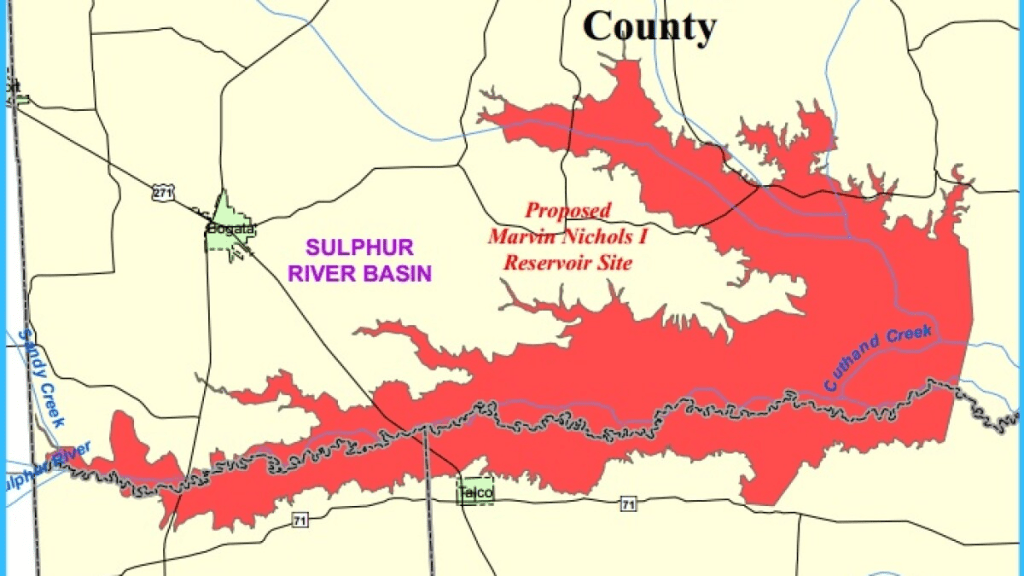
    The proposed Marvin Nichols Reservoir, which would occupy over 72,000 acres in Northeast Texas, has been in the works since 1968. However, with Texas’ more-imminent-than-ever water crisis, it’s recently gained more and more traction— and just as much controversy.

    What is it?

    The proposed Marvin Nichols Reservoir would occupy the Sulphur River Basin and supply drinking water to the Dallas-Fort Worth area. With a plethora of available water from the basin and a low estimated water cost, the reservoir first appeared in Texas’ 1968 State Water Plan as the Naples Reservoir; then, it was proposed in the 1984, 1990, and 1997 state water plans as the Marvin Nichols Reservoir. In 1997, the 75th Texas Legislature passed Senate Bill 1, which divided Texas into 16 regions with local representatives to develop  water plans. 

    Since then, renditions of the reservoir have been recommended in eleven regional and state water plans. While the Texas Legislature designated the reservoir site as a

    “Site of unique value for the construction of a reservoir.”

    In 2007, the Region D Regional Water Planning Group voted against it due to predicted negative impacts on agricultural, timber, and natural resources, as well as on local economies.

    Why’s it taking so long?

    First of all, it can take at least 15-20 years to receive a permit for a new lake or reservoir. The reservoir didn’t make it into the State Water Plan (under the name Marvin Nichols) until 1984, and, by 2001 (17 years later), the project was facing strong pushback from northeast Texans. 

    While the 2021 Region C Regional Water Plan and the 2022 State Water Plan believe  the reservoir should be ready by 2050, the Bois d’Arc Lake reservoir, another controversial and large project, took just 18 years to implement. Well, we already passed the 18 year mark—24 years ago! Regional Texas water planners stress that these projects must be operational in a timely manner. In other words, they need to happen before shortages occur- not after a drought is already underway.

    So, we can expect a 2050 completion unless a future water plan indicates otherwise.

    What’s happening with Texas’ water crisis?

    But why do we even need the reservoir in the first place? I mean, we’re obviously running out of water, but here’s why. Texas’ Region C, made up of Arlington, Carrollton, Dallas, Denton, Fort Worth, Frisco, Garland, Irving, Mckinney, Plano, Richardson, and Frisco, is rapidly growing in population. It’s predicted to grow by nearly 6,000,000 people from 2030 to 2080, and with more people comes more water demand, which would increase by around 1,000,000 acre-feet by 2080. Even with conservation tactics outlined in the Region C Water Plan, Region C would still lack around 1,000,000 acre-feet per year. 

    For example, Fort Worth plans to use more wastewater, so it needs to expand its water treatment plants to treat nearly 830,000,000 gallons of water per day by 2080. However, around ⅓ of the water would have to come from new reservoirs, and that’s where Marvin Nichols comes in. Of course, it would not only supply water to Fort Worth—many cities in region C likely have similar plans for Marvin Nichols.

    How will Texans be affected? What’s the controversy?

    Alright, let’s get to the downsides. Although the reservoir would help some of Texas’ most populous cities, the Region C crew, it would destroy around 72,000 acres of rural land in northeast Texas through flooding. And that means wetlands destroyed, jobs gone, and history killed.

     Bottomland hardwood forests are Texas’ most biologically diverse ecosystems; however, from the nineteenth century to now, only ¼ of East Texas’ bottomland hardwood forests still stand. But guess what—they make up 30,000 of the 72,000 acres that Marvin Nichols plans to destroy. Plus, because the forests house so many different animal species, the reservoir would endanger wildlife already threatened in Texas, like black bears.

    And since Marvin Nichols’ construction would flood so much working land, local farmers, loggers, ranchers, and livestock ranchers would very-likely lose their jobs. School districts would be wiped, Native American historical sites and family cemeteries would be destroyed, and families who’ve lived on the land for centuries would be kicked out. 

    Although the aforementioned Region C Water Plan tactics aren’t quite enough, if Region C goes above the conservation levels it outlines, then it could save the entirety of the water that Marvin Nichols would provide.

    So, the reservoir’s proposal raises a debate of the merits of destroying livelihoods, habitats, and history to supply even more water to some of Texas’ most populated and water-consuming cities.

    Is the reservoir really the best solution?

    Although water costs are estimated to be relatively low once the reservoir is built, the construction of Marvin Nichols has been estimated to cost seven-billion dollars. Yup, $7,000,000,000. That’s around $97,222 per acre. To revisit our earlier comparison, the Bois d’Arc Lake reservoir cost around $1,600,000,000 for 16,640 acres—that’s about $96,154 per acre. Both reservoirs are incredibly expensive, but one has passed and the other hasn’t. 

    Let’s look at the cost of the Region C Water Plan’s conservation tactics. (Table from Bryan McMath’s Marvin Nichols Reservoir Project Feasibility Review)
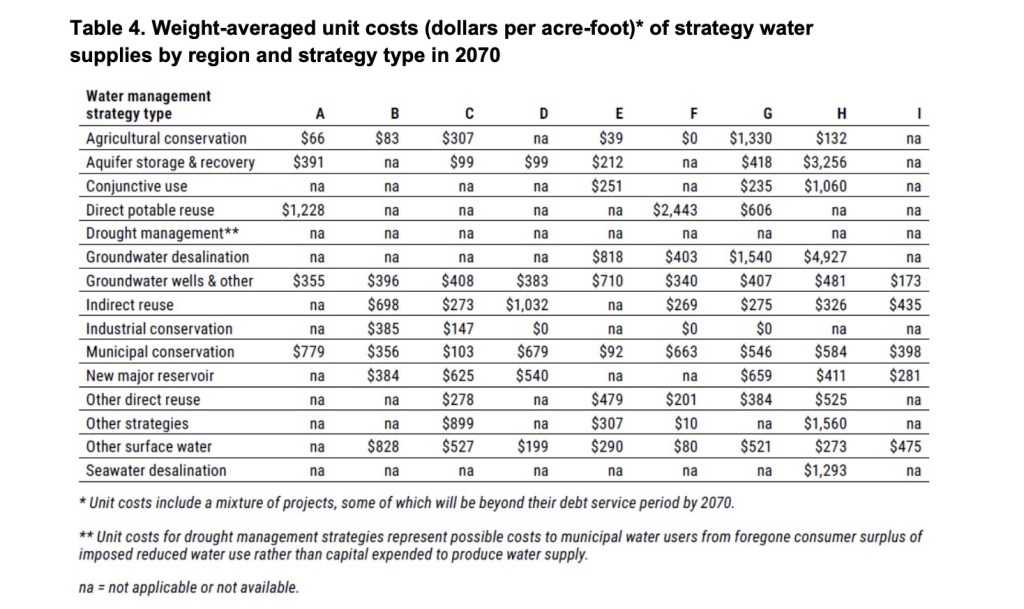
    Bryan McMath / Marvin Nichols Reservoir Project Feasibility Review / Page 22

    For Region C, every tactic costs immensely less than Marvin Nichols. Even by using all the tactics together, water for Region C would cost just $3,666 per acre-foot, a sharp decrease from Marvin Nichols’ construction asking for $97,222 per acre. And although only doing these tactics would leave Region C deficient of 1,000,000 acre-feet of water per year, citizens could use the strategies more aggressively with the surplus of money to fix the lack. 

    Marvin Nichols is not the only solution to Region C’s drinking water shortage, and it’s certainly not the best one. Let’s save the people, animals, habitats, homes, jobs, and history living in northeast Texas, and let’s do so by speaking up. If the project hadn’t received so much pushback in the early 2000s, it very well could have already been implemented or be even closer to implementation. So, we must continue to push back because our voices—Region C’s and Regions A through Z’s alike—are the most powerful tools we have to stop Marvin Nichols.

    References

    Bois d’Arc Lake. (n.d.). About the lake. Bois d’Arc Lake. https://boisdarclake.org/about-the-lake/ 
    Hovland, A. (2024, October 31). East Texas water group considers controversial Marvin Nichols Reservoir project. Texas Scorecard. https://texasscorecard.com/local/east-texas-water-group-considers-controversial-marvin-nichols-reservoir-project/ 
    Lopez, N. (2025, May 20). North Texas needs new reservoirs, water planners say. But plan faces stiff opposition. Kera News. https://www.keranews.org/environment-nature/2025-05-20/north-texas-needs-new-reservoirs-water-planners-say-but-plan-faces-stiff-opposition 
    Marvin Nichols Reservoir Project Feasibility Review [PDF]. (2025). https://www.twdb.texas.gov/publications/reports/special_legislative_reports/doc/Marvin-Nichols-Reservoir-Project-Feasibility-Review.pdf 
    Satija, N. (2015, January 8). Controversial Marvin Nichols Reservoir stays in state plan. The Texas Tribune. https://www.texastribune.org/2015/01/08/twdb-marvin-nichols-decision/
    Texas Living Waters. (n.d.). Case study: Proposed Marvin Nichols Reservoir. Texas Living Waters. https://texaslivingwaters.org/state-and-regional-water-plan/case-study-proposed-marvin-nichols-reservoir/ 


  • My Experience Shadowing an Oncologist

    My Experience Shadowing an Oncologist

    By Aravli Paliwal

    ~ 9 minutes


    Earlier this summer, I was graciously given the opportunity to shadow a private-practice oncologist/hematologist in the Dallas area. There, I gained a clear understanding of what a career in STEM entails, learned how doctors approach complex cancer cases, and secured an inside view into the emotionally taxing yet deeply rewarding work of an oncologist.

    What does an Oncologist’s career look like?

    At the ground level, an oncologist’s job involves diagnosing and treating cancer. They play a central role in administering cancer treatments and developing long-term plans. There are three main types of oncologists:

    • Medical Oncologist: Dr. Nair, whom I shadowed, practices as a medical oncologist. These doctors use targeted therapies like chemotherapy and immunotherapy to treat cancers.
    • Surgical Oncologist: Surgical oncologists perform biopsies and remove tumors through surgical procedures. Usually, after a medical oncologist has successfully shrunk a tumor through targeted therapy, a surgical oncologist will excavate the remaining piece.
    • Radiation Oncologist: As the name suggests, these doctors treat cancer through radiation therapy.

    Dr. Nair works as a hematologist-oncologist. Because cancer often involves blood and bone marrow (leukemia, lymphoma, myeloma), having training in both oncology (solid tumors) and hematology (blood disorders) allows a doctor to treat a wider variety of patients without having to refer them to another clinic. Also, in the U.S., most oncologists need no extra schooling to end up board-certified in both.

    Typically, becoming an oncologist requires about 14-16 years of school. This includes a four-year undergraduate program, where students generally major in biology, chemistry, mathematics, or physics. Then, students take the MCAT, or the Medical College Admission Test, and attend medical school to earn their MD. After four years of medical school, doctors attend a three-year residency program. Finally, they complete a three-year fellowship program, subspecializing in oncology or hematology-oncology. Oncologists typically finish schooling in their mid-thirties, and though they spend most of their twenties in schooling, many agree that this time is fully necessary due to the extensive information students have to understand.

    A central part of an oncologist’s job is responding to a wide spectrum of questions, ranging from emotional ones like “if the tumor is getting bigger, do I have less time to live?” to straightforward questions like, “if I eat and sleep more, will I have more energy the next morning?” Sure, many of these questions become routine over time, but it’s that rare, complex one that truly tests a doctor’s knowledge and, when answered well, builds even more trust between the patient and their provider. Because cancer is such a serious topic, patients seek oncologists who make them comfortable, and the best way to provide that security is by easing their uncertainties and reinforcing confidence in their provider. This is exactly why those 14 long years of medical training matter so much.

    The Difference Between Private Practice and Clinic

    Dr. Nair is affiliated with the broader group Texas Oncology and practices at Medical City Dallas, but before going in to shadow her, I had no idea what the difference between a private practice and a clinic was. Here is an easy way to break it down:

    • Private practice: When a doctor or group of doctors owns, manages, and runs their own medical office. Like a business, they hire staff, manage billing, and run their own practice from top to bottom. Though private practice intersects the two contrasting fields of medicine and business, these doctors have more flexibility when not working for a large hospital or healthcare system.
    • Clinic: Usually affiliated with a larger group, hospital, or university. Doctors who work as part of a clinic follow the protocol set up by a broader employer and focus less on business and management.

    Highlight Patients

    You may think that looking at cancer gets repetitive after a while, and maybe you’re right- but in the two weeks that I shadowed Dr. Nair, we saw a wide variety of patients that kept me quite interested. Often, it wasn’t the cancer or condition that made them memorable, but their personality, and the reminder that cancer does not discriminate. People from all walks of life, rich or poor, tall or short, male or female, can be struck by the disease at random and affected in similar ways.

    1. Female, mid-40s, obese

    This patient was on blood-thinners that were administered by the hospital. Upon arriving home, she purposefully took double the prescribed dose for a few days. With the alarmingly high dosage this patient was taking, her gums would bleed when brushing her teeth, and minor cuts would bleed profusely without stopping. Suddenly, the patient formed a massive internal hemorrhage in her stomach, and was rushed to the ICU where she took a break from blood thinners and recuperated.

    2. Female, mid-30s

    This patient was aware she had a tumor in her lungs, but didn’t know the extent of its spread or whether it was even malignant. As the cardiothoracic surgeon opened her chest to perform a biopsy and assess the situation, he found that the cancer presented as stage 4 and had spread extensively throughout the lungs. After removing substantial diseased lung tissue, the patient’s remaining lung capacity was too low to sustain oxygenation. Therefore, she was placed on a ventilator that essentially acted as a pair of bedside lungs, pumping air for her.

    3. Female, early-60s, groaning in pain

    As Dr. Nair and I walked into the patient’s room, she was lying on the bed, groaning and screaming in severe pain. This woman had a pancreatic tumor, one of the most painful types of cancer, due to the tumor pressing on bunches of nerves and organs in the abdomen and back. Though she was fully lucid, the pain was preventing her from formulating complete thoughts or ideas, and her husband described that she could not eat properly or move around without a wheelchair. Dr. Nair told the couple to visit the ER within the hospital immediately, so that the patient could be administered stronger pain medications.

    The role of women in healthcare

    One thing that really stuck out to me was the number of women who worked in the office with Dr.Nair. Out of the three oncologists, only one was a man, and the rest of the staff, including the P.A. and infusion nurses, were all women.

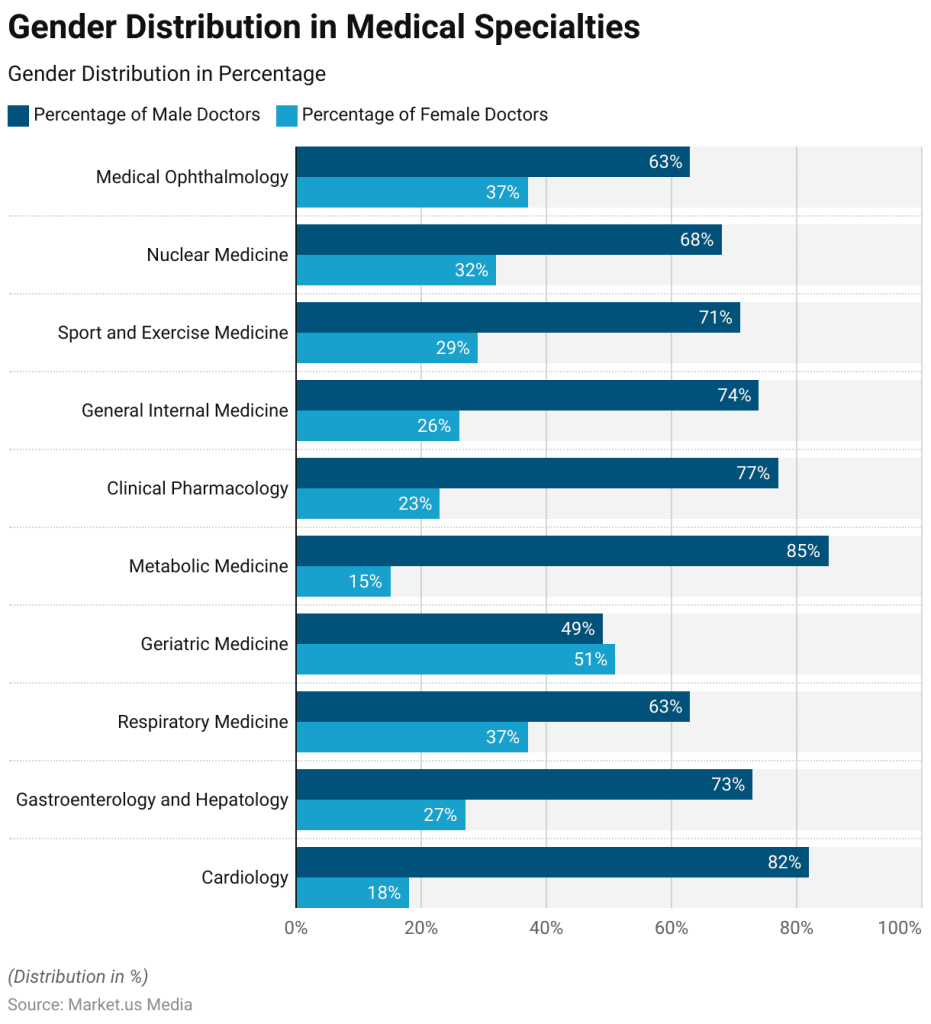
    In fact, according to the U.S. Bureau of Labor Statistics; around 77.6% of all healthcare workers are women. However, we hold a disproportionately small number of leadership positions compared to men. Where 77.6% of healthcare workers are women, only about 38% of all physicians are women.

    Male and Female Doctors Statistics 2025 By Disparities, Trajectories and Professions / Market.us Media ©

    Despite the gender gap that still exists today, equality growth in the last 20 years alone has been monumental. According to the Association of American Medical Colleges,

    “From 2004 to 2022, the number of women in the active physician workforce increased 97%.”

    Going forward, the future looks bright too. In 2019, women for the first time accounted for a majority (50.5%) of students enrolled in medical school in the United States. Today, women account for about 54.6% of medical school students. As women make up the majority of medical school graduates, the number of physicians in the coming years will consequently increase.

    Conclusion

    Before I arrived at the oncologist’s office, I pictured a gloomy waiting room filled with silent, dejected patients. Instead, I discovered something completely different. People tend to imagine only the sickest patients at a cancer clinic, the ones who are dying. But they often forget about the many who are improving, on the uphill climb, and who see the doctor’s office not as a place of punishment or despair, but as a lifeline that offers hope and light at the end of the tunnel.

    Seeing this side of cancer care reshaped my view of healthcare entirely. It made me realize that medicine isn’t just about treating disease and sending patients on their way, but instead creating an environment where people are given a reason to keep fighting.


    References

    AMA Writers. (2023, October 25). What is private practice-and is it right for you?. American Medical Association. https://www.ama-assn.org/practice-management/private-practices/what-private-practice-and-it-right-you
    Deb, T. (2025, January 13). Male and female doctors statistics and facts (2025). Market.us Media. https://media.market.us/male-and-female-doctors-statistics/
    U.S. Bureau of Labor Statistics. (n.d.). Over 16 million women worked in health care and social assistance in 2021. U.S. Bureau of Labor Statistics. https://www.bls.gov/opub/ted/2022/over-16-million-women-worked-in-health-care-and-social-assistance-in-2021.html