About

Tag: Climate change

  • Exploring the Marvin Nichols Reservoir Proposal: Yay or Nay?

    Exploring the Marvin Nichols Reservoir Proposal: Yay or Nay?

    By Bela Koganti

    ~ 6 minutes


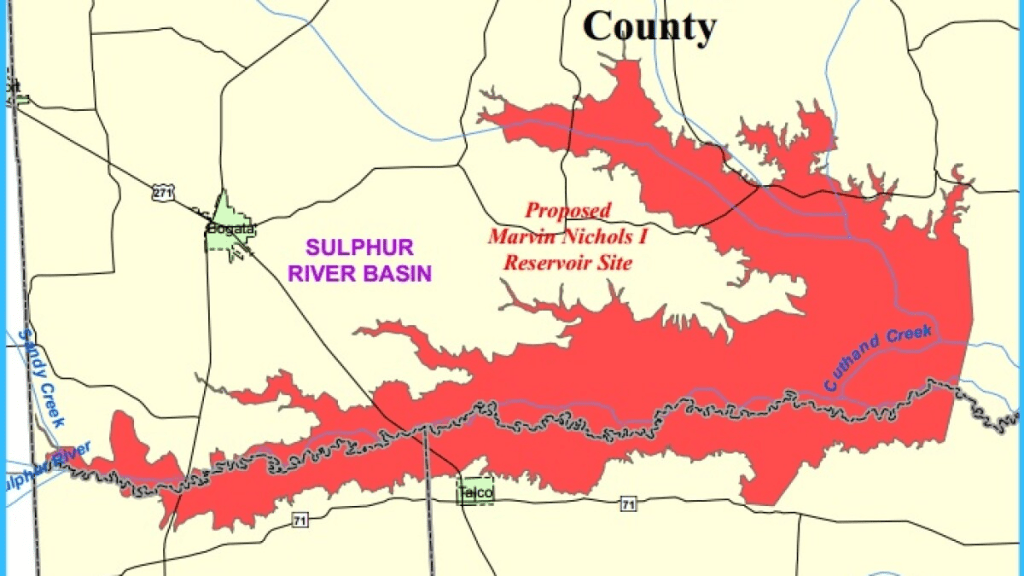
    The proposed Marvin Nichols Reservoir, which would occupy over 72,000 acres in Northeast Texas, has been in the works since 1968. However, with Texas’ more-imminent-than-ever water crisis, it’s recently gained more and more traction— and just as much controversy.

    What is it?

    The proposed Marvin Nichols Reservoir would occupy the Sulphur River Basin and supply drinking water to the Dallas-Fort Worth area. With a plethora of available water from the basin and a low estimated water cost, the reservoir first appeared in Texas’ 1968 State Water Plan as the Naples Reservoir; then, it was proposed in the 1984, 1990, and 1997 state water plans as the Marvin Nichols Reservoir. In 1997, the 75th Texas Legislature passed Senate Bill 1, which divided Texas into 16 regions with local representatives to develop  water plans. 

    Since then, renditions of the reservoir have been recommended in eleven regional and state water plans. While the Texas Legislature designated the reservoir site as a

    “Site of unique value for the construction of a reservoir.”

    In 2007, the Region D Regional Water Planning Group voted against it due to predicted negative impacts on agricultural, timber, and natural resources, as well as on local economies.

    Why’s it taking so long?

    First of all, it can take at least 15-20 years to receive a permit for a new lake or reservoir. The reservoir didn’t make it into the State Water Plan (under the name Marvin Nichols) until 1984, and, by 2001 (17 years later), the project was facing strong pushback from northeast Texans. 

    While the 2021 Region C Regional Water Plan and the 2022 State Water Plan believe  the reservoir should be ready by 2050, the Bois d’Arc Lake reservoir, another controversial and large project, took just 18 years to implement. Well, we already passed the 18 year mark—24 years ago! Regional Texas water planners stress that these projects must be operational in a timely manner. In other words, they need to happen before shortages occur- not after a drought is already underway.

    So, we can expect a 2050 completion unless a future water plan indicates otherwise.

    What’s happening with Texas’ water crisis?

    But why do we even need the reservoir in the first place? I mean, we’re obviously running out of water, but here’s why. Texas’ Region C, made up of Arlington, Carrollton, Dallas, Denton, Fort Worth, Frisco, Garland, Irving, Mckinney, Plano, Richardson, and Frisco, is rapidly growing in population. It’s predicted to grow by nearly 6,000,000 people from 2030 to 2080, and with more people comes more water demand, which would increase by around 1,000,000 acre-feet by 2080. Even with conservation tactics outlined in the Region C Water Plan, Region C would still lack around 1,000,000 acre-feet per year. 

    For example, Fort Worth plans to use more wastewater, so it needs to expand its water treatment plants to treat nearly 830,000,000 gallons of water per day by 2080. However, around ⅓ of the water would have to come from new reservoirs, and that’s where Marvin Nichols comes in. Of course, it would not only supply water to Fort Worth—many cities in region C likely have similar plans for Marvin Nichols.

    How will Texans be affected? What’s the controversy?

    Alright, let’s get to the downsides. Although the reservoir would help some of Texas’ most populous cities, the Region C crew, it would destroy around 72,000 acres of rural land in northeast Texas through flooding. And that means wetlands destroyed, jobs gone, and history killed.

     Bottomland hardwood forests are Texas’ most biologically diverse ecosystems; however, from the nineteenth century to now, only ¼ of East Texas’ bottomland hardwood forests still stand. But guess what—they make up 30,000 of the 72,000 acres that Marvin Nichols plans to destroy. Plus, because the forests house so many different animal species, the reservoir would endanger wildlife already threatened in Texas, like black bears.

    And since Marvin Nichols’ construction would flood so much working land, local farmers, loggers, ranchers, and livestock ranchers would very-likely lose their jobs. School districts would be wiped, Native American historical sites and family cemeteries would be destroyed, and families who’ve lived on the land for centuries would be kicked out. 

    Although the aforementioned Region C Water Plan tactics aren’t quite enough, if Region C goes above the conservation levels it outlines, then it could save the entirety of the water that Marvin Nichols would provide.

    So, the reservoir’s proposal raises a debate of the merits of destroying livelihoods, habitats, and history to supply even more water to some of Texas’ most populated and water-consuming cities.

    Is the reservoir really the best solution?

    Although water costs are estimated to be relatively low once the reservoir is built, the construction of Marvin Nichols has been estimated to cost seven-billion dollars. Yup, $7,000,000,000. That’s around $97,222 per acre. To revisit our earlier comparison, the Bois d’Arc Lake reservoir cost around $1,600,000,000 for 16,640 acres—that’s about $96,154 per acre. Both reservoirs are incredibly expensive, but one has passed and the other hasn’t. 

    Let’s look at the cost of the Region C Water Plan’s conservation tactics. (Table from Bryan McMath’s Marvin Nichols Reservoir Project Feasibility Review)
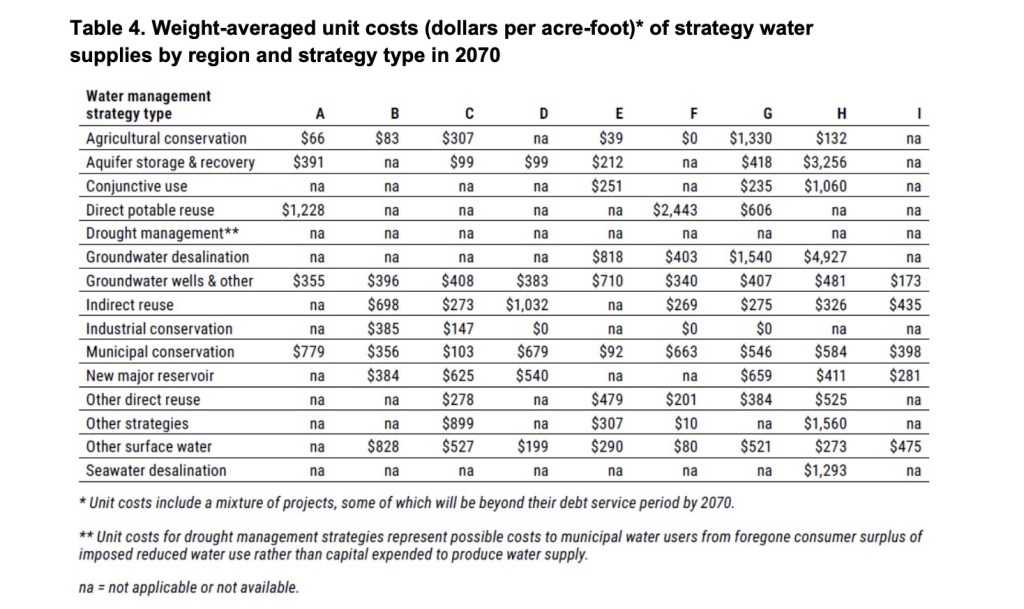
    Bryan McMath / Marvin Nichols Reservoir Project Feasibility Review / Page 22

    For Region C, every tactic costs immensely less than Marvin Nichols. Even by using all the tactics together, water for Region C would cost just $3,666 per acre-foot, a sharp decrease from Marvin Nichols’ construction asking for $97,222 per acre. And although only doing these tactics would leave Region C deficient of 1,000,000 acre-feet of water per year, citizens could use the strategies more aggressively with the surplus of money to fix the lack. 

    Marvin Nichols is not the only solution to Region C’s drinking water shortage, and it’s certainly not the best one. Let’s save the people, animals, habitats, homes, jobs, and history living in northeast Texas, and let’s do so by speaking up. If the project hadn’t received so much pushback in the early 2000s, it very well could have already been implemented or be even closer to implementation. So, we must continue to push back because our voices—Region C’s and Regions A through Z’s alike—are the most powerful tools we have to stop Marvin Nichols.


    References

    Bois d’Arc Lake. (n.d.). About the lake. Bois d’Arc Lake. https://boisdarclake.org/about-the-lake/ 
    Hovland, A. (2024, October 31). East Texas water group considers controversial Marvin Nichols Reservoir project. Texas Scorecard. https://texasscorecard.com/local/east-texas-water-group-considers-controversial-marvin-nichols-reservoir-project/ 
    Lopez, N. (2025, May 20). North Texas needs new reservoirs, water planners say. But plan faces stiff opposition. Kera News. https://www.keranews.org/environment-nature/2025-05-20/north-texas-needs-new-reservoirs-water-planners-say-but-plan-faces-stiff-opposition 
    Marvin Nichols Reservoir Project Feasibility Review [PDF]. (2025). https://www.twdb.texas.gov/publications/reports/special_legislative_reports/doc/Marvin-Nichols-Reservoir-Project-Feasibility-Review.pdf 
    Satija, N. (2015, January 8). Controversial Marvin Nichols Reservoir stays in state plan. The Texas Tribune. https://www.texastribune.org/2015/01/08/twdb-marvin-nichols-decision/
    Texas Living Waters. (n.d.). Case study: Proposed Marvin Nichols Reservoir. Texas Living Waters. https://texaslivingwaters.org/state-and-regional-water-plan/case-study-proposed-marvin-nichols-reservoir/ 


  • The Pinnacle of Motorsport: F1’s Sustainable Future

    The Pinnacle of Motorsport: F1’s Sustainable Future

    By Aniela Coughlin

    ~ 7 minutes


    Formula 1 has been given many names. From the “Pinnacle of Motorsport” to the “Motorsport soap opera,” its high stakes and thrilling speeds have earned it many nicknames. Most recently, Formula 1 has also been dubbed a “tech lab on wheels”.1 This nickname is well-deserved, as the innovations brought to F1 in order to make the cars quicker or more efficient often carry over into every-day road vehicles. One example of this is the carbon-fibre monocoque chassis introduced by McLaren in 1981. This light but durable material is now ubiquitous; it is the basis of almost every supercar and is used in everything from spacecraft to golf clubs. This leads us to reflect on just how much Formula 1 has influenced our daily lives, and how different our world would be today without it. For decades, Formula 1 has served as a model for elite performance in road vehicles and has sparked a passion for engineering in many people.

    Ferrari drivers Sainz and Leclerc shake down new F1-75 car at Fiorano / F1

    But with this attention comes a great responsibility for Formula 1. It must set the standard toward which the rest of the automobile industry strives. With global warming becoming an increasingly pressing issue in the global community, Formula 1 must find ways to keep racing at high speeds that are also sustainable for our environment. In 2026, Formula 1 seeks to radically change its regulations in order to reach its goal of going 100% carbon neutral by 2030.2 What do these new regulations mean for the sport, and, most importantly, what do they mean for us? 

    The new 2026 regulations encompass a wide variety of details, from aerodynamics to tyre size, and everything in between. Most of these will not have a tremendous impact on everyday road cars, as these regulations are focused more on getting these supercars to be even more “super”. One major change that does impact standard vehicles, though, is the new fuel regulations. Formula 1 cars use a hybrid of electric and hydrocarbon-fueled energy. Each of the (soon to be) eleven Formula 1 teams outsources their fuel to a third party. Ferrari famously partners with Shell, for instance, and Aston Martin works with Aramco. Throughout 2025, the petrol used in Formula 1 cars had to be ten percent bioethanol, a green alcohol fuel derived from biomass. But this requirement goes away in 2026, when the teams will have to supply their cars with 100% sustainable fuels.3 This means that no fossil carbons may be used, and the teams must produce net-zero carbon cars: they will have to extract carbon from pre-existing sources, instead of adding more into the atmosphere.

    What does this look like? Well, air-capture technologies for carbon already exist, but these are inefficient since only 0.04% of the air is carbon dioxide. Teams are instead looking toward non-food bio sources of carbon, such as excess from the wood or paper industries, or municipal waste. A caveat to this, however, is that they cannot compete with existing food sources. In an interview about Formula 1’s sustainable fuel plans, F1’s chief technology officer Pat Symonds explains,

    “You can make this fuel out of potato peelings, but not out of potatoes.

    Sustainable fuels are, ironically, still not financially sustainable options for “layman” car manufacturers. 100% sustainable fuel is much more expensive to produce than standard fossil fuels, which cost about $63 per barrel compared with the $300 for the sustainable fuel. Add that to the cost of experimenting with and researching new technologies, and you are looking at a budget that far exceeds what the average car manufacturer can afford. This is why Formula 1 is the optimal test hamster for sustainable technologies: its teams deal with huge budgets, which are designed to be spent on innovative technologies. Plus, in Formula 1, the goal is to produce the most efficient and high-performing car possible, not the cheapest. With some luck, these innovations in the way carbon fuels are sourced in Formula 1 will trickle down into the “real world.” 

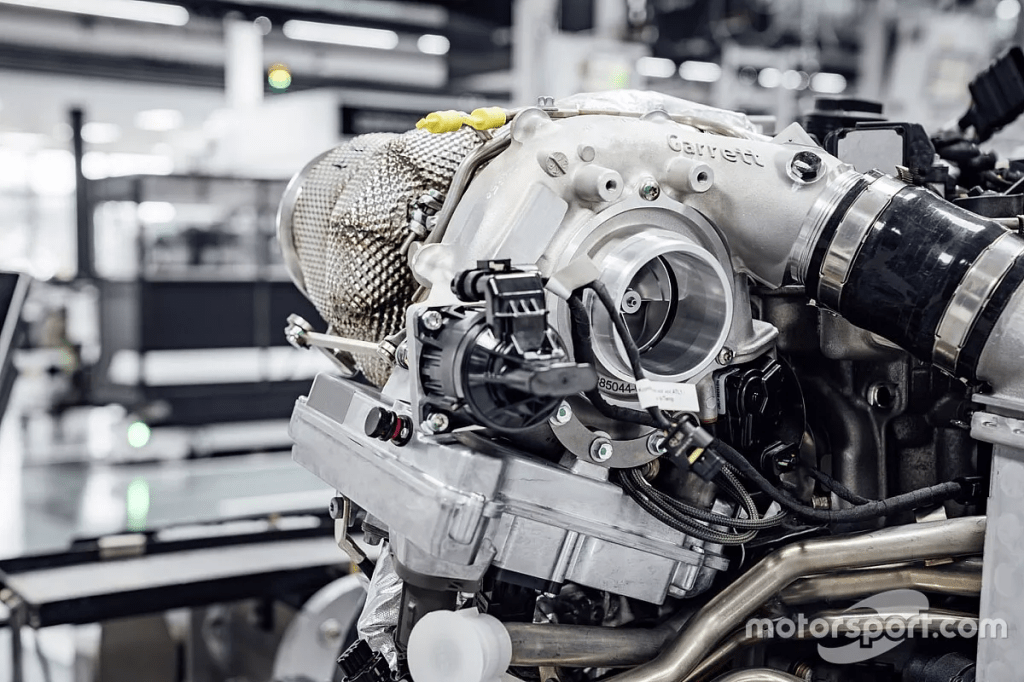
    Another major change to occur in 2026 is the removal of the MGU-H unit. This component is part of the Energy Recovery System on an F1 car, along with the MGU-K and the energy store. The energy store is essentially a large lithium-ion battery that stores energy recovered from breaking or excess exhaust. The MGUs (Motor Generator Units) act as both motors and generators, depending on what the car necessitates. This works because providing energy to the motors causes them to spin, and spinning the motors causes them to generate energy. The MGU-K (Motor Generator Unit Kinetic) works alongside the car’s engine to provide extra power to the car. It harvests excess energy from braking, when the MGU-K is spinning solely due to the rotational energy of the wheels, and the still-rotating magnets inside the motor provide energy to the battery for later use. The MGU-H (Motor Generator Unit Heat), to be removed in 2026, supplies the same energy storage system. It works alongside the turbocharger so that when exhaust gas passes through the generator turbine of the MGU-H, the turbine spins, transforming kinetic energy into electric energy. The MGU-H can also supply electric energy to the turbocharger, and thus eliminate turbo lag in the engine.5

    Mercedes reveals first use of F1’s MGU-H in road cars / motorsport

    The MGU-H does serve a purpose, but only in the context of Formula 1. Everyday road cars do not travel at fast enough speeds to require a component to diminish turbolag; in fact, most hybrid cars do not have a turbocharger at all. This, coupled with the fact that the MGU-H is incredibly expensive to produce, is why the MGU-H will be removed from F1 cars in 2026. 

    But with the switch to a 50/50 ICE-electric engine in 2026, F1 cars still need an energy recovery system to boost performance and efficiency. The MGU-K is much more affordable to produce than the MGU-H because it is mechanically simpler. To compensate for the loss of the MGU-H, the MGU-K output nearly triples in 2026, with a jump from 120 kWh to 350 kWh. The impacts of this on the “real” world are that now everyday road cars have a realistic exemplar of what an efficient hybrid car looks like, and can look to F1 cars to minimize their carbon footprint. 

    Formula 1 is more than just a sport. At the pinnacle of speed, its cars are the role models for the maximized efficiency and performance to which most cars aspire. F1 cars have the responsibility to set the example for others by reducing their carbon footprint, and this is just what the 2026 regulations aim to do. With the implementation of 100% sustainable fuel and increased reliance on electrical power, Formula 1 is pioneering technologies that have the potential to lead the world to a more sustainable future. 


    Bibliography

    Explained: The chemistry behind F1’s sustainable fuel future.” Race Fans, 25 March 2023, Explained: The chemistry behind F1’s sustainable fuel future · RaceFans. Accessed 15 November 2025. 
    “FIA unveils Formula 1 regulations for 2026 and beyond featuring more agile cars and active aerodynamics.” FIA, 06 June 2024, FIA unveils Formula 1 regulations for 2026 and beyond featuring more agile cars and active aerodynamics | Formula 1®. Accessed 15 November 2025. 
    “Formula One Isn’t Just Racing – It’s A Tech Lab On Wheels.” DCB Editorial, 26 August 2025, Formula One Isn’t Just Racing-It’s A Tech Lab On Wheels. Accessed 09 November 2025. 
    “The game-changer in F1’s 2026 fuel evolution.” The Race, 17 September 2025, The game-changer in F1’s 2026 fuel revolution – The Race. Accessed 23 November 2025.
    “What Is ERS In F1? (How The MGU-H And MGU-K Work).” Flow Racers. Accessed 23 November 2025.

  • The Green Price of Intelligence

    The Green Price of Intelligence

    By Summer Chen

    ~ 6 minutes


    Over the past three years, a rush of excitement has emerged globally regarding artificial intelligence. In a student’s everyday life, discussions about artificial intelligence arise frequently- whether about the potential benefits of generative AI, using ChatGPT on homework assignments, or seeing AI’s growing presence on social media platforms like TikTok. 

    Claims that AI holds significant potential in the development of society and technology are impossible to ignore, with AI occupying numerous sectors seen throughout daily life. In fact, when I began writing this article, even clicking enter on a google search titled “Impact of AI on climate change” immediately caused an AI overview to pop up unprompted.  

    AI generated images / The Economic Times India ©

    While the environmental repercussions of AI usage cannot be ignored, to deny the multitude of potential benefits from artificial intelligence would be absurd. Instead, it makes more sense that the use of (mostly generative) AI for recreational purposes is the issue– hundreds of thousands of people contribute to this environmental impact, not realizing that even a short prompt into ChatGPT has been proven by the International Energy Agency to equate to 4-10x the amount of energy that just one Google search consumes.

    There are four key problems attributed to why AI can cause widespread harm to our environment. First, the mining required to extract critical minerals and rare earth elements for the microchips that power AI is incredibly destructive to the environments where these resources are found. Navigating New Horizons confirms this, stating,

    “[The minerals and elements] are often mined unsustainably”.

    The second is that AI servers are held in data centers which produce a shocking amount of electronic waste. They also contain hazardous substances such as mercury and lead, according to the United Nations Environment Program (UNEP). This is harmful because when they are (often) disposed of improperly, the wildlife, soil, air, and water around it are contaminated. 

    Thirdly, these AI data centers use preposterous amounts of electricity and energy, due to advanced technology seen in these models. Therefore, the energy used in most of these data centers comes from fossil fuels which produce greenhouse gases that further contribute to global warming. Research by the University of Nottingham shows that by 2026, AI data centers will likely account for nearly 35% of Ireland’s energy consumption. Added effects to climate change are something that we simply can’t afford currently, with the already increasing rate of rising global temperatures.  

    Pollution due to Elon Musk’s AI data center in Memphis / NAACP ©

    Finally, and most of all, data centers consume a colossal amount of water, not only to construct but also to cool electrical components of AI. Chilled water absorbs heat from computing equipment. This water does not return to the water cycle; most of it is gone forever when used to cool these heated data centers. The centers use mechanical chillers which carry heat away from the servers, releasing it through a condenser, and so the water becomes water vapor where it does not cycle back through treatment systems like in a typical household. Even though some of it returns as rainfall, a majority of vapor in the air cannot be recovered. Not only this, but data centres are often located near locations which are already prone to droughts, which gives the inhabitants of this area even less access to water. This is a huge problem when a quarter of humanity already lacks access to clean water and sanitation. MIT News tells us that for every single kilowatt hour of energy a data center consumes, it would need two entire liters of water for cooling. It is an atrocity to restrict so much life from access to clean water and instead use it on generating ‘a cartoon version of me’ or asking ChatGPT to write a quick email that could be written by the individual in just two minutes instead.  

    The impacts of these contributors on climate change are immense. It also doesn’t help that generative AI models have an extremely short shelf-life as AI companies such as ChatGPT and DeepSeek consistently deliver new models, provoked by rising demand for new AI applications. So, the energy used to train previous models goes to waste every few weeks, and new models use even more energy because they are more advanced than the previous ones. Sure, one person using Perplexity AI doesn’t do much to the environment, but if everyone follows this logic, the large scale of people using AI results in terrible repercussions.

    On the other hand, popular articles repeat that because “500ml of water are used for every 20-50 ChatGPT prompts, not every prompt”, the amount of energy that ChatGPT uses is not that significant. However, like govtech.com states, even if 500ml sounds small, combined with the 122 million people who use ChatGPT daily, this is a lot of water that is wasted for purposeless reasons. AI’s energy use has exploded only because AI has exploded. It is not that each prompt uses a significant amount of energy, but that AI has had an explosive growth being the quickest adopted technology ever, therefore the energy adds up to be significant through the sum of people using AI. 

    As a society, we have to acknowledge that even though AI provides us an abundance of opportunities and ideas for our modern world, we must not forget the consequences to the already declining environment that overuse brings. We should take into consideration that life would most likely not be worse without generative AI for the average person. We should take into consideration that the tradeoff of mindless entertainment and having ChatGPT search for basic facts is worth a better chance at restoring our Earth. And ultimately, we should simply refrain from using AI for recreational reasons unless the purpose is absolutely urgent and necessary.  


    References

    After Ghibli art trend, Barbie Box Challenge breaks the internet: How to create your ai doll avatar?. The Economic Times. (n.d.). https://economictimes.indiatimes.com/magazines/panache/after-ghibli-art-trend-barbie-box-challenge-breaks-the-internet-how-to-create-your-ai-doll-avatar/articleshow/120257077.cms?from=mdr
    Elon Musk’s Xai threatened with lawsuit over air pollution from Memphis Data Center, filed on behalf of NAACP. NAACP. (2025, June 17). https://naacp.org/articles/elon-musks-xai-threatened-lawsuit-over-air-pollution-memphis-data-center-filed-behalf
    GovTech. (n.d.). About Us. GovTech. https://www.govtech.com/about