About

Category: Articles

  • My Experience Shadowing an Oncologist

    My Experience Shadowing an Oncologist

    By Aravli Paliwal

    ~ 9 minutes


    Earlier this summer, I was graciously given the opportunity to shadow a private-practice oncologist/hematologist in the Dallas area. There, I gained a clear understanding of what a career in STEM entails, learned how doctors approach complex cancer cases, and secured an inside view into the emotionally taxing yet deeply rewarding work of an oncologist.

    What does an Oncologist’s career look like?

    At the ground level, an oncologist’s job involves diagnosing and treating cancer. They play a central role in administering cancer treatments and developing long-term plans. There are three main types of oncologists:

    • Medical Oncologist: Dr. Nair, whom I shadowed, practices as a medical oncologist. These doctors use targeted therapies like chemotherapy and immunotherapy to treat cancers.
    • Surgical Oncologist: Surgical oncologists perform biopsies and remove tumors through surgical procedures. Usually, after a medical oncologist has successfully shrunk a tumor through targeted therapy, a surgical oncologist will excavate the remaining piece.
    • Radiation Oncologist: As the name suggests, these doctors treat cancer through radiation therapy.

    Dr. Nair works as a hematologist-oncologist. Because cancer often involves blood and bone marrow (leukemia, lymphoma, myeloma), having training in both oncology (solid tumors) and hematology (blood disorders) allows a doctor to treat a wider variety of patients without having to refer them to another clinic. Also, in the U.S., most oncologists need no extra schooling to end up board-certified in both.

    Typically, becoming an oncologist requires about 14-16 years of school. This includes a four-year undergraduate program, where students generally major in biology, chemistry, mathematics, or physics. Then, students take the MCAT, or the Medical College Admission Test, and attend medical school to earn their MD. After four years of medical school, doctors attend a three-year residency program. Finally, they complete a three-year fellowship program, subspecializing in oncology or hematology-oncology. Oncologists typically finish schooling in their mid-thirties, and though they spend most of their twenties in schooling, many agree that this time is fully necessary due to the extensive information students have to understand.

    A central part of an oncologist’s job is responding to a wide spectrum of questions, ranging from emotional ones like “if the tumor is getting bigger, do I have less time to live?” to straightforward questions like, “if I eat and sleep more, will I have more energy the next morning?” Sure, many of these questions become routine over time, but it’s that rare, complex one that truly tests a doctor’s knowledge and, when answered well, builds even more trust between the patient and their provider. Because cancer is such a serious topic, patients seek oncologists who make them comfortable, and the best way to provide that security is by easing their uncertainties and reinforcing confidence in their provider. This is exactly why those 14 long years of medical training matter so much.

    The Difference Between Private Practice and Clinic

    Dr. Nair is affiliated with the broader group Texas Oncology and practices at Medical City Dallas, but before going in to shadow her, I had no idea what the difference between a private practice and a clinic was. Here is an easy way to break it down:

    • Private practice: When a doctor or group of doctors owns, manages, and runs their own medical office. Like a business, they hire staff, manage billing, and run their own practice from top to bottom. Though private practice intersects the two contrasting fields of medicine and business, these doctors have more flexibility when not working for a large hospital or healthcare system.
    • Clinic: Usually affiliated with a larger group, hospital, or university. Doctors who work as part of a clinic follow the protocol set up by a broader employer and focus less on business and management.

    Highlight Patients

    You may think that looking at cancer gets repetitive after a while, and maybe you’re right- but in the two weeks that I shadowed Dr. Nair, we saw a wide variety of patients that kept me quite interested. Often, it wasn’t the cancer or condition that made them memorable, but their personality, and the reminder that cancer does not discriminate. People from all walks of life, rich or poor, tall or short, male or female, can be struck by the disease at random and affected in similar ways.

    1. Female, mid-40s, obese

    This patient was on blood-thinners that were administered by the hospital. Upon arriving home, she purposefully took double the prescribed dose for a few days. With the alarmingly high dosage this patient was taking, her gums would bleed when brushing her teeth, and minor cuts would bleed profusely without stopping. Suddenly, the patient formed a massive internal hemorrhage in her stomach, and was rushed to the ICU where she took a break from blood thinners and recuperated.

    2. Female, mid-30s

    This patient was aware she had a tumor in her lungs, but didn’t know the extent of its spread or whether it was even malignant. As the cardiothoracic surgeon opened her chest to perform a biopsy and assess the situation, he found that the cancer presented as stage 4 and had spread extensively throughout the lungs. After removing substantial diseased lung tissue, the patient’s remaining lung capacity was too low to sustain oxygenation. Therefore, she was placed on a ventilator that essentially acted as a pair of bedside lungs, pumping air for her.

    3. Female, early-60s, groaning in pain

    As Dr. Nair and I walked into the patient’s room, she was lying on the bed, groaning and screaming in severe pain. This woman had a pancreatic tumor, one of the most painful types of cancer, due to the tumor pressing on bunches of nerves and organs in the abdomen and back. Though she was fully lucid, the pain was preventing her from formulating complete thoughts or ideas, and her husband described that she could not eat properly or move around without a wheelchair. Dr. Nair told the couple to visit the ER within the hospital immediately, so that the patient could be administered stronger pain medications.

    The role of women in healthcare

    One thing that really stuck out to me was the number of women who worked in the office with Dr.Nair. Out of the three oncologists, only one was a man, and the rest of the staff, including the P.A. and infusion nurses, were all women.

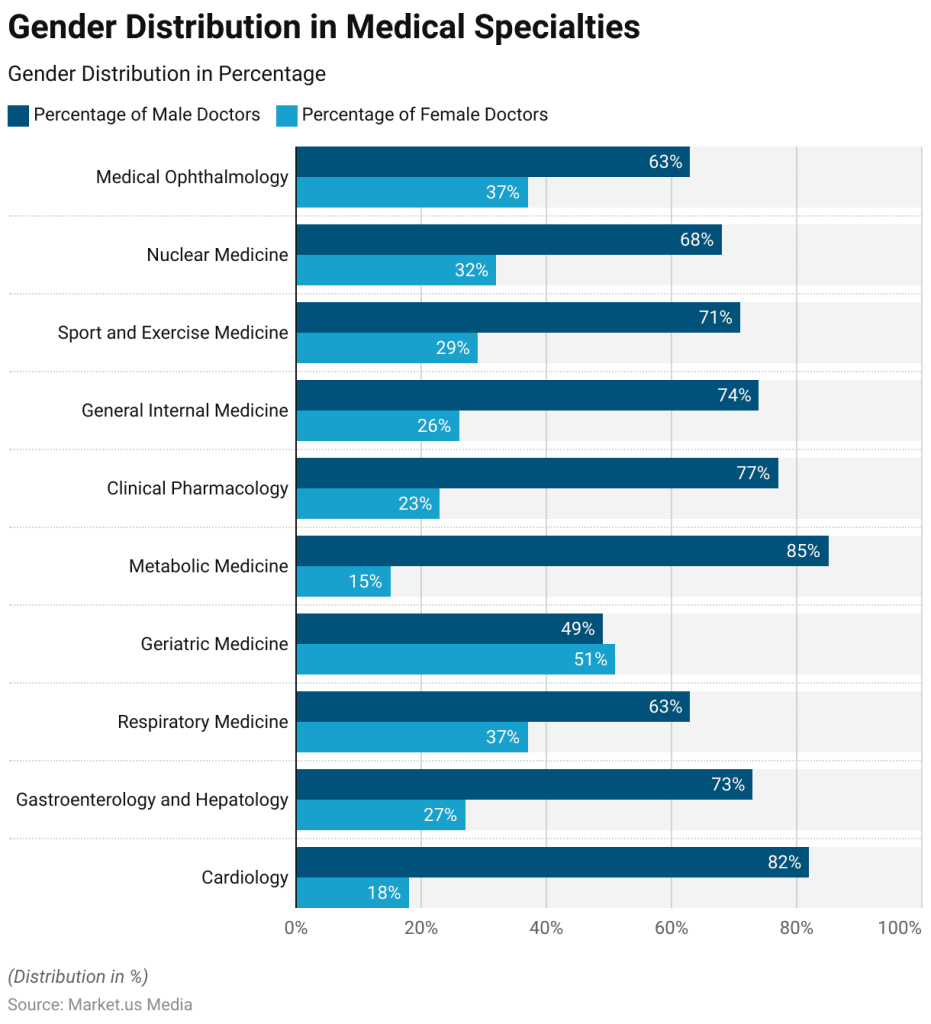
    In fact, according to the U.S. Bureau of Labor Statistics; around 77.6% of all healthcare workers are women. However, we hold a disproportionately small number of leadership positions compared to men. Where 77.6% of healthcare workers are women, only about 38% of all physicians are women.

    Male and Female Doctors Statistics 2025 By Disparities, Trajectories and Professions / Market.us Media ©

    Despite the gender gap that still exists today, equality growth in the last 20 years alone has been monumental. According to the Association of American Medical Colleges,

    “From 2004 to 2022, the number of women in the active physician workforce increased 97%.”

    Going forward, the future looks bright too. In 2019, women for the first time accounted for a majority (50.5%) of students enrolled in medical school in the United States. Today, women account for about 54.6% of medical school students. As women make up the majority of medical school graduates, the number of physicians in the coming years will consequently increase.

    Conclusion

    Before I arrived at the oncologist’s office, I pictured a gloomy waiting room filled with silent, dejected patients. Instead, I discovered something completely different. People tend to imagine only the sickest patients at a cancer clinic, the ones who are dying. But they often forget about the many who are improving, on the uphill climb, and who see the doctor’s office not as a place of punishment or despair, but as a lifeline that offers hope and light at the end of the tunnel.

    Seeing this side of cancer care reshaped my view of healthcare entirely. It made me realize that medicine isn’t just about treating disease and sending patients on their way, but instead creating an environment where people are given a reason to keep fighting.


    References

    AMA Writers. (2023, October 25). What is private practice-and is it right for you?. American Medical Association. https://www.ama-assn.org/practice-management/private-practices/what-private-practice-and-it-right-you
    Deb, T. (2025, January 13). Male and female doctors statistics and facts (2025). Market.us Media. https://media.market.us/male-and-female-doctors-statistics/
    U.S. Bureau of Labor Statistics. (n.d.). Over 16 million women worked in health care and social assistance in 2021. U.S. Bureau of Labor Statistics. https://www.bls.gov/opub/ted/2022/over-16-million-women-worked-in-health-care-and-social-assistance-in-2021.html

  • The Fall of the Big, Bad Boiler: The Latest Climate Technology Infiltrating New York City

    The Fall of the Big, Bad Boiler: The Latest Climate Technology Infiltrating New York City

    By Montserrat Tang

    ~ 9 minutes


    The Hot Hell of Boilers

    As someone born and raised in New York City (NYC), I can attest to the urgent need to upgrade the city’s climate control infrastructure. Current systems are outdated and hinder the city’s ability to meet emissions goals and address global warming; the encapsulation of this problem is the boiler. A staggering 72.9% of heating in NYC comes from fossil-fuel-burning steam boilers, one of the most carbon-intensive options available. Tenants of apartments pay for the maintenance of centralized boilers without control over the temperature, leading many to open their windows in winter to release excessive warmth. This heat and the fossil fuels used to produce it are wasted, highlighting the inefficiency and impracticality of NYC’s existing infrastructure. 

    Industrial boiler room / Controlled Combustion ©

    Even when this heat remains indoors, steam boilers are only about 80-85% efficient at burning fossil fuels. Up to a fifth of a boiler’s fuel does not generate usable heat, but burning it still releases vast quantities of pollutants like CO2, exacerbating climate change. Furthermore, boilers continue to lose efficiency during their lifetimes and require frequent maintenance and replacement. While steam boiler systems were revolutionary in the 19th century, they may now become obsolete as NYC implements a technology that could change how the world thinks about climate control.

    The Cool(ing) Mechanics of Heat Pumps

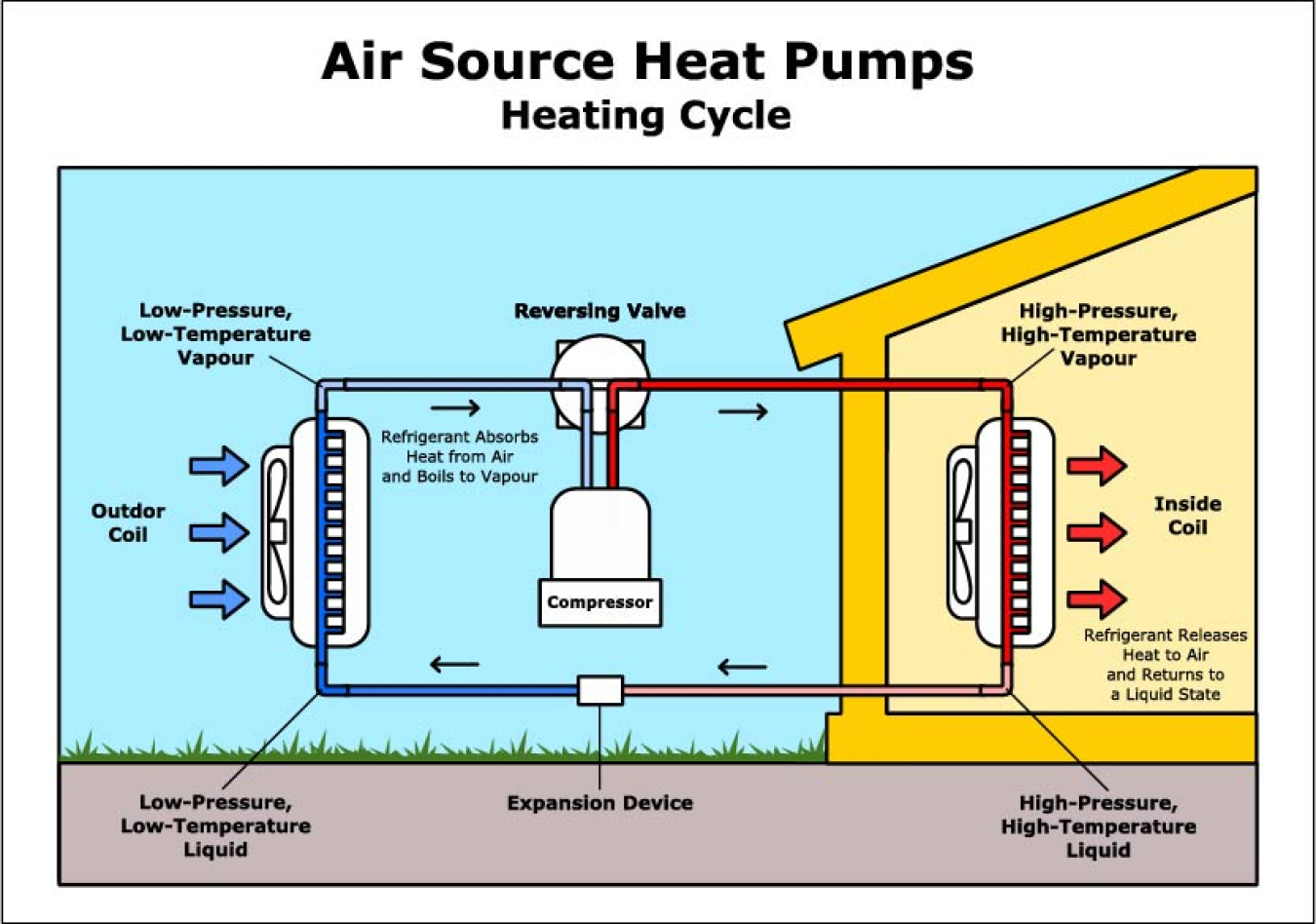
    Mechanics of an air source heat pump / U.S. Department of Energy ©

    The innovation behind heat pumps comes from the mantra of use what is given; instead of generating heat through combustion, they simply move existing warmth between two places. Most of these fully-electric pumps remain functional well below 0℃, even though it may seem like there is no warmth to be moved. This operative capacity allows them to have heating efficiencies of 300-500%! Because of this, International Energy Agency partner Yannick Monschauer estimates that “Heat pumps could bring down global CO2 emissions by half a gigaton by the end of this decade.”

    Heat pumps work by operating on the Second Law of Thermodynamics (SLOT), which states that heat will move from a hotter object to a colder one. In the wintertime, the pumps pull in outdoor air and blow it over fluids (called refrigerants) held in a closed-loop system. The air transfers warmth to the cold refrigerants through SLOT, and the heated fluids turn into gas. Heat pumps can work in freezing temperatures because these refrigerants have such unusually low boiling points, allowing them to vaporize easily; one of them, Refrigerant 12, has a boiling point of just -21.64°F!

    The hot, gaseous refrigerants move into a compressor that compacts their molecules, making them even warmer. They then flow through a coil that exposes them to indoor air, and the refrigerants release their warmth inside through SLOT. As the refrigerants cool, they condense back into liquid and pass through an expansion valve, decreasing their temperature further. They move to an outdoor coil and are ready to restart the process, continuing to warm cold homes during the winter.

    Even more significantly, heat pumps have reversing valves that switch the flow of their refrigerants. These valves allow the pumps to cool homes by pushing out warm, indoor air in the summertime. Thus, heat pumps make air conditioners, boilers, radiators, and related piping unnecessary, freeing space and alleviating material and labour costs that typically get passed on to homeowners. 

    Heat pumps in NYC

    In 2024, NYC pledged to have heat pumps provide 65% of residential heating, air conditioning, and water-heating needs by 2030. This shift would drastically reduce the city’s carbon emissions from the climate control sector, which contributed to 10% of global energy-related CO2 emissions in 2021.

    This pledge is logical both environmentally and practically: having one heat pump replace two systems saves valuable space, lowers costly installation and maintenance fees, and reduces energy demands. The NYC government realized this potential and signed a $70,000,000 contract to install 30,000 window heat pumps in NYCHA buildings, better known as public housing. Two heating companies, Midea and Gradient, will provide these units.

    In late 2023, Gradient installed 36 preliminary test units in NYCHA buildings. Most NYC steam boilers, including those in NYCHA’s current system, are powered by gas with oil reserves in case of an emergency. Gradient found that their pump can lower tenants’ heating bills by 29-62% on moderate winter days compared to gas-powered boilers. Savings are as high as 59-78% compared to oil-burning boilers. In testimonials that Gradient collected, NYCHA tenants noted the heat pumps’ impressive air filtration, heating, and operational capabilities. Midea conducted similar tests and soon plans to release its heat pump for public purchase.

    The Cold Drawbacks of Heat Pumps

    Although technological faults remain, NYC is continuing its plans to install and promote heat pumps to replace its intensive, outdated systems. For one, Midea’s upcoming pump will cost ~$3,000 per unit, greatly exceeding the combined price of ~$460 for their bestselling, single-room heating and cooling systems. This is a misleading comparison, however, because heat pumps also act as heating systems. The technology can lower electricity and fuel bills over an extended period, but the current price point makes heat pumps an unaffordable investment for many households – despite government subsidies and incentives. Even the NYC government’s bulk order of Midea and Gradient pumps averages over $2,300 per unit.

    Furthering the inaccessibility of these systems, the most advanced, aesthetically pleasing, and apartment-friendly heat pumps can only heat and cool individual rooms. This means that multiple units must be purchased, installed, and powered to service a home, and each must be replaced about every 20 years. Still, NYC’s firm stance on heat pumps indicates the climate control systems’ proven efficacy, practicality, and sustainability.

    Heat Pumps Globally, and Plans for the Future

    While technological challenges remain, NYC is continuing to deliver on its pledges. This decision on heat pumps is being made throughout the United States (US). In 2022, heat pump sales in the US significantly outpaced those of gas furnaces (a type of central heating system particularly popular in North America). This lead has continued into 2025 as more people realize that the pumps can lower fossil fuel emissions and energy bills.

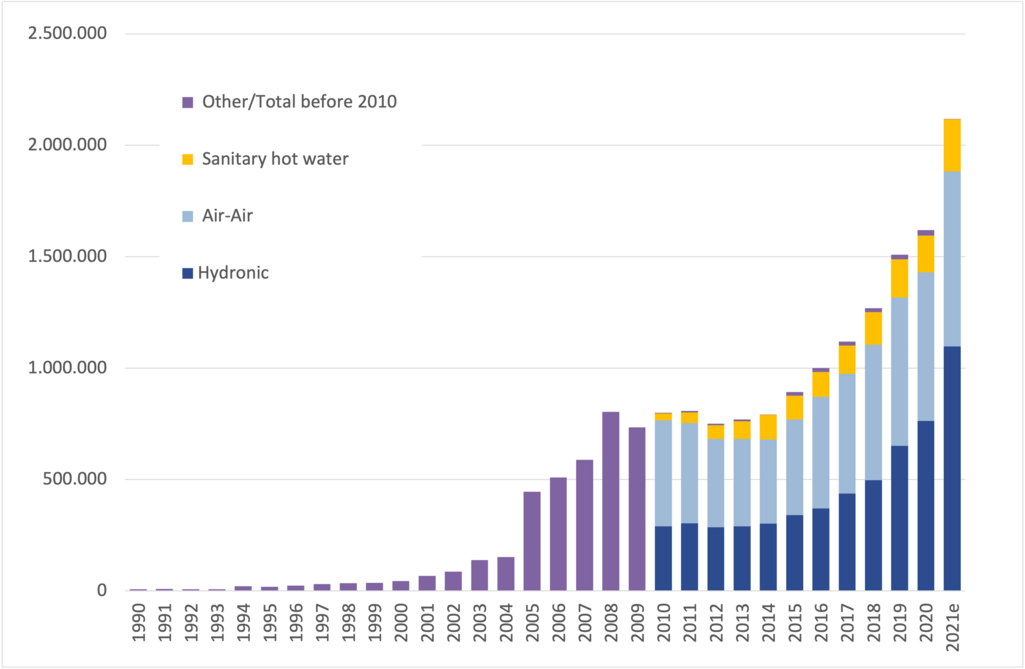
    This switch is not just happening in the US; countries worldwide are beginning – or continuing – to invest in these pumps. Sales in European countries have soared in the 21st-century, an accomplishment partly attributed to friendly government policy. The country with the most pumps relative to its population, Norway, has 632 heat pumps installed for every 1,000 households (the majority of these pumps service entire houses, unlike the Midea and Gradient systems discussed above). Despite this high ownership rate, 48 pumps were purchased in Norway for every 1,000 households in 2024.

    1990-2021 Heat pump sales in Europe, by technology / European Heat Pump Association ©

    In spite of these promising statistics, heat pump sales in most economies have either slowed or slumped in recent years – particularly in Europe. Analysts suspect this is due to high interest rates, rising electricity prices, low consumer confidence, and low gas prices. While this is discouraging, pump sales and ownership rates remain higher than they were several years ago.
    In 2023, New York Governor Kathy Hochul pledged to help the U.S. Climate Alliance (USCA) install 20,000,000 pumps across the U.S. The USCA is a coalition of 24 governors representing 54% of the United States population and 57% of its economy. The bipartisan group has successfully delivered on their promises of emissions reduction, climate resilience, economic growth, energy savings, and zero-carbon electricity standards that heat pumps are engineered to meet. 

    This coalition has proved that environmental action is popular, necessary, and possible. At a time when climate policy is under question, sustainable and feasible technologies – like heat pumps – need the investment of citizens, industries, and governments alike; no matter how small the scale.

    So, how can you help? Since 2022, the US government has given a federal tax credit to citizens who install efficient heat pumps. The Energy Efficient Home Improvement Credit provides eligible homeowners up to $2,000 annually. Combined with other energy-efficient credits, US citizens can regain up to $3,200 every year. These monetary incentives offer another reason to consider switching to heat pumps, and similar policies are being enacted worldwide.

    I am proud to live in a city that rewards and encourages the sustainability of citizens, corporations, and public works. As the severity and irreversibility of global warming loom, heat pumps offer us a breezy solution to polluting climate control systems. Eventually, NYC’s infamous boiler rooms and clanging pipes may become relics of the past.


    References

    About Us. (n.d.). United States Climate Alliance. https://usclimatealliance.org/
    Azau, S. (2025, July 3). Heat pump sales 14 times greater in lead countries. European Heat Pump Association. https://www.ehpa.org/news-and-resources/press-releases/heat-pump-sales-14-times-greater-in-lead-countries/
    Bray, T. (2021, October 7). How Do Heat Pumps Work? | Heat Pumps Explained. YouTube. https://www.youtube.com/watch?v=iQaycSD5GWE
    DeJong, K. (n.d.). The Difference Between Heat Pumps and Air Conditioners – Comparing Heat Pump Mini Splits with Cooling Only Systems. eComfort. Retrieved July 31, 2025, from https://www.ecomfort.com/stories/1310-Comparing-Heat-Pump-Mini-Splits-with-Cooling-Only-Systems.html
    Demir, H., Ulku, S., & Mobedi, M. (2013, August). A review on adsorption heat pump: Problems and solutions. ResearchGate. https://www.researchgate.net/publication/223303816_A_review_on_adsorption_heat_pump_Problems_and_solutions
    Ferrell, M. (2024, May 28). How does an air conditioner actually work? – Anna Rothschild. YouTube. https://www.youtube.com/watch?v=6sSDXurPX-s
    Ferrell, M., & Natividad, S. (2024, June 11). Why This Window Heat Pump Is Genius. Undecided. https://undecidedmf.com/why-this-window-heat-pump-is-genius/
    Gradient Transforms Public Housing HVAC at NYCHA. (2024, June 3). Gradient. https://www.gradientcomfort.com/blogs/news/how-gradient-is-transforming-public-housing-with-innovative-window-heat-pumps
    Heat pump. (2025, July 31). Wikipedia. https://en.wikipedia.org/wiki/Heat_pump
    Midea Packaged Window Heat Pump. (n.d.). Midea HVAC. Retrieved July 31, 2025, from https://www.mideacomfort.us/packaged.html
    New York City Climate Dashboard: Energy. (2024). NYC Comptroller. https://comptroller.nyc.gov/services/for-the-public/nyc-climate-dashboard/energy/
    New York State. (n.d.). Efficient and Emission-Free, Heat Pumps Are Gaining Popularity in New York and Beyond. New York State Energy Research and Development Authority. https://www.nyserda.ny.gov/Featured-Stories/US-Heat-Pump-Sales
    New York State. (2023). Recapping Climate Week 2023. New York State Energy Research and Development Authority. https://www.nyserda.ny.gov/Featured-Stories/Recapping-Climate-Week-2023
    New York State. (2023, September 20). Governor Hochul Announces Installation of Window Heat Pumps for New York City Public Housing Residents. Governor Kathy Hochul. https://www.governor.ny.gov/news/governor-hochul-announces-installation-window-heat-pumps-new-york-city-public-housing
    New York State & ENERGY STAR. (2024). 2024 ENERGY STAR Products Partner Meeting. New York State Energy Research and Development Authority. https://cdn.shopify.com/s/files/1/0558/4925/5070/files/NYSERDA_Room_Heat_Pump_Presentation_from_2024_ENERGY_STAR_Product_Partners_Meeting.pdf?v=1736361913United States Government. (2025, May 29). Energy Efficient Home Improvement Credit | Internal Revenue Service. IRS. https://www.irs.gov/credits-deductions/energy-efficient-home-improvement-credit

  • Bringing Back the Dead: De-Extinction

    Bringing Back the Dead: De-Extinction

    By Stella Fish

    ~ 4 minutes


    Have you ever wondered what life would be like if it were possible to revive extinct animals? To see a woolly mammoth, or a dodo bird? Thanks to a new modern-day technology, these doors are being opened.

    A dire wolf is a species of canine that went extinct about 13,000 years ago, differing from the modern gray wolf in its larger body, more massive skull, and smaller brain. In 2021, a company called Colossus Biosciences was able to extract dire wolf DNA from ancient fossils. Using this DNA to find the specific dire wolf genes, the scientists made 20 edits to a gray wolf gene, the closest living relative, until they produced an animal with the same key features as a dire wolf. After creating embryos from these genes, they implanted them into surrogate canine mothers.

    Romulus and Remus, wolf pups with dire wolf genes / Colossal Biosciences ©

    Soon after this, three healthy baby wolves were born, carrying the key traits of dire wolves. These three wolves are now known as the first successful use of de-extinction, sparking much debate over whether this practice should be continued.

    The Pros of De-extinction:

    De-extinction is a powerful tool for animal conservation and ecosystem restoration. Bringing back extinct keystone species could restore degraded habitats that have withered without them, opening doors to revive grasslands and other ecosystems. Along with ecosystem restoration, keystone species could impact the climate and weather in their habitat by impacting carbon storage and moisture regulation.

    This technology could also target endangered species, allowing scientists to save and protect animals at risk. By altering extinct genes to restore genetic diversity in a threatened species, scientists could avoid the extinction of important keystone species, keeping the ecosystem’s equilibrium steady. 

    Along with these two pros, de-extinction has led to significant scientific breakthroughs, specifically in biology and genetics. If it continues to be explored, it de-extinction could lead to other discoveries and raise awareness around the importance of protecting species and biodiversity. 

    Cons of De-Extinction:

    Yet, this useful new technology also harbors many risks. Dr. Meachen, a vertebrate paleontologist and morphologist, stated that she is wary of this new process, saying,

    “I have questions. We have trouble with the wolves we have today.”

    Dr. Meachen / Des Moines University ©

    The de-extinction process is costly and requires funds that the private sector may not be able to provide, meaning governments may have to assume funding. In this case, resources used in this process would come from the government’s conservation budget, making present conservation efforts lose funding. This would mean that existing endangered species facing immediate threats would be at risk, resulting in biodiversity loss.

    Placing extinct animals back into their environments might also have drawbacks, as most extinct animals’ ecosystems have changed since they became extinct, and there is no guarantee that they will be able to adapt back. This could lead to potentially invasive species, as their habitats may lack natural predators to keep the revived population in check. Reintroducing a species might also create conflict within the ecosystem, impacting the stability and equilibrium.

    Finally, many ethical questions come with de-extinction. By providing a way to return past life to the planet, there may be consequences of falsely condoning extinction and pardoning harm to species. Many critics also believe it is not our responsibility to “play God” and create new life.

    In Conclusion:

    De-extinction has provided substantial progress in science and has opened doors to new ways to conserve animals and habitats. However, many disadvantages come with it, posing the question: should de-extinction be further used, and if so, should there be limitations to what scientists can and can’t do with the genetic engineering of extinct animals? 


    References

    Dire Wolf Digital. (2024). Dire Wolf Digital, Inc. Direwolfdigital.com. https://www.direwolfdigital.com/
    Direwolf Biology – Colossal. (2025, April 7). Colossal. https://colossal.com/direwolf/biology/
    Jarvis, B. (2025, May 7). There’s No “Undo” Button for Extinct Species. The New York Times. https://www.nytimes.com/2025/05/07/magazine/extinct-species-dire-wolf.html
    Kluger, J. (2025, April 7). The Return of the Dire Wolf. Time. https://time.com/7274542/colossal-dire-wolf/
    Zimmer, C. (2025, April 7). Scientists Revive the Dire Wolf, or Something Close. The New York Times. https://www.nytimes.com/2025/04/07/science/colossal-dire-wolf-deextinction.html

  • the entire history of spacetime, i guess (part 3)

    the entire history of spacetime, i guess (part 3)

    By Aashritha Shankar

    ~ 11 minutes


    While the concepts of space and time were fundamental to the Newtonian world, centuries of digging deeper into the mechanics of our universe have uncovered that it isn’t all as simple as it seems. From Einstein’s Special Relativity to theories of multi-dimensional time, the science behind space and time has evolved into a complex field.

    Why Extra Temporal Dimensions?

    The search for extra spatial dimensions raises questions of the potential for extra temporal dimensions. If space can have more dimensions, why can’t time? The motivations to explore the potential for extra temporal dimensions arise from a desire to better understand the nature of time and the symmetries between them.

    Another reason to study these extra-temporal dimensions is the desire to unify seemingly disconnected parts of time. Many frameworks for extra temporal dimensions have revealed previously unnoticed symmetries and relationships between different temporal systems that would not be discovered while only working in one dimension.

    The concept of “complex time” is used to fix some of the problems of quantum mechanics. This idea suggests that time should be represented as a complex value rather than a real number. It would allow more ways to represent wave-particle duality, entanglement, and other fundamental concepts of quantum physics.

    2T-Physics

    Proposed by physicist Itzhak Bars, 2T-Physics suggests that the one dimension of time we experience is really just a “shadow” of the real two dimensions of time. The core motivation of 2T-Physics is to reveal the deeper temporal connections that we don’t see in our one-dimensional perspective. In 2T-Physics, two seemingly disconnected temporal systems are actually connected and represent different views or ‘shadows’ of the same two-dimensional time. 

    2T-Physics unifies a wide range of physical systems using “gauge symmetry,” which is the property of a system where a set of transformations, called gauge transformations, can be used on a system without changing any of the physical properties of that system. Bars also illustrated that the Standard Model could be explained by 2T-Physics with four spatial dimensions. Not only can this model predict most of the Standard Model, but it also provides a solution to some quantum issues.

    An interesting difference between the Standard Model and the predictions of 2T-Physics is the gravitational constant. While it is currently established that the coefficient in gravitational equations is a constant 6.67⋅10-11, the mathematics of 2T-Physics means that the gravitational constant has different values for different periods of our universe (inflation, grand unification, etc). This allows new possibilities for early expansion of our universe that General Relativity and the Standard Model do not. Through its new perspectives, 2T-Physics allows a more complete framework of gravity, especially at higher dimensions.

    While 2T-Physics is well-established, it remains highly theoretical and has little to no practical impact. While there is no evidence directly supporting the theory, 2T-Physics predicts certain connections between different physical systems that could potentially be verified through complex experiments, though none have been conducted so far. Above all, 2T-Physics provides a new perspective on time and the nature of the laws of physics that has opened the eyes of many scientists and will likely inspire future discoveries.

    3D Time

    One of the most recent papers in the field, Kletetschka, proposes a mathematical framework of spacetime that includes temporal dimensions. Kletetschka provides a new perspective on combining gravity and quantum mechanics. Instead of having two hidden dimensions of time, Kletetschka theorizes that each of these dimensions is used to represent time at different scales: the quantum scale, the interaction scale, and the cosmological scale. He explains that the other two dimensions are not visible in our daily life because they occur at very small (quantum) levels or very large (cosmological) levels.

    Figure 3, Three-Dimensional Time: A Mathematical Framework for Fundamental Physics, World Scientific Connect ©

    A massive difference between this theory and conventional physics is that while conventional physics considers space to be something vastly different from time, Kletetschka proposes that space is a byproduct of time in each of these dimensions, rather than an entirely separate entity. What we experience as mass or energy actually arises from the curvature of time in these three dimensions. As Kletetschka explored more into this, he discovered surprising consistency in the mathematics, leading to a deeper exploration into the concept.

    The key to not creating causality issues and instability in the theory was the usage of regular geometry and spatial dimensions instead of exotic situations that are hard to prove or test. This theory aimed to address many of the long-standing issues in quantum mechanics, and its success thus far makes it a prominent theory in the field.

    The theory is able to add extra temporal dimensions without causing causality issues, something very few theories of its type have been able to grapple with. This is due to its structure. The theory is designed so that the three axes share an ordered flow, preventing an event from happening before its cause. Furthermore, these three axes operate at very different scales, leaving very little overlap between them. The mathematics of the framework does not allow for the alteration of events in the past, something that many other theories allow.

    The theory is able to offer physical significance and a connection to our world alongside mathematical consistency. Things such as finite quantum corrections, which other theories were not able to predict, were mechanized by this model without creating extra complexity.

    This mathematical framework is able to predict several properties and new phenomena that can be experimentally tested, allowing pathways to prove or disprove it soon. Meanwhile, many scientists have spoken in support of the theory, considering it a promising candidate for a near “Theory of Everything” just a few months after its publication.

    Conclusion

    While the theoretical motivation for extra dimensions is compelling, the reality of their existence remains unconfirmed. Meanwhile, the scientific community works to experimentally prove or disprove their existence through observational evidence.

    The Large Hadron Collider (LHC) at CERN is one of the major players on the experimental side. They engage in many experiments, a few of which I have highlighted below.

    1. Tests for Microscopic Black Holes: Many of the theories that propose extra dimensions lead to increased gravitational power within short distances. This manifests physically as microscopic black holes that would dissipate near instantaneously due to Hawking Radiation. However, the byproduct of this dissipation would be particles detected through the LHC.
    2. The Graviton Disappearance: Another common feature of extra-dimensional theories is the manifestation of gravity as a particle called a graviton. That particle would disappear into these extra dimensions, taking energy with it. This would result in an imbalance in the total energy of the system.

    While experiments have managed to provide more limitations for potential values that would work in certain theories, they have yet to prove or disprove them.

    Meanwhile, it is important to consider what extra dimensions would mean for us and the way we live. The concept of extra dimensions provides multiple philosophical considerations for us as humans. This concept completely changes our worldview and affects our perception of the universe. Dr. Michio Kaku explains this through the analogy of a fish in a pond, unaware of the world outside its simple reality. Our perception of reality is limited, not only by our understanding of physics, but also by the biology of our brains.

    The work towards a “Theory of Everything” is not only a physical goal but a philosophical one as well. We strive to understand our universe and everything within it in the simplest way possible. It embodies human desire for ultimate knowledge and drives centuries of physical progress.

    Overall, the concept of extra dimensions represents one of the most arduous and ambitious goals in human history. While they lack proof, these theories motivate people to search more into the nature of our universe and question the very fabric of our reality. The exploration into further discoveries about our universe truly shows who we are as humans and will continue to motivate centuries of physicists to question the very nature of everything.


    References

    6.2: Relation Between Events- Timelike, Spacelike, or Lightlike. (2022, January 20). Physics LibreTexts. https://phys.libretexts.org/Bookshelves/Relativity/Spacetime_Physics_(Taylor_and_Wheeler)/06%3A_Regions_of_Spacetime/6.02%3A_Relation_Between_Events-Timelike_Spacelike_or_Lightlike
    A quote from Physics of the Impossible. (2025). Goodreads.com. https://www.goodreads.com/quotes/8392801-but-historically-the-fourth-dimension-has-been-considered-a-mere
    Albert Einstein Quote: “When forced to summarize the general theory of relativity in one sentence: Time and space and gravitation have no separa…” (n.d.). Quotefancy.com. https://quotefancy.com/quote/763238/Albert-Einstein-When-forced-to-summarize-the-general-theory-of-relativity-in-one-sentence
    Bars, I. (2006). The Standard Model as a 2T-physics Theory. 903(1). https://doi.org/10.1063/1.2735245
    Bars, I., & Costas Kounnas. (1997). Theories with two times. Physics Letters B, 402(1-2), 25–32. https://doi.org/10.1016/s0370-2693(97)00452-8
    Bars, I., & Kuo, Y.-C. (2007). Field Theory in Two-Time Physics withN=1Supersymmetry. Physical Review Letters, 99(4). https://doi.org/10.1103/physrevlett.99.041801
    Bars, I., & Terning, J. (2010). Extra Dimensions in Space and Time (F. Nekoogar, Ed.). Springer New York. https://doi.org/10.1007/978-0-387-77638-5
    Bell, J. (n.d.). Time and Causation in Gödel’s Universe. https://publish.uwo.ca/~jbell/Time.pdf
    Beuke, F. (2025). beuke.org. Beuke.org. https://beuke.org/calabi-yau-manifold/
    Centre for Theoretical Cosmology: The Origins of the Universe: M-theory. (n.d.). http://Www.ctc.cam.ac.uk. https://www.ctc.cam.ac.uk/outreach/origins/quantum_cosmology_four.phpcern. (2000, March 7). Discovering new dimensions at LHC – CERN Courier. CERN Courier.
    Church, B. (2022). Kaluza-Klein Theory. https://web.stanford.edu/~bvchurch/assets/files/talks/Kaluza-Klein.pdf
    Continuing the search for extra dimensions. (2025, July 8). ATLAS. https://atlas-public.web.cern.ch/updates/briefing/continuing-search-extra-dimensions
    DUFF, M. J. (1996). M THEORY (THE THEORY FORMERLY KNOWN AS STRINGS). International Journal of Modern Physics A, 11(32), 5623–5641. https://doi.org/10.1142/s0217751x96002583
    Dunn, T. (2017, January 10). Classic Time Travel Paradoxes (And How To Avoid Them). Quirk Books. https://www.quirkbooks.com/classic-time-travel-paradoxes-and-how-to-avoid-them/
    Extra Dimensions. (n.d.). Retrieved August 10, 2025, from https://pdg.lbl.gov/2025/listings/rpp2025-list-extra-dimensions.pdf
    Extra dimensions – (Principles of Physics III) – Vocab, Definition, Explanations | Fiveable. (2025). Fiveable.me. http://library.fiveable.me/key-terms/principles-physics-iii-thermal-physics-waves/extra-dimensions
    Extra dimensions – and how to hide them «Einstein-Online. (2025). Einstein-Online.info. https://www.einstein-online.info/en/spotlight/hiding_extra_dimensions/
    Fazekas, L. (2025, July 13). How Einstein’s Special Relativity Theory Redefined Space and Time. Medium. https://thebojda.medium.com/how-einsteins-special-relativity-theory-redefined-space-and-time-45b79573443d
    Filimowicz, M. (2025, April). Hidden Geometries: The Search for Extra Dimensions and Their Technological Implications. Medium: Quantum Psychology, Biology, and Engineering. https://medium.com/quantum-psychology-and-engineering/hidden-geometries-the-search-for-extra-dimensions-and-their-technological-implications-b999133086c9
    Foster, J. G., & Müller, B. (2025). Physics With Two Time Dimensions. ArXiv.org. https://arxiv.org/abs/1001.2485
    Gunther Kletetschka. (2025). Three-Dimensional Time: A Mathematical Framework for Fundamental Physics. Reports in Advances of Physical Sciences, 09. https://doi.org/10.1142/s2424942425500045
    Hawking, S. W. (1992). Chronology protection conjecture. Physical Review D, 46(2), 603–611. https://doi.org/10.1103/physrevd.46.603
    Hoang, L. N. (2013, June 2). Spacetime of General Relativity. Science4All. http://www.science4all.org/article/spacetime-of-general-relativity/
    Horoto, L., & G, S. F. (2024). A New Perspective on Kaluza-Klein Theories. ArXiv.org. https://arxiv.org/abs/2404.05302https://www.facebook.com/thoughtcodotcom. (2009). The Physics of Moving Backward in Time. ThoughtCo. https://www.thoughtco.com/closed-timelike-curve-2699127
    Hyperspace – A Scientific Odyssey: Official Website of Dr. Michio Kaku. (n.d.). https://mkaku.org/home/articles/hyperspace-a-scientific-odyssey/
    Kalligas, D., S, W. P., & Everitt,. (1995). The classical tests in Kaluza-Klein gravity. The Astrophysical Journal, Part 1, 439(2). https://ntrs.nasa.gov/citations/19950044695
    Kaluza, Klein and their story of a fifth dimension. (2012, October 10). Plus.maths.org. https://plus.maths.org/content/kaluza-klein-and-their-story-fifth-dimension
    Kaluza-Klein theories. (n.d.). Retrieved August 10, 2025, from https://indico.cern.ch/event/575526/contributions/2368967/attachments/1430033/2196226/Mondragon_BeyondSM_L3.pdf
    Lee, S. (2025a). Calabi-Yau Manifolds: A Deep Dive. Numberanalytics.com. https://www.numberanalytics.com/blog/calabi-yau-manifolds-deep-dive-differential-topology#google_vignette
    Lee, S. (2025b). The M-Theory Revolution. Numberanalytics.com. https://www.numberanalytics.com/blog/m-theory-revolution
    Lloyd, S., Maccone, L., Garcia-Patron, R., Giovannetti, V., Shikano, Y., Pirandola, S., Rozema, L. A., Darabi, A., Soudagar, Y., Shalm, L. K., & Steinberg, A. M. (2011). Closed Timelike Curves via Postselection: Theory and Experimental Test of Consistency. Physical Review Letters, 106(4). https://doi.org/10.1103/physrevlett.106.040403
    M. S., M. E., & B. A., P. (n.d.). M-Theory: Maybe Even More Dimensions Can Fix String Theory. ThoughtCo. https://www.thoughtco.com/m-theory-2699256
    Mei, Z.-H. (2024). Time Has Two Dimensions-Exploring Coordinate Connotation of Five-Dimensional Space. 24(7), 21–25. https://www.researchgate.net/publication/381282542_Time_Has_Two_Dimensions-Exploring_Coordinate_Connotation_of_Five-Dimensional_Space
    Michael B. Schulz: Research Interests – String Theory Compactifications. (2024). Bryn Mawr College. https://www.brynmawr.edu/inside/academic-information/departments-programs/physics/faculty-staff/michael-b-schulz/michael-b-schulz-research-interests-string-theory-compactifications
    Muntean, I. L. (2017). Unification and explanation in early Kaluza-Klein theories. Escholarship.org. https://escholarship.org/uc/item/5ws3s18g
    Research Interests – Itzhak Bars. (2024, July 15). Itzhak Bars. https://dornsife.usc.edu/bars/research/
    Richmond, A. (2018). Time Travelers. Inference, 3(4). https://inference-review.com/article/time-travelers
    Rynasiewicz, R. (2011). Newton’s Views on Space, Time, and Motion (Stanford Encyclopedia of Philosophy). Stanford.edu. https://plato.stanford.edu/entries/newton-stm/
    Stein, V., & Dobrijevic, D. (2025, May 12). Einstein’s Theory of Special Relativity. Space.com. https://www.space.com/36273-theory-special-relativity.html
    String Theory. (2025, May 8). Institute for Advanced Study. https://www.ias.edu/default/tags/string-theory
    Tegmark, M. (1997). On the dimensionality of spacetime. Classical and Quantum Gravity, 14(4), L69–L75. https://doi.org/10.1088/0264-9381/14/4/002
    The Many Dimensions of Oskar Klein. (2021, February 11). Galileo Unbound; Galileo Unbound. https://galileo-unbound.blog/2021/02/10/the-many-dimensions-of-oskar-klein/
    There are 2 dimensions of time, theoretical physicist states. (2017, May 9). Big Think. https://bigthink.com/surprising-science/there-are-in-fact-2-dimensions-of-time-one-theoretical-physicist-states/
    Tillman, N. T., Bartels, M., & Dutfield, S. (2024, October 29). Einstein’s Theory of General Relativity. Space.com. https://www.space.com/17661-theory-general-relativity.html
    Visser, M. (2025). The quantum physics of chronology protection. ArXiv.org. https://arxiv.org/abs/gr-qc/0204022
    Weinstein, S. (2025). Multiple Time Dimensions. ArXiv.org. https://arxiv.org/abs/0812.3869
    Wolchover, N. (2017). Why Is M-Theory the Leading Candidate for Theory of Everything? | Quanta Magazine. Quanta Magazine. https://www.quantamagazine.org/why-is-m-theory-the-leading-candidate-for-theory-of-everything-20171218/

  • the entire history of spacetime, i guess (part 2)

    the entire history of spacetime, i guess (part 2)

    By Aashritha Shankar

    ~ 8 minutes


    While the concepts of space and time were fundamental to the Newtonian world, centuries of digging deeper into the mechanics of our universe have uncovered that it isn’t all as simple as it seems. From Einstein’s Special Relativity to theories of multi-dimensional time, the science behind space and time has evolved into a complex field.

    What are Extra Spatial Dimensions?

    As scientists explored further into spacetime, theories of more dimensions of space, beyond the three we know, were suggested as a way to explain many of the phenomena that we cannot explain with only three dimensions. These ideas gained most of their traction from the pursuit to combine quantum mechanics with General Relativity, especially issues such as quantum gravity. These theories also attempt to address the rapid growth of the universe after the Big Bang.

    What were the motivations to search for Extra Dimensions?

    The idea of more dimensions began as a way to unify the fundamental forces of our universe. Modern theories regarding these ideas come from a drive to resolve some of the unaddressed issues of the Standard Model of physics. While the Standard Model is able to describe fundamental particles and the strong, weak, and electromagnetic forces, it is unable to describe gravity. In addition, the Standard Model cannot address dark matter and dark energy, which make up the majority of our universe.

    One of the most significant problems in physics is the Hierarchy problem. It refers to the massive gap in strength between gravity and the other three fundamental forces. This extreme difference comes from the small scale of the strength of gravity in comparison to the other forces. Extra-Dimensions have attempted to resolve this by suggesting that while gravity may be just as strong as the other forces, its strength is leaked into the other dimensions, thus weakening it.

    This search to discover extra dimensions is not only about solving these specific technical issues; it’s about the centuries-long quest to find a Theory of Everything. Physicists constantly strive to find simpler solutions to describe our universe rather than leaning on hyperspecific coefficients/constants.

    While there are many theories involving extra-spatial dimensions, part 2 will focus on a few of the biggest and most influential theories so far.

    Kaluza-Klein Theory

    In 1919, Theodor Kaluza proposed his theory of four-dimensional space as an attempt to combine gravity and electromagnetism. This theory was later built upon by Oscar Klein in 1926.

    In Kaluza’s attempt to combine these fundamental forces, he suggested a fourth, unseen spatial dimension. To create this system, he used Einstein’s equations and extended them into a fifth dimension. He found that the five-dimensional version of Einstein’s equations naturally created the four-dimensional version in one part. The equation had fifteen components, ten of which described our four-dimensional General Relativity. Four of the remaining five described the electromagnetic force through Maxwell’s equations, while the last dimension was the scalar field, which had no known use. 

    A key concept of Kaluza-Klein theory is that, rather than seeing electric charge as simply an event or calculation, it is represented as the motion of the fifth dimension. The attempt to create the simplest mathematical structure that could represent the five dimensions led to the assumption that no part of the five-dimensional Einstein equations relied explicitly on this fifth dimension. Instead, its presence was there to alleviate other issues in the Standard Model without disrupting the basic functions of Einstein’s equations. In order to do this, Kaluza created the cylinder condition, where he described all coordinate values in the fifth dimension to be zero, effectively hiding it at a macroscopic level, preserving the four dimensions that we experience.

    Oscar Klein produced a physical explanation for the cylinder condition in 1926. He suggested that the fifth dimension was compactified and curled up into an unobservable circle with an incredibly small radius, explaining that this is why we are unable to witness the fifth dimension.

    An interesting way to understand this is to think of a hose. From a distance, the hose looks like a single-dimensional line. However, the hose actually has two dimensions, both a dimension of length as well as a circular dimension.

    This theory revolutionized how physicists thought about spacetime. In a letter to Kaluza that same year, Einstein wrote,

    “The idea of achieving unification by means of a five-dimensional cylinder world never dawned on me […]. At first glance, I like your idea enormously. The formal unity of your theory is startling.” (Einstein, 1919)

    Over time, Kaluza-Klein theory has been disproven due to its several fundamental flaws. Scientists have tested for Kaluza-Klein resonances, particles that would have to exist if the theory were to be true, and have found none. In addition, Kaluza-Klein theory only addresses gravity and electromagnetism but excludes the strong and weak forces. When incorporated with quantum mechanics, Kaluza-Klein theory predicts many incorrect values for otherwise known constants, showing massive discrepancies. Despite these issues, Kaluza-Klein theory has long been considered the first step into the exploration of extra-dimensions, becoming the precursor to many theories in the decades after. Its core idea- that hidden dimensions cause forces in our four dimensions-has been crucial to further exploration into the concept of spacetime.

    String Theory and M-Theory

    String Theory / Kids Press Magazine ©

    String Theory is a very common term, but few people actually know what it means. String theory proposed that instead of the universe being made up of zero-dimensional points, it is made up of strings that vibrate. The specific vibration of these strings would determine what they would be (photon, quark, etc.). The theory aimed to unify all of these different particles and properties into one thing: the string.

    When physicists first began to work on String Theory, they found many mathematical issues, such as negative probabilities. In four dimensions, these strings don’t have enough space to produce the wide range of vibrations needed to create all the particles in the standard model.  Thus, Superstring Theory suggests that these strings are ten-dimensional objects (nine dimensions of space and one of time). A major reason why physicists were happy with string theory at the time was that it naturally predicted a particle called a ‘graviton’. This particle would have the same effect as the force of gravity. Theoretical physicist Edward Witten has commented on this by saying,

    “Not only does [string theory] make it possible for gravity and quantum mechanics to work together, but it […] forces them upon you.” (Edward Witten, NOVA, PBS)

    M-Theory is an extension of String Theory that adds one more spatial dimension. Prior to its creation, different groups of physicists had created five versions of String Theory.

    However, a true “Theory of Everything” should be one theory, not five possibilities.

    M-Theory was created as an attempt to unify these five types of string theory. The key to the development of M-Theory was the discovery of mathematical transformations that took you from one version of String Theory to another, showing that these were not truly separate theories. M-theory theorized that these different versions were just different approximations of the same theory that could be unified by adding another dimension. M-Theory’s eleven-dimensional framework allowed for the unification of these five theories alongside the theory of supergravity.

    M-Theory, similarly to Kaluza-Klein Theory, also proposes that the extra dimensions are curled up and compacted. M-Theory uses a specific geometric shape, known as a Calabi-Yau manifold, to create the physical effects we observe in our four dimensions from the other hidden seven. Calabi-Yau manifolds are a highly compact and complex type of manifold that are the foundation of M-Theory because they allow complex folding without affecting the overall curvature of our universe through a property called “Ricci-flatness”.  The Calabi-Yau manifolds also have “holes” within their shapes that are thought to connect to the number of families of particles we experience in the Standard Model. This introduces the key concept that, instead of the fundamental laws of physics just being rules, they are actually geometric properties of our universe.

    The biggest challenge that M-Theory is facing is its lack of experimental evidence. Predictions made by this model are not testable by currently available or foreseeable technology due to the high-dimensional microscopic levels required. Without making testable predictions, the theory remains just a theory for the time being.

    Despite this lack of proof, many physicists still see M-Theory as a prominent candidate in our search for a “Theory of Everything”. Its mathematical consistency and its ability to unify both gravitational and quantum effects lead to it being considered highly promising.

    However, while the math behind M-Theory is highly developed, it is not yet complete. The theory is still a work in progress as research is being conducted to better understand its structure and significance.

    Meanwhile, critics believe that M-Theory is fundamentally flawed. Many of them believe that the “Landscape” problem is a significant reason that M-Theory is untrue. The “Landscape” problem is described as the fact that the theory predicts many different universes, each with its own set of physical laws. Critics believe that this prediction proves the unreliability of M-Theory and that a true “Theory of Everything” would be applicable only to our universe.

    Overall, M-Theory has neither been proven nor disproven and remains a crucial area for future exploration.


    All references listed on Part 3.


  • Mist, Crepuscular Rays, Mammatus Clouds, and More

    Mist, Crepuscular Rays, Mammatus Clouds, and More

    By Charlotte Lee

    ~ 3 minutes


    Mist

    Mist is comprised of tiny droplets of water hanging in the air. They are often white or grey and look like they are floating over land. It is formed when warmer air over water meets cooler air, which rapidly cools the warmer air. Because when the air is rapidly cooled, it turns air (invisible gas) into tiny water droplets.  It can also be formed when warm air on land meets cooler air from the ocean. The tiny droplets are particles suspended in the air due to condensation near the surface of the Earth and scatter light, allowing us to see them. Fun Fact: While fog and mist are similar, they are not the same thing. Mist tends to be less dense than fog and does not last as long.

    Crepuscular Rays / Physics Stack ©

    Crepuscular rays

    Crepuscular rays look like sunbeams raining down from a point and have alternating dark and light areas. They are often colored orange and red and are formed when sunlight shines through gaps in the clouds, often during sunrise or sunset, giving them their color. These rays are visible because the sunlight hits vapor, dust, and other particles as it passes through the clouds and has a high enough contrast between shadows and light. The particles then cause the sunlight to scatter and create distinct beams. Fun Fact: The rays are actually parallel, but an optical illusion makes them appear angled.

    Mammatus Clouds / Aero Crew News ©

    Mammatus Cloud

    Mammatus clouds are rounded pouches of cloud that hang from the underside of a larger cloud. They often form during the warmer months when cool air sinks into warmer air. Mammatus clouds get their unique look when cooler air containing ice crystals and water droplets sinks into warmer, drier air. As it descends, the moisture condenses, forming pouch-like shapes. These clouds are often associated with storms because the cooler air typically comes from cumulonimbus clouds that are connected to thunderstorms. This creates these pouches. There is an association with storms because the cooler air often comes from cumulonimbus clouds that are connected to thunderstorms. Fun Fact: The way that they are formed is the opposite of how most clouds are formed (air rising and cooling), and aircraft stay away from them because they can indicate storm activity and severe thunderstorms. 

    Other less-known phenomena

    Anticrepuscular Rays Over Ontario, Canada / USRA ©

    Anti-crepuscular rays

    These rays look like a horizontal crepuscular ray. This phenomenon appears when rays of light and shadows converge at a point opposite the sun, making the rays appear like they are diverging horizontally, even though they are parallel.

    Virga Clouds / Adobe iStock ©

    Virga clouds

    Streaks of precipitation that are falling from a cloud, but evaporate before they hit the ground. They look like wispy trails and are often found in deserts or places with higher temperatures. Although the precipitation does not reach the ground, it is often picked up by the radar as rain.


    References

    “Crepuscular Rays and Light Scattering.” Nasa.gov, NASA Earth Observatory, 17 July 2022, earthobservatory.nasa.gov/images/150090/crepuscular-rays-and-light-scattering.
    “Mammatus Clouds | Center for Science Education.” Scied.ucar.edu, scied.ucar.edu/image/mammatus-clouds.
    “Mist.” Education.nationalgeographic.org, education.nationalgeographic.org/resource/mist/.

    Office, Met. “Virga Clouds.” Met Office, 21 June 2018, weather.metoffice.gov.uk/learn-about/weather/types-of-weather/clouds/other-clouds/virga
    SpatialNasir. “What’s the Difference between Cloud, Fog, Haze and Mist?” Medium, 7 Sept. 2019, geoafrikana.medium.com/whats-the-difference-between-cloud-fog-haze-and-mist-a06c7cf0cbf3. Accessed 2 Aug. 2025.
    “What Is Mist?” Earth.com, http://www.earth.com/earthpedia-articles/mist/.
    Witt, Derek. “Weather Word of the Week: Crepuscular Rays.” Https://Www.13abc.com, WTVG, 24 Apr. 2025, http://www.13abc.com/2025/04/24/weather-word-week-crepuscular-rays/. Accessed 2 Aug. 2025.

  • the entire history of spacetime, i guess (part 1)

    the entire history of spacetime, i guess (part 1)

    By: Aashritha Shankar

    ~ 8 minutes


    While the concepts of space and time were fundamental to the Newtonian world, centuries of digging deeper into the mechanics of our universe have uncovered that it isn’t all as simple as it seems. From Einstein’s Special Relativity to theories of multi-dimensional time, the science behind space and time has evolved into a complex field.

    Newtonian Absolutism

    At the dawn of classical mechanics, Newton created the foundation upon which all of modern spacetime theory is built. Space and time were considered to be entirely unrelated and absolute concepts. There was no question in his mind that time moves forward and space exists around us. Space was considered a static body within which we exist, while time was described as flowing in only one direction at a steady rate. Imagine space as a box, where events are contained within, and time as a river whose current pulls us along.

    Newton coined the terms ‘absolute space’ and ‘absolute time’ to describe the absolutes from the relativity we measure. For centuries, this theory remained unquestioned, so physicists didn’t consider time and space to be real entities, but rather our human way of interpreting the world around us.

    Einstein’s Revolution:

    Special Relativity

    The first true challenge to the Newtonian perspective of space and time came in the form of Einstein’s Special Relativity. He introduced one key revolutionary concept: everything, including space and time, is relative, depending only upon the observer’s frame of reference.

    The motivations for Einstein’s work arose from the desire to eliminate the contradiction between Maxwell’s equations and Newtonian Mechanics. A simple way to visualize this contradiction is by imagining the following scenario:

    Two rockets in space are flying towards each other at a speed of 500 miles per hour. This would result in a relative speed of 1000 miles per hour. Now, if you were to throw a rock from one ship to another at a speed of 10 miles per hour, it would reach the other ship with a relative speed of 510 miles per hour. However, the substitution of light into this situation instead of a rock changes this because the speed of light is constant. No matter how fast you travel towards light, it will always come towards you at the same constant speed: 3·108m/s, or the speed of light.

    Many tests were done to prove that the wave-particle duality of light was the reason for this phenomenon. Rather than trying to disprove or explain away the theory, Einstein decided to take the constant speed of light as a fundamental property. He didn’t explain the speed of light, but used it to explain other things. Einstein was willing to give up the time-honored fundamentals of Newton’s laws in favor of the constant speed of light. 

    He began with the basic definition of speed as the distance divided by the time. If the speed of light remains constant as this rocket reduces the distance to be travelled, then the time must also decrease to preserve this equality. When mathematically calculating this, Einstein discovered the concept of time dilation, where objects in motion experience time more slowly than objects at rest. Continuing with similar methods for other properties, such as conservation, he discovered that mass would increase with speed and length would decrease. The true genius in Einstein was his willingness to question his own assumptions and give up some of the most basic qualities of the universe, in favor of the speed of light.

    General Relativity

    Special Relativity, however, did not incorporate gravity. Before Einstein, physicists believed that gravity was an invisible force that dragged objects towards one another. However, Einstein’s general relativity suggested that the ‘dragging’ was not gravity, but rather an effect of gravity. He theorized that objects in space bent the space around them, inadvertently bringing objects closer to one another.

    General Relativity defines spacetime as a 4D entity that has to obey a series of equations known as Einstein’s equations. He used these equations to suggest that gravity isn’t a force but instead a name we use to describe the effects of curved spacetime on the distance between objects. Einstein proved a correlation between the mass and energy of an object and the curvature of the spacetime around it.

    His work allowed him to prove that:

    “When forced to summarize the general theory of relativity in one sentence: Time and space and gravitation have no separate existence from matter.” -Einstein.

    Einstein’s General Relativity predicted many things that were only observationally noticed years later. A famous example of this is gravitational lensing, which is when the path of light curves as it passes a massive object. This effect was noticed by Sir Arthur Eddington in 1919 during a solar eclipse, yet Einstein managed to predict it with no physical proof in 1912.

    Closed-Timelike-Curves (CTCs)

    Another major prediction made by Einstein’s General Relativity is Closed-Timelike-Curves (CTCs), which arise from mathematical solutions to Einstein’s equations. Some specific solutions to these equations, such as massive, spinning objects, create situations in which time could loop.

    In physics, objects are considered to have a specific trajectory through spacetime that will indicate the object’s position in space and time at all times. When these positions in spacetime are connected, they form a story of an object’s past, present, and future. An object that is sitting still will have a worldline that goes straight in the time direction. Meanwhile, an object in motion will also have an element of spatial position. Diagrams of a worldline are drawn as two light cones, one into the future and one into the past, with a spatial dimension on the other axis, as seen in figure 1.

    Figure 1 / Takeshimg ©

    CTCs are created when the worldline of an object is a loop, meaning that the object will go backwards in time at some point to reconnect to its starting point. Closed-Timelike-Curves are, in essence, exactly what they sound like: closed curving loops that travel in a timelike way. Traveling in a timelike way, meaning that their change in time is greater than their change in space, suggests that these objects would have to be static or nearly static. As seen in Figure 2, the worldline of a CTC would be a loop, as there is some point in space and time that connects the end and the beginning.

    Figure 2 / Classical and Quantum Gravity / ResearchGate ©

    Two major examples of famous CTC solutions are the Gödel Universe and the Tipler Cylinder:

    • Gödel Universe: Suggested by mathematician Kurt Gödel in 1949, the Gödel Universe is a rotating universe filled with swirling dust. The rotation must be powerful enough that it can pull the spacetime around it as it spins. The curvature would become the CTC. This was the first solution found that suggested the potential for time-travel to be a legitimate possibility, not just a hypothetical scenario. 
    • Tipler Cylinder: In the 1970s, physicist Frank Tipler suggested an infinitely long, massive cylinder spinning along the vertical axis at an extremely high speed. This spinning would twist the fabric of spacetime around the cylinder, creating a CTC.

    Closed timelike curves bring many paradoxes with them, the most famous of which is the grandfather paradox. It states that if a man has a granddaughter who goes back in time to kill her grandfather before her parents are born, then she wouldn’t exist. However, if she doesn’t exist, then there is no one to kill her grandfather, thus meaning that she must exist. Yet if she exists, then her grandfather doesn’t.

    Most importantly, CTCs drove further exploration and directed significant attention to the spacetime field for decades. Scientists who didn’t fully believe Einstein’s General Relativity pointed to CTCs as proof of why it couldn’t be true, leaving those who supported Einstein to search extensively for a way to explain them. This further exploration into the field has laid the foundation for many theories throughout the years.

    The belief amongst scientists is that CTCs simply don’t exist because, while they are hypothetically possible, the energy requirements to create them are not yet feasible. Many of these setups require objects with negative energy density and other types of  ‘exotic matter’ that have not been proven to even exist yet. Furthermore, even if CTCs were to be formed, the specific region of spacetime where they form would be highly unstable, meaning that these CTCs would not sustain themselves. The situations in which CTCs would be feasible require types of fields of energy that would approach infinity and the Cauchy Horizon (the limit at which causality no longer exists, therefore making these situations physically unviable).


    All references listed on Part 3.


  • Cow Farts, Climate Change, and Coffee: The Unexpected Connection

    Cow Farts, Climate Change, and Coffee: The Unexpected Connection

    By Wanni Zhu

    ~10 minutes


    Though seemingly unrelated, cow farts, climate change, and coffee have unexpected connections. For starters, cow farts produce methane – and lots of it. In fact, a single cow can produce a massive amount of methane – usually 250-500 liters per day. Now, think of how many cows we have here on Earth (I’ll give you a hint: it’s 1.5 billion).  And while CO2 gets all the attention when it comes to climate change, methane has twice the effect on a per-unit basis.  But we can’t just blame climate change on the cows: other livestock also contribute to the greenhouse gases that warm our planet. Well, it’s a good thing that climate change is a widely known issue around the world, right? We know that these gases will cause the heating of the Earth, resulting in ice melting and oceans rising. However, while these problems may take years to manifest, other negative effects won’t be nearly as delayed. One impending problem is the devastation that this heat will bring to both weather patterns and crops. Warmer temperatures cause more evaporation, meaning more water in the atmosphere and more storms. Many plants, coffee included, can’t grow in these changing and unstable climates. And while scientists are doing all that they can to fix these problems, individual citizens are unlikely to act unless they understand the full extent of what is going on. 

    What Is Climate Change?

    Climate change is a universal issue backed by scientific evidence and recognized by most of the public. The Earth is warming, and rapidly at that. According to NASA, the average global temperature on Earth has increased by at least 1.1° Celsius (1.9° Fahrenheit) since 1880, and the majority of the warming has occurred since 1975, at a rate of roughly 0.15 to 0.20°C per decade. It may not seem like much, but the environment is not accustomed to adapting quickly, and if this goes on, the results could be devastating.

    Greenhouse Gases

    Greenhouse gases – let’s call them GHGs for short – are essential for our survival, but could very well be the key to our doom. The most common GHGs include water vapor, carbon dioxide, methane, and nitrous oxide. They absorb heat from the Sun and trap the warmth, preventing it from escaping into space. It’s the reason why life on Earth is possible: just like their name, these gases basically function as the glass in a greenhouse, raising the temperature so that we can thrive.

    But greenhouses can also get too hot. The more gases in the atmosphere, the more effective the heat-trapping process is. This excess heat-trapping is precisely what has been occurring over the past few decades, especially since the Industrial Revolution

    Left: Radiative forcing relative to 1750 due to the long-lived greenhouse gases CO2, methane, nitrous oxide and the synthetic greenhouse gases, expressed as watts per metre squared. Right: Global mean CO2 concentration and global mean greenhouse gas concentrations expressed as CO2-e (ppm). CO2-e is calculated from the atmospheric concentrations of CO2, methane, nitrous oxide and the suite of synthetic greenhouse gases. / Bureau of Meteorology ©

    So, what is causing the surplus of GHGs warming our Earth?

    One cause is transportation, which accounts for 14% of GHGs. Cars, buses, trains, airplanes – most of them use gasoline, diesel, or jet fuel to function. Burning these materials releases many harmful gases, the most relevant of them carbon dioxide, methane, or nitrous oxide. In some countries, like the US, transportation may be the leading cause of GHG emissions. However, there are many ways to combat these effects. You’ve most likely heard that walking and public transportation will reduce emissions, and they can! Even electric vehicles will help if you’re using clean electricity. Additionally, biofuels and hydrogen can replace fossil fuels in aviation and shipping.

    Another significant cause is electricity and heat production, which accounts for a fourth of total GHGs alone. These processes still rely heavily on burning fossil fuels, such as coal, oil, and natural gas. Now that more and more homes and buildings are being constructed, there is a higher electricity demand than before. As a result, more fuel is burned – unless we switch to cleaner sources such as wind, solar, or hydro power. Transmission losses (electricity lost as it travels over power lines) require extra generation, further increasing emissions. Therefore, improving efficiency in buildings and the power grid could reduce the demand and associated GHGs.

    Buildings can cause around 6-7% of GHG emissions. The production of materials like cement, steel, and aluminum all release gases such as carbon dioxide, and use the process of burning fossil fuels. According to the BBC, cement production contributes 8% of global GHGs. Not to mention, transporting those materials and the use of heavy machinery and equipment while building them also adds to emissions. 

    These are all large and well-known reasons that contribute to GHG emissions, so let’s take a look at something lesser known. Agriculture.

    What About Cows?

    Let’s be honest: your answer to the question about major sources of GHGs was probably not cows. But, in truth, these adorable creatures that we raise account for around 14.5 percent of greenhouse gases that warm our planet. Of course, it’s not cows alone: other livestock, including chickens, horses, pigs, and more, are all included in that percentage. We’re looking at cows specifically because a breakthrough with them could lead to resulting solutions with the other animals, and cows are large and easy to work with. 

    Cows make methane in two ways: through their digestive process and their waste.  They are part of a group of animals called ruminants, with four distinct stomach chambers. The first is called the rumen, a home for microorganisms that break down the starch and sugar from plants. The next chamber is called the reticulum, where hard-to-digest plant materials are stored. The next chamber is called the omasum, which mechanically breaks the food down further. Finally, the last chamber is called the abomasum, which absorbs the nutrients from the food. 

    In the rumen, a process called enteric fermentation takes place. This is where the previously stated microorganisms and bacteria break down complex carbohydrates and turn them into sugars. The resulting products include volatile fatty acids (used as a major energy source for the cows), as well as GHGs such as carbon dioxide and methane. The gases are released from the cows either as burps or farts.

    What Are We Doing About It?

    Trend Hunter / INTA ©

    Scientists are attempting to find the most effective solution to this large problem. There have been many different approaches to this issue, some of which are below.

    One method that has been used is seaweed in the cow feed. A 2018 study focused on mixing a seaweed species called Asparagopsis armata with hay and small amounts of molasses. Animal science professor Ermias Kebreab says they’re hoping that the seaweed can inhibit an enzyme that’s involved in producing methane in a cow’s gut, a chemical reaction discovered by researchers in Australia. After a day of eating this feed, the cow’s methane emission dropped by a drastic 50%. However, they also discovered a small dent in the amount of food consumed, as well as milk produced, due to the seaweed’s ocean smell. The next steps of this experiment are to find ways so the cows don’t notice the seaweed, and plan an experiment to use beef cattle instead of dairy cattle. Though there is still a long way before this can be implemented on a large scale, even the smallest start can lead to a bigger solution.

    Another study from 2019 discovered that selective breeding can lead to a “cleaner cow.”  Project’s leaders and co-author Professor John Williams says: “What we showed is that the level and type of methane-producing microbes in the cow is to a large extent controlled by the cow’s genetic makeup.” By selecting cattle that produce less methane than their counterparts, it may be possible to create a livestock industry that generates fewer GHGs. However, the breeding will also depend on other desired characteristics, such as meat quality, milk, and disease resistance.

    Finally, Argentina’s National Institute of Agricultural Technology (INTA) created the cow-fart-backpack (the picture shown above). This device captures the methane from these cows through a tube in their skin, which scientists claim is painless. The gas is then condensed and ready to provide power for the farm. By utilizing this gas for power, farms would consume less purchased gas and thereby reduce the total emissions.

    Where Does Coffee Come In?

    Even with all these solutions, climate change is still one of the biggest issues out there. One common outcome that you may have heard of is the rising ocean levels. Because of the rapid heating, the northern and southern reaches of the planet are warming faster than any area on Earth, with the temperatures there rising twice as much as elsewhere. This damages the fragile ecosystems there, leaving less space for animals such as polar bears, seals, and penguins to venture. Not only that, but the sheer amount of ice that is melting each year has increased ocean levels drastically. According to NASA, the ocean levels have risen 10.1 centimeters since 1992. 

    But there’s another effect that’s less heard of. Agriculture will also be greatly impacted by climate change, as some plants need very specific temperatures and weather conditions to grow. 

    Let’s take a closer look at coffee.

    Some plants need very specific temperatures and weather conditions to grow, and now that it’s all changing, the locations where the plants grow would need to change with it. For example, the coffee plant grows in temperatures of around 15-24 C, or 60-70 F. Areas such as Hawaii, Africa, and Brazil are all large coffee exporters, but if the temperatures keep rising, coffee would cease to grow in those places. Coffee plants are highly sensitive to temperature and moisture changes, and stress leads to lower yields and flavor quality. But, it’s okay, right? We can just plant coffee in different areas that are now suitable for coffee growth!

    Not quite. Coffee takes 3-4 years to grow, and needs to be processed after. Processing plants will take even longer to build, not to mention the cost and GHG emissions. So, in that time, global coffee supply shortages would lead to higher coffee prices, affecting consumers and businesses. Millions of jobs in farming, processing, transport, and retail depend on coffee, leading to unemployment in producing regions. Countries that rely on coffee exports would suffer major losses in GDP and stability.

    Now think of this on a large scale. Not just coffee, but other plants as well. The world would be in chaos: jobs lost, prices increased drastically, and businesses shut down. These are the results of climate change.

    Conclusion

    Ultimately, climate change is affecting our world fast. With the temperatures rising each year and GHG emissions growing, the world is in dire need of a solution. Though there isn’t a single “correct” fix to this problem, everything that we do to prevent it counts. The effects of climate change can be disastrous – environments are being destroyed, oceans are rising, and plants are dying. But…if everyone helps, if everyone contributes, and understands just how dangerous and volatile climate change can be…perhaps we can prevent the problem that we are causing in the first place.


    References

    Center for Climate and Energy Solutions. 2019. “Main Greenhouse Gases | Center for Climate and Energy
    Solutions.” Center for Climate and Energy Solutions. June 6, 2019.
    https://www.c2es.org/content/main-greenhouse-gases/.
    NASA. 2022. “World of Change: Global Temperatures.” Earth Observatory. NASA Earth Observatory. 2022. https://earthobservatory.nasa.gov/world-of-change/global-temperatures.
    Okshevsky, Mira. 2020. “Cows, Methane, and Climate Change.” Let’s Talk Science. March 15, 2020. https://letstalkscience.ca/educational-resources/stem-in-context/cows-methane-and-climate-change.
    “Potential for Reduced Methane from Cows.” 2019. ScienceDaily. 2019. https://www.sciencedaily.com/releases/2019/07/190708112514.htm.
    Rodgers, Lucy. 2018. “Climate Change: The Massive CO2 Emitter You May Not Know About.” BBC News, December 17, 2018. https://www.bbc.com/news/science-environment-46455844.
    “Surf and Turf: To Reduce Gas Emissions from Cows, Scientists Look to the Ocean.” n.d. NPR.org. https://www.npr.org/sections/thesalt/2018/07/03/623645396/surf-and-turf-to-reduce-gas-emissions-from-cows-scientists-look-to-the-ocean.
    “The Causes of Climate Change.” Edited by Kalina Velev. NASA. October 23, 2024. https://science.nasa.gov/climate-change/causes/.

  • Gene Editing in Focus

    Gene Editing in Focus

    By Maggie Wright

    ~6 minutes


    Advancements in genetic engineering have brought revolutionary tools to the forefront of biotechnology, with CRISPR leading as one of the most precise and cost-effective methods of gene editing. CRISPR, which stands for Clustered Regularly Interspaced Short Palindromic Repeats, allows scientists to alter DNA sequences by targeting specific sections of the genome. Originally discovered as part of a bacterial immune system, CRISPR systems have now been adapted to serve as programmable gene-editing platforms. This paper explores how CRISPR works, its current uses, its future potential, and the ethical considerations surrounding its application in both human and non-human systems.

    How CRISPR System Works

    The CRISPR-Cas system operates by combining a specially designed RNA molecule with a CRISPR-associated protein, such as Cas9 or Cas12a. The RNA guides the protein to a specific sequence in the genome, where the protein then cuts the DNA. Once the strand is cut, natural repair mechanisms within the cell are activated. Researchers can either allow the cell to disable the gene or insert a new gene into the gap. As described by researchers at Stanford University,

    “The system is remarkably versatile, allowing scientists to silence genes, replace defective segments, or even insert entirely new sequences.” (CRISPR Gene Editing and Beyond)

    This mechanism has been compared to a pair of molecular scissors that can cut with precision. For example, the Cas9 protein is programmed with a guide RNA to recognize a DNA sequence of about 20 nucleotides. Once it finds the target, it makes a double-stranded cut. The repair process that follows enables gene knockouts, insertions, or corrections. This technology has dramatically reduced the time and cost associated with gene editing, making previously complex tasks achievable in weeks rather than months. According to a 2020 review,

    “CRISPR/Cas9 offers researchers a user-friendly, relatively inexpensive, and highly efficient method for editing the genome.” (Computational Tools and Resources Supporting CRISPR-Cas Experiments)

    A simple guide to CRISPR / Javier Zarracina / Vox ©

    CRISPR’s Application in Medicine

    CRISPR’s influence extends across many fields, but its role in medicine has attracted the most attention. Scientists are using CRISPR to treat genetic diseases such as sickle cell anemia by editing patients’ own stem cells outside the body and then reinserting them. In 2023, researchers published results showing that a single treatment could permanently alleviate symptoms for some patients with these genetic diseases (Zhang 4.) Another area of exploration includes its potential for treating cancers by modifying immune cells to better recognize and destroy cancerous tissue. According to Molecular Cancer,

    “Gene editing technologies have successfully demonstrated the correction of mutations in hematopoietic stem cells, offering hope for long-term cures.” (Zhang 3)

    Current gene-editing uses / Royal Society ©

    CRISPR in Agriculture

    Beyond human health, CRISPR has transformed agricultural practices. Scientists are using it to develop crops that resist pests, drought, or disease without the need for traditional genetic modification methods that insert foreign DNA. One of the longer processes of traditional modifications in DNA could include conjugation. This is moving genetic material through bacterial cells in a direct contact. Conjugation is just one example of many of the traditional genetic modification methods.

    CRISPR has been used to produce tomatoes with longer shelf lives and rice varieties that can survive in low-water environments. According to the World Economic Forum,

    “CRISPR can help build food security by making crops more resilient and nutritious.” (CRISPR Gene Editing for a Better World)

    Such developments are increasingly critical in addressing global food demands and climate challenges.

    Research is also underway to apply CRISPR in animal breeding and disease control. In mosquitoes, scientists are testing ways to spread genes that reduce malaria transmission. In livestock, researchers are working to produce animals that are more resistant to disease. These experiments, while promising, require cautious monitoring to ensure ecosystem stability and safety.

    Future Potential

    Looking ahead, new techniques are refining CRISPR’s capabilities. Base editing allows researchers to change a single letter of DNA without cutting the strand entirely, reducing the off-targeting effect such as prime editing, a newer method that uses an engineered protein to insert new genetic material without causing double-stranded breaks. These tools provide even more control. According to the Stanford report,

    “Prime editing may become the preferred approach for correcting single-point mutations, which are responsible for many inherited diseases.” (CRISPR Gene Editing and Beyond)

    Possible Concerns

    Despite its potential, CRISPR also raises important ethical concerns. One of the most debated topics is germline editing, or the modification of genes in human embryos or reproductive cells. Changes made at this level can be passed down to future generations, leading to unknown consequences. In 2018, the birth of twin girls in China following germline editing sparked international outrage and led to widespread calls for stricter regulation. The scientific community responded swiftly, with many organizations calling for a global prohibition on clinical germline editing. As CRISPR & Ethics – Innovative Genomics Institute (IGI) states,

    “Without clear guidelines, genome editing can rapidly veer into ethically gray areas, particularly in germline applications.”

    Another concern is the potential for unintended consequences, known as off-target effects. These are accidental changes to parts of the genome that were not intended to be edited, which could lead to harmful mutations or unforeseen health problems. I will expand on this later in the article. Researchers are actively developing tools to better predict and detect such errors, but long-term safety remains a topic of study. The possibility of using CRISPR for non-therapeutic purposes, such as enhancing physical or cognitive traits.

    Cost and accessibility are also significant factors. Although the CRISPR tools themselves are affordable for research institutions, the cost of CRISPR-based therapies remains high. According to Integrated DNA Technologies,

    “Therapies based on CRISPR currently cost hundreds of thousands of dollars per patient, limiting their availability.” (CRISPR-Cas9: Pros and Cons)

    Bridging this gap requires investments in infrastructure, policy development, and global partnerships to ensure that developing countries are not left behind.

    In conclusion, CRISPR is reshaping the landscape of genetics and biotechnology. It has already brought major advances to medicine, agriculture, and environmental science. While the technology is still evolving, its precision offers a glimpse into the future of human health. CRISPR the potential to unlock solutions to some of humanity’s most pressing challenges.


    References

    “5 Novel Uses of CRISPR Gene Editing.” Genetic Engineering & Biotechnology News, http://www.genengnews.com/topics/genome-editing/5-novel-uses-of-crispr-gene-editing. Accessed 31 July 2025.
    “CRISPR Gene Editing and Beyond.” Stanford News, Stanford University, 2024, news.stanford.edu/stories/2024/06/stanford-explainer-crispr-gene-editing-and-beyond. Accessed 31 July 2025.
    “CRISPR-Cas9 Gene Editing.” Broad Institute of MIT and Harvard, http://www.broadinstitute.org/news/crispr-cas9-gene-editing-explained. Accessed 31 July 2025.
    “CRISPR Gene Editing for a Better World.” World Economic Forum, 2024, www.weforum.org/stories/2024/04/crispr-gene-editing-better-world. Accessed 31 July 2025.
    “CRISPR-Cas9: What Are the 10 Pros and 7 Cons?” IDT DNA, Integrated DNA Technologies, www.idtdna.com/pages/community/blog/post/crispr-cas9-what-are-the-10-pros-and-7-cons. Accessed 31 July 2025.
    “Current Gene Editing Uses.” National Human Genome Research Institute, http://www.genome.gov/about-genomics/fact-sheets/Genome-Editing. Accessed 31 July 2025.
    Lino, Cathryn A., et al. “Delivering CRISPR: A Review of Methods and Applications.” Drug Delivery and Translational Research, vol. 8, no. 1, 2020, pp. 1–14. PubMed Central, https://www.ncbi.nlm.nih.gov/pmc/articles/PMC7427626/. Accessed 31 July 2025.
    Zhang, Yujing, et al. “Gene Editing in Cancer: Opportunities and Challenges.” Molecular Cancer, vol. 22, no. 48, 2023, https://molecular-cancer.biomedcentral.com/articles/10.1186/s12943-023-01925-5. Accessed 31 July 2025.

  • How Microplastics in the Placenta and Other Reproductive Parts Pose a Threat to Human Health

    How Microplastics in the Placenta and Other Reproductive Parts Pose a Threat to Human Health

    By Gabrielle Eisenberg

    ~17 minutes


    “Not only are plastics polluting our oceans and waterways and killing marine life – it’s in all of us and we can’t escape consuming plastics,” says Marco Lambertini, Director General of WWF International [20].

    The emergence of plastic and its accumulation in people and the environment has been a rising global concern for over 80 years, since it first caught the attention of scientists in the 1960s due to the observed effects in marine species [7]. Even more concerning, plastics continue to accumulate on the planet year after year. In 2019, there were a predicted 22 million tons of plastic worldwide, with a projected 44 million tons of plastic polluting our earth within the next 35 years [5].

    In particular, humans inhale about 53,700 particles of plastic a year and orally ingest anywhere between 74,000 and 121,000 annually [5]. Plastics production and environmental buildup are surging with modern prosperity and efficiency, posing a serious threat to human reproductive health as they accumulate in critical reproductive organs like the placenta.

    Microplastics

    “Microplastics could become the most dangerous environmental contamination of the 21st century, with plastic in everything we consume, it may seem helpless.” [18]

    Microplastics are tiny particles of plastic that are contained in the air, plastic dust, food, fabrics, table salt, trash, and nearly every part of modern life. They can range from five millimeters to one micrometer (µm) [11]. Even smaller sizes of microplastics, called nanoplastics, pose a threat to human cells. Less than 100 nm in size, nanoplastics can cross all organs, including the placenta and blood system [11]. Microplastics of size ≤ 20 µm can enter any organ, and; ≤ 100 µm can be absorbed from the gut to the liver [11]. Scientists have discovered microplastics in many parts of the human body, including the liver, blood, and other reproductive organs, including the placenta [15].

    Microplastics have multiple routes of getting into the body, which makes them a challenging threat for humans to overcome. To begin, they can be absorbed into the body by wearing clothes with fabrics containing plastic, like polyester. Although this most commonly occurs via inhalation of microplastics in the air, emerging theories also suggest that with long enough exposure to intact or open wounds, absorption of nanoplastics through the skin is possible as well. Inhalation can also occur from air pollution, specifically in areas with high carbon dioxide and dust levels. 

    In addition, microplastics can be consumed through foods we eat, or plastics we drink or touch, like plastic straws. Marine life also consumes a significant amount of microplastics from pollution in the ocean. Importantly for humans, this is an entry point to the food supply, as the contaminated marine life will then pass the microplastics up the food chain to humans when we eat seafood [11]. Moreover, cleaning products and cosmetics can contain a high amount of plastics that are absorbed into the skin [11]. Some estimates say that a credit card’s worth of microplastics is inhaled by an individual human every week [2]. 

    Micro plastics mixed in the sand in Famara beach / Lanzarote / Inside Water ©

    A practical solution would be to pass the microplastics in the stool; however, the plastics do not always leave the body via waste. Sometimes, microplastics accumulate in the body over long periods of time and absorb into the intestines, bloodstream, and other tissues. Microplastics tend to find their way into crucial arteries and tissues due to their molecular composition.

    They are made of synthetic polymers, a series of repeating monomers. The monomers in microplastics are made up of carbon and hydrogen atoms and occasionally have oxygen, nitrogen, chlorine, or sulfur atoms inside [3]. Some of the main components of microplastics are their polymer chains because, like polyethylene, they contain monomers like (–CH₂–CH₂–)ₙ [3]. Also, plastics usually contain additives to enhance their usual properties, but they also have harmful effects on humans. For example, phthalates, which make polyethylene flexible, negatively impact reproductive signals, while colorants are not chemically bonded to the polymer, and thus escape into the environment [3]. Most importantly, microplastics are mostly hydrophobic, which means they repel against water. This causes them to bind with oily substances and bioaccumulate in human tissues [3].

    Female Reproductive System

    The reproductive system is a highly complex system requiring the coordination between several organ systems and the endocrine system to ensure the human body is an adequate environment for fetal development. The hypothalamic-pituitary-gonadal axis, located between the brain and reproductive organs helps to control ovulation and coordinate reproductive behavior [8].

    Hypothalamic pituitary gonadal axis / IJMS / ResearchGate ©

    First, a primary signal called the GnRH (gonadotropin-releasing hormone) is produced by the hypothalamic neurons, which stimulates the pituitary gland to release two important hormones: FSH (follicle–a fluid filled sac in the ovary that contains the immature egg–stimulating hormone) and LH (luteinizing hormone) [8]. These hormones lead to ovarian growth, egg maturation, and preparation of the uterine lining for pregnancy [8]. As the follicles grow, they start to make a form of estrogen known as estradiol, which will ultimately slow down the production of GnRH and FSH [8]. Once there is an adequate amount of estradiol, the GnRH and FSH will burst and surge, leading to ovulation. These reproductive hormones, such as GnRH, regulate the proper timing of a woman’s reproductive cycle [8].

    However, foreign chemicals, microplastics, and agents can interfere with hormonal signals, either blocking or mimicking them. This disruption can cause infertility, irregular menstrual cycles, and complications in fetal development, since hormones are key to regulating and protecting the growth of vital organs like the baby’s brain and heart [8].

    The placenta forms in a woman during pregnancy. The placenta is crucial for fetal development as it connects the fetal and maternal circulations via the umbilical cord. It supports the baby’s growth and development by providing nutrition and removing waste from the baby’s blood. In addition, the organ plays a major role in immunity because it helps the fetus identify self versus non-self cells and antigens. The placenta is located on the wall of the uterus lining and usually on the top, side, and sometimes even the lower area. When the placenta is too low, it raises a risk known as placenta previa, which is caused when the organ covers the cervical opening, and it can develop this way if microplastics were to block and change growth signaling for the placenta [14].

    Microplastics in Female Reproduction

    Microplastics enter the human placenta through many of the same pathways they use to accumulate in other tissues. First, they can be introduced through food consumption or inhalation [2]. Then, particles are absorbed through the gut and travel into the bloodstream, where they find their way into the placenta during pregnancy. 

    On a molecular level, after entering the body, their hydrophobic polymer chains prevent normal decomposition [2]. This means microplastics can proceed and bind to other toxins such as heavy metals, which can enhance the harmful effects in living organisms. Once inside the body, the microplastics can cross membranes such as those in the gut, like the M-cells in the intestinal lining, through the cellular process of endocytosis, which can take in foreign particles [2]. From there, they can enter the lymphatic system and/or the bloodstream [2].

    Structure of the placenta / Frontiers in immunology / ResearchGate ©

    Another pathway for microplastics is that sometimes they can bypass the digestive system completely through cells or between cells transport, which is also known as trans-cellular and paracellular transport [2]. Once in the bloodstream, microplastics can circulate to any part of the body, including the placenta. While the placenta does have a layer to protect it from harmful substances called a syncytiotrophoblast layer, nanoplastics can bypass this layer through endocytosis or passive diffusion through functional surfaces coated with proteins [2].

    Once inside, the microplastics may interact with intracellular structures like the mitochondria, which can affect energy production, the endoplasmic reticulum, and as a result impact protein synthesis and lysosomes, ultimately leading to cell damage [2]. Studies show high levels of microplastics in human placental tissue:

    In a 2024 study led by Dr. Matthew Campen and colleagues, microplastics were found in all 64 placentas studied, with amounts ranging from 6.5 to 790 micrograms per gram of tissue. Moreover, it was found that 54% of the plastic was polyethylene, the plastic that makes up plastic bags and bottles, with polyvinyl chloride and nylon being 10%, and the rest being nine other polymers [13]. This suggests that a majority of the placental microplastics are likely inhaled due to direct contact with the plastics on our mouth, nose, hands, etc.

    Another study showed that 10.9% of all microplastics found in a human body were in the placenta, demonstrating how common microplastic exposure is during human development [5]. Thus, microplastics can enter the developing fetus through the placenta [13]. Multiple international studies have found microplastics within the placenta and neonatal samples, suggesting a widespread exposure of microplastics globally [4]. Between 2021 and 2023, seven studies were conducted in four countries, which showed a high percentage of microplastics in the placental tissue.

    In 2021, an Italian study identified microplastics in four out of six placentas from vaginal births using light microscopy and Raman microspectroscopy [9]. In another Italian study, all ten placentas (from both vaginal and Cesarean section births) contained microplastics [9]. Electron microscopy revealed cellular damage, although the association with microplastics was not definitive [9]. Importantly, higher microplastics and polymer levels were linked to greater water consumption and frequent use of certain personal care products [9].

    In 2022, an Iranian study detected microplastics in 13/13 placentas from the intrauterine growth restriction (IUGR) group and only 4/30 in the normal group [9]. This study implied that microplastic exposure may affect fetal development and normal growth. More studies also showed the presence of microplastics in cord blood samples [4]. However, only a few were tested since there is no commercially available test to find microplastics in placentas. These studies demonstrate that, as reproduction continues, this cycle could lead to a growing buildup of microplastics in future offspring and a possibility of new illnesses that will go unnoticed.

    Placental microplastics affect reproduction and early fetal development. Fetal development begins from the first stage of pregnancy, often before many women realize they are pregnant [19]. There are three stages of fetal development: germinal, embryonic, and fetal [19]. The germinal stage is where the sperm and egg combine to form the zygote [19]. From there, the zygote turns into a blastocyst, where it is implanted into the uterus [19]. Next is the embryonic stage, usually from around the third week of pregnancy to the eighth week [19]. During this stage, the blastocyst becomes an embryo as the baby develops human characteristics such as organs [19]. At weeks five to six, the heart is recognized in the baby, and little arm and leg stubs are also discoverable [19]. Finally, the fetal stage begins around the ninth week and lasts until birth. During the fetal stage, the baby develops its primary sex characteristics that officially turn the embryo into a fetus. The fetus also grows hair and fingernails at this time and can start to move [19].

    Microplastics can affect fetal development in several ways. Ultimately, babies are born pre-polluted [12].

    “If we are seeing effects on placentas, then all mammalian life on this planet could be impacted,” says Dr. Matthew Campen, Regents’ Professor, UNM Department of Pharmaceutical Sciences.

    Once the microplastics and nanoplastics enter cells, including both germ and somatic cells, they can cause oxidative damage, which can lead to DNA damage and cell death [16].

    Microplastics can lead to cell death through pyroptosis [16], a highly inflammatory form of lytic programmed cell death caused by microbial infection [17]. When microplastics are detected, there is trafficking of immune cells like natural killer, T cells, and uterine dendritic cells to extinguish them as they are detected as non-self [16]. In mouse models, placental microplastics were shown to reduce the number of live births, alter the sex ratio of offspring, and cause fetal growth restriction, all effects that have also been observed in humans.

    Microplastics in mice shown to reduce the number of live births / Wikimedia Commons ©

    If one of these effects is already seen in humans, it raises the possibility that the others could follow. Since microplastics are present in human tissues, the outcomes seen in animal models like hormonal disruption, reduced sperm count and viability, decreased egg quality, neurophysiological and cognitive deficits, and disrupted embryonic development, [1] could also emerge in humans.

    Furthermore, microplastics can change the gut microbiome and hormonal signaling, which can directly impact normal physiology and alter the signals sent between the uterus and embryo [1]. They do this by changing the balance and composition of the gut, which can lead to dysbiosis, an imbalance of the gut bacteria [10]. Some changes to the delicate gut microbiome could cause a condition called leaky gut, which shifts the previously semi-permeable membrane into a hyperpermeable one [10]. Emerging research demonstrates increasing rates of infertility, with scientists implicating environmental exposures, including microplastics.

    Microplastics may also affect the endocrine system, which leads to neurodevelopmental issues in the offspring [1]. Another feature of abnormal pregnancies can be high blood pressure in mothers (like preeclampsia), which can result in organ failure and severe problems in the mother [1]. The endocrine system is the hormone-regulating system in your body that directly involves the glands of the gonads (ovaries and testes). Microplastics can interfere with the production of these hormones due to the additive factors the polymers carry, like Bisphenol A (BPA), which is used to harden the plastic [1].

    These chemicals are known as endocrine-disrupting chemicals. In addition to this, it can directly bind to the hormone receptors and block normal signaling [1]. Such effects can change gene expression, cause hormone-related cancers, and most importantly, impact fetal endocrine function and development, including lower birth weight and reproductive disorders [1]. Ovarian cysts—fluid-filled sacs that develop on or in the ovaries—can also be caused by microplastics in the reproductive system [15]. When a hormone signal is out of balance, it can trigger the egg not to be released, which can persist to form a cyst [15]. Although this is still being researched by scientists today, there has been a direct correlation in mice, suggesting microplastics disrupt ovarian follicle development.

    Ovarian cyst / Zen Hospital ©

    While the immediate effects of microplastics in placentas are concerning, there are other long-term concerns, such as a generational impact, that raise a sense of urgency to the issue. First, microplastics do not disappear once a person dies [6]. The synthetic particles of microplastics resist biodegradation when the body is buried or even cremated [6]. This means it can reenter the ecosystem and harm other organisms [6]. On the other hand, microplastics are also being passed from generation to generation through parental gametes and the placenta. Microplastics can lead to more detrimental impacts that haven’t even been discovered yet. With more and more accumulation, the body can respond in many different ways that are hard to predict. However, it can be assumed that populations with more microplastics are more likely to be infertile in the future. One can imagine a scenario in which natural selection might occur, as people with less microplastics or who are less affected by their presence will be better able to survive and reproduce.

    Summary and Conclusion

    Microplastics lead to hormone imbalances of estrogen and other hormones in female bodies by disrupting hormone signaling (activating and blocking), and altering reproductive organ function and development, including infant birth weight, length, and head circumference [10]. Microplastics can interfere with gene expression or epigenetic markers, which can alter the way a fetus develops [10]. They can cut gene readings short, which could lead to affecting their length or head circumference [10]. Impaired egg development and follicular growth can impair fertility and have been linked with microplastic exposure [10]. Similarities can be seen in male fertility as microplastics affect the inflammatory response, change hormone levels with their disrupting and toxic chemicals, and cause cellular damage to the development of the gametes [5].  Overall, the effects of microplastics on reproductive systems have grave consequences, with evidence suggesting infertility in humans.

    In addition to understanding the effects of microplastics on human health and reproduction, scientists are working to rid the body of microplastics. By studying plastic-eating microorganisms, they can examine the enzymes they have that allow them to process microplastics naturally [10]. Additionally, as there is increasing understanding of methods of exposure, such as inhalation or absorption, [10], there are ways to reduce the chance of microplastic exposure to your body. For example, humans face the biggest possibility of exposure from food. Fish is a great source of nutrients and protein, however, it is extremely crucial to know that fish carry large quantities of microplastics ingested in the ocean. By ensuring trash and plastics do not end up in aquatic ecosystems, humans can reduce the chance of microplastics entering the food chain. Scientists are also advocating for the elimination of single-use plastic and finding a more sustainable way to save the human population and the environment.


    References

    Adverse effects of microplastics and nanoplastics on the reproductive system: A Comprehensive Review of Fertility and Potential Harmful Interactions. 10 Dec. 2023, http://www.sciencedirect.com/science/article/pii/S0048969723048830.
    “Alarming Increase in Microplastics Detected in Human Placentas.” ScienceAlert, 23 Dec. 2023, http://www.sciencealert.com/alarming-increase-in-microplastics-detected-in-human-placentas. Accessed 24 Apr. 2025.
    A Simple Technique for Studying the Interaction of Polypropylene-Based Microplastics with Adherent Mammalian Cells Using a Holder. Feb. 2025, research.ebsco.com/c/3uzxq3/search/details/hul46wuiu5?isDashboardExpanded=true&limiters=FT1%3AY&q=DE%20%22MICROPLASTICS%22.
    Chemical Analysis of Microplastics and Nanoplastics: Challenges, Advanced Methods, and Perspectives. 26 Aug. 2021, pubs.acs.org/doi/10.1021/acs.chemrev.1c00178.
    Cleveland Clinic. “Fetal Development.” Cleveland Clinic, 19 Mar. 2024, my.clevelandclinic.org/health/articles/7247-fetal-development-stages-of-growth.
    Comparison of Microplastic Levels in Placenta and Cord Blood Samples of Pregnant Women With Fetal Growth Retardation and Healthy Pregnant Women. Kutahya Health Sciences University, 1 Apr. 2022. clinicaltrials.gov/study/NCT05070715?cond=placenta&term=microplastics&rank=1.
    Exposure to Microplastics and Human Reproductive Outcomes: A Systematic Review. 29 Jan. 2024, obgyn.onlinelibrary.wiley.com/doi/10.1111/1471-0528.17756.
    From Cradle to Grave: Microplastics—A Dangerous Legacy for Future Generations. 22 Nov. 2024, http://www.mdpi.com/2076-3298/11/12/263.
    Haederle, Michael. “Microplastics in Every Human Placenta, New UNM Health Sciences Research Discovers.” UNM HSC Newsroom, 2024, hscnews.unm.edu/news/hsc-newsroom-post-microplastics.
    History and Future of Plastics. Science History Institute, http://www.sciencehistory.org/education/classroom-activities/role-playing-games/case-of-plastics/history-and-future-of-plastics/#:~:text=Growing%20Concerns%20About%20Plastics&text=In%20the%20postwar%20years%2C%20there,increasingly%20aware%20of%20environmental%20problems. Accessed 23 Apr. 2025.
    Hormonal Regulation of Female Reproduction. Georg Thieme Verlag KG Stuttgart, 2012, http://www.thieme-connect.de/products/ejournals/abstract/10.1055/s-0032-1306301. Accessed 29 Mar. 2025.
    Hunt K, Davies A, Fraser A, Burden C, Howell A, Buckley K, et al. Exposure to microplastics and human reproductive outcomes: A systematic review. BJOG. 2024; 131(5): 675–683. https://doi.org/10.1111/1471-0528.17756.
    Leaky Gut Syndrome. Cleveland Clinic, 6 Apr. 2022, my.clevelandclinic.org/health/diseases/22724-leaky-gut-syndrome.
    Microplastics Everywhere. 2023, magazine.hms.harvard.edu/articles/microplastics-everywhere.
    Microplastics Found in Human Placenta. 17 Mar. 2021, eco-nnect.com/microplastics-found-in-human-placenta/.
    Placenta: How It Works, What’s Normal. Mayo Clinic Staff, 8 Mar. 2024, http://www.mayoclinic.org/healthy-lifestyle/pregnancy-week-by-week/in-depth/placenta/art-20044425#:~:text=The%20placenta%20is%20an%20organ,nutrients%20to%20a%20developing%20baby.
    Plasticenta: First Evidence of Microplastics in Human Placenta.” Jan. 2021, http://www.sciencedirect.com/science/article/pii/S0160412020322297#:~:text=Potentially%2C%20MPs%2C%20and%20in%20general,foetal%20communication%2C%20signalling%20between%20the.
    Plastic Pollution Enters Human Placenta. 29 Dec. 2020, http://www.medindia.net/news/healthinfocus/plastic-pollution-enters-human-placenta-199111-1.html.
    Pyroptosis: Mechanisms and Diseases. 29 Mar. 2021, http://www.nature.com/articles/s41392-021-00507-5.
    Palanisami, Thava. “Plastic Ingestion by People Could Be Equating to a Credit Card a Week.” The University of Newcastle, Australia, 12 June 2019, http://www.newcastle.edu.au/newsroom/featured/plastic-ingestion-by-people-could-be-equating-to-a-credit-card-a-week.